Moors and Christians

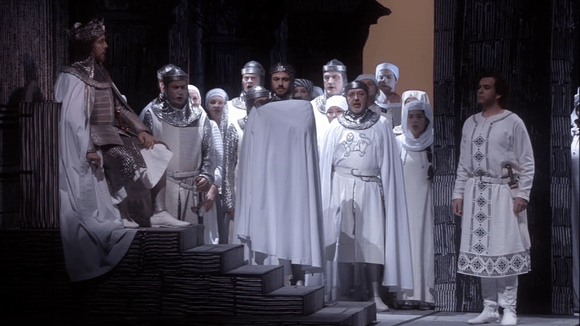
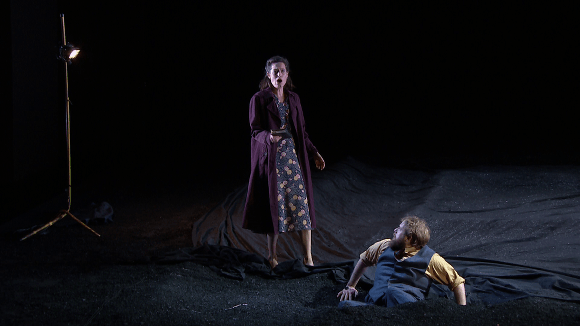
Schubert could write great melodies and he had a real affinity for the voice so one might expect him to have been successful when he turned his hand to opera.  He wasn’t with Fierrabras which wasn’t performed until decades after his death and has been revived seldom since, most recently at Salzburg in 2014 where it was recorded. It’s easy to see why.  The libretto is awful and even if the music were really amazing, which it isn’t but more of that later, I doubt it would have made much impact.

1-knickets

Continue reading

La fuga in maschera

I find it interesting the way some opera composers become canonical to the point where their most unsuccessful (often deservedly so) works still get produced while others, equally famous in their day, disappear pretty much entirely.  One of the latter group is Gaspare Spontini who had a long career stretching from the the late 18th into the middle of the 19th centuries during which he was active in Italy, Paris, Vienna and Germany.  There was a revival of his La Vestale at La Scala with Visconti directing and Callas in the title role but otherwise the 20th century pretty much ignored him.  So obscure had he become that the Wikipedia entry for his operas describes his La fuga in maschera as “genre unknown”.  Perhaps that’s not so surprising as the work was last performed in 1800 and the score was thought to be lost until it turned up in an English bookshop in 2007.  Subsequently it was performed in 2012 at the Teatro GB Pergolesi in Jesi as part of the Festival Pergolesi Spontini.

1-portrait

Continue reading

Freudian Elektra

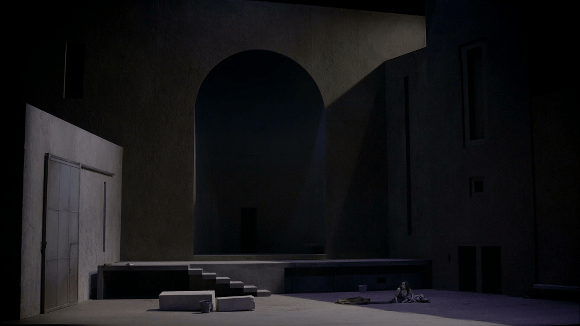
Patrice Chéreau’s last major opera production was of Strauss’ Elektra for the 2013 Aix-en-Provence Festival where it was recorded.  It later appeared with a different cast at the Met and was broadcast in HD but that performance has not yet been released on disk.  It’s a very good example of Chéreau’s work.  The towering, blocky sets recall his From the House of the Dead and are equally dark and grey.  The interest is all in the characters.

elektra1

Continue reading

The Merchant of Venice

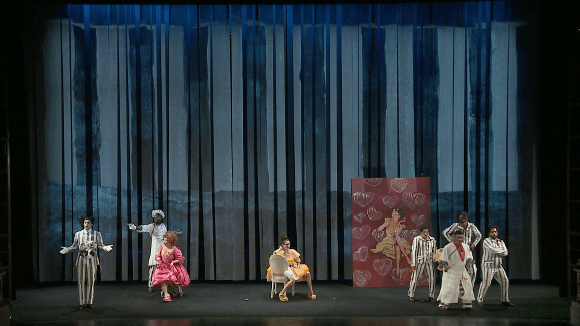
André Tchaikowsky’s The Merchant of Venice was written in the years leading up to his premature death in 1982 but, despite interest from ENO in the 1980s, it did not get a full performance until David Pountney decided to stage it at the the 2013 Bregenz Festival with Keith Warner directing.  It’s hard to explain the neglect though Pountney ascribes it some degree as the fate of the emigré  (the composer being a Polish Jew domiciled in the UK).  The Merchant of Venice is a really solid piece.  It’s got all the elements; a strong story, a really interesting but not overly intimidating score and really good writing for voice (it really is singable).  It’s the right length at around two and a half hours and it doesn’t call for unreasonable orchestral or vocal forces.  John O’Brien’s libretto even manages to overcome some of the objections to staging Shakespeare’s play.  While one might consider the Shakespeare piece to be antisemitic, O’Brien’s libretto is much more clearly about anti-semitism.  There’s also a clear homoerotic element in the Antonio – Bassanio relationship and perhaps too in Portia – Nerissa.

mov1

Continue reading

Rusalka à la Freud

Stefan Herheim’s 2012 production of Dvořák’s Rusalka for Brussels’ La Monnaie Theatre is predictably ambitious and complex.  He takes an explicitly Freudian (by way of Lacan) view of the piece(*).  The female characters are representations of male views of the female and, sometimes it seems, vice versa.  It’s seen most clearly in Act 2 and I found unpacking Act 1 much easier after seeing it so I’m going to start there.  We open not with bucolic, if coarse, peasants preparing for a wedding feast.  We are on a street in a scruffy part of, I guess, Brussels.  The gamekeeper and kitchen boy are replaced by a priest and a policeman.  The traditional dismembered game animals become a female chorus, many of them nuns, with exaggerated secondary sexual characteristics.  There is, essentially, an orgy.  Clearly the human world that Rusalka cannot enter is about sex in its most physical aspects not meaty Central European banquet platters!  Rusalka and the Foreign Princess are dressed and wigged identically.  They are quite freely interchanged.  Lines that are canonically addressed to one are addressed to the other and so forth.  It’s pretty clear that each represents, albeit imperfectly, the Prince’s ideal woman.  Rusalka is the unattainable feminine ideal; flawed in that she cannot engage in fully satisfying sexual activity.  The foreign Princess is sexually satisfying but falls short precisely by not being unattainable.  Some less clear male duality is suggested by the appearance of the Vodnik dressed as the Prince.  It just gets weirder from there with the ballet of nuns, prostitutes, fish, squid and heaven knows what else spilling over into the auditorium while the Prince and Foreign Princess watch from a box and Rusalka and the Vodnik get caught up in the action.  At the conclusion of the act it’s Rusalka not the Princess that he begs for help.

rusalka1

Continue reading

Wozzeck as puppet theatre

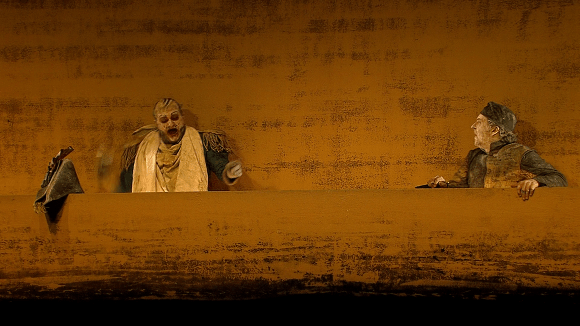
Wozzeck is a tricky piece for a director.  There seem to be two possible approaches.  One can find a character for Wozzeck himself that resonates with contemporary audiences and treat the piece more or less realistically.  That’s the approach taken by both Bieito and Tcherniakov.  Alternatively one can run with the overtly expressionist aspects of the piece and present it in a more abstract way as Peter Mussbach did.  Andreas Homoki’s 2015 Zürich production takes the second route.  The piece is presented as if the characters are puppets in a puppet theatre in a sort of ultra-grim version of Punch and Judy.  It’s visually quite arresting and there are some very well composed scenes.  To give just one example, immediately after Wozzeck has decapitated Marie the chorus appear as nightmarish Maries while Wozzeck sits nursing the severed head.  That said, the concept does pall and maybe hasn’t really got the legs, absent any other real directorial ideas, to carry the piece for two hours.

1-wozzcap

Continue reading

The Romans, being wanton, worship chastity

Continuing my struggle with Britten’s The Rape of Lucretia I got hold of the Blu-ray recording of Fiona Shaw’s 2015 Glyndebourne production.  I’m beginning, I think, to see my way to understanding the problems inherent in the libretto and some of the strategies that can be used to overcome them.  The more minor problem is Junius and the odd scene early in Act 2 where he seems to be inciting the Romans to revolt while acting as a general in Tarquinius’ army while, also, apparently, been in some sense complicit in the rape.  So we have a two faced power hungry schemer who is oblivious to the consequences of his mischief making; whether rape or rabble rousing (a sort of Roman Boris Johnson).  Most productions ignore this aspect of things and probably rightly.

0-chorus

Continue reading

Rationing the rapture

Katharina Wagner’s take on Tristan und Isolde recorded at Bayreuth in 2015 is hard to unpack.  There are some hints in a short essay in the booklet accompanying the disk and a few more in the interview with conductor Christian Thielemann included as an extra but it still leaves the viewer with a lot to do.  It’s essentially unromantic and quite abstract.  A lot of stuff that happens in a traditional interpretation just doesn’t happen but there’s not really anything much to replace it.  What’s left is the story of two people who fall in love in a situation where that is bound to end badly and where, despite the best efforts of pretty much everyone else, it does.  It’s actually quite nihilistic.  Tristan, and maybe Isolde, seek a kind of transcendence in love/death but there is none.  At the end Isolde doesn’t die but something in her does.  It had me thinking of Bergman’s The Seventh Seal (but then so much in life does).

1.gantry

Continue reading

Abstract Fidelio

Fidelio is an interesting piece.  The music is great and it has a powerful, very straightforward, plot.  There are no convoluted subplots here.  But there is a lot of spoken dialogue which slows things down.  Is it necessary?  Claus Guth doesn’t think so and in his 2015 Salzburg production he replaces the dialogue with ambient noise and also doubles up Leonora and Don Pizarro with silent actor “shadows”; the former using sign language in the manner of the narrator character in Guth’s Messiah.  It works remarkably well.  The ambient noise sections are quite disturbing and the “shadows” add some depth, especially the frantic signing in the final scene.  Perhaps worth noting that the “noise” contains a lot of very low bass and precise spatial location.  It may need a pretty good sound system to have the intended effect.

1.room

Continue reading

Alcina in Aix

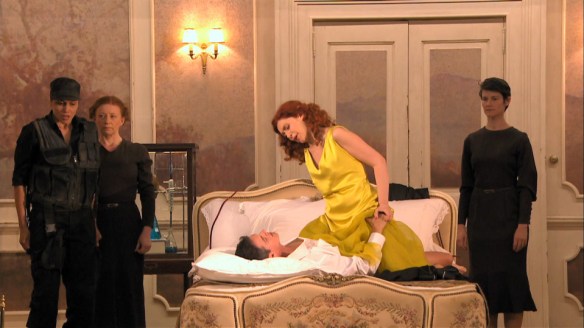
Katie Mitchell’s production of Handel ‘s Alcina recorded at Aix-en-Provence in 2015 is extremely interesting.  It’s almost complete with maybe twenty minutes of the ballet music cut.  None of the ballet is actually staged as such.  It’s also a Mitchell special multi-space set (like Written on Skin) with the lower level having Alcina/Morgana’s boudoir, drawing room or whatever at any given moment flanked by two smaller spaces which are the “personal” spaces of the two sisters.  When the ladies withdraw from the public/enchanted space they are replaced by actresses who look decades older.  Only late in the piece as Alcina’s magic fades do the two worlds get confused.  The upper level of the set is taken up with the giant machine that turns Alcina’s victims into taxidermied animals.  The overall aesthetic is upscale modern with lots of actors as very competent servants.

2.alcina

Continue reading