Faccio’s Amleto

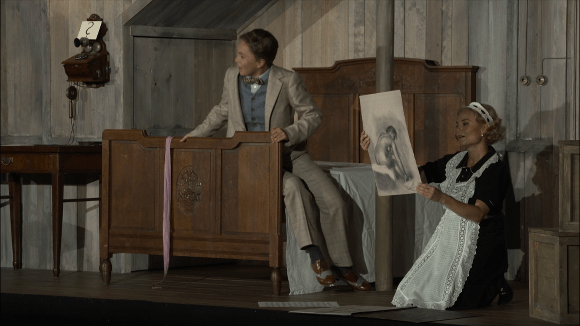
Franco Faccio’s 1865 work Amleto disappeared from the opera repertoire after the disastrous opening night of its 1871 revival at La Scala only to be “rediscovered” in recent years and featured at the 2016 Bregenz Festival.  It was Faccio’s second, and last opera, though he enjoyed a career as a conductor, that included eighteen years as Music Director at La Scala before being institutionalized due to the effects of syphilis.  So, one naturally asks, is it any good?  The answer is an emphatic “yes”.  It’s not only good but seems quite advanced for an Italian opera of that date.  It’s closer in spirit to Puccini than bel canto.  Indeed the soliloquy Essere o non essere sounds curiously like E lucevan le stelle.  It’s similar to later Verdi and, indeed, Puccini in that it’s through sung with recitative like passages and set piece arias and ensemble numbers and it’s more conventionally tonal than its contemporary Tristan und Isolde.  Arguably the orchestral writing is more interesting than that for voice (Ophelia’s funeral march is very fine) and certainly the weakest parts are the ensembles.  It’s probably also fair to say that there is no big hummable melody.  Still, Faccio was twenty five when he wrote it and there aren’t many better operas by twenty five year olds.

1.dance

Continue reading

Dani’s Rosina

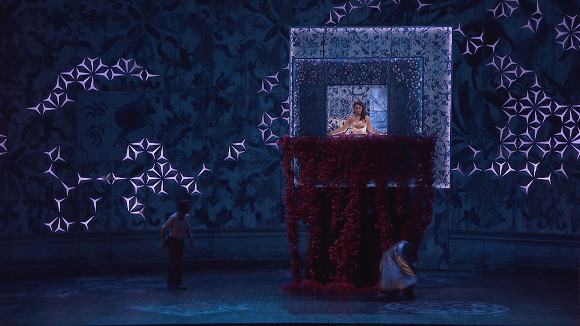
One rather gets the feeling that the 2016 Glyndebourne production of Rossini’s Il barbiere di Siviglia was built around the lady of the house.  It makes a lot of sense.  There may have been better singers in the role of Rosina but I doubt there has ever been a better mover than Danielle de Niese.  She’s matched move for move, eye candy for eye candy by the guys; Björn Burger as Figaro and Taylor Stayton as Almaviva.  There’s more mature comedy from the always fantastic Alessandro Corbelli as Bartolo and the irrepressible Janis Kelly as Berta.

1.balcony

Continue reading

Faust as you have never seen it before

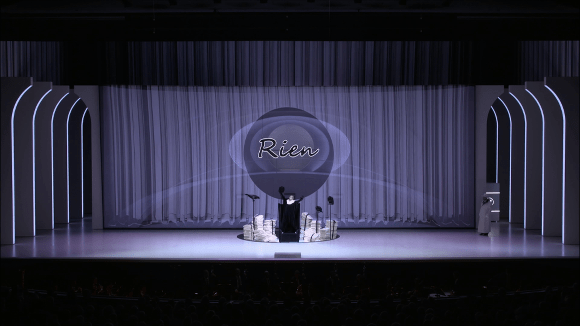
The 2016 Salzburg recording of Gounod’s Faust is challenging.  Perhaps the nine pages of the booklet given over to a concept discussion with the directors should have given me sufficient warning that this was not going to be Faust à la Met.  It’s not.  It’s extremely complex and I’m not sure I fully understand it or whether all the ideas work but I did find it fascinating visually and dramatically, and musically it’s top notch.  That said, traditionalists can save themselves a trip to the ER by walking away now.

1.rien

Continue reading

Spectacular Die Liebe der Danae

Richard Strauss’ Die Liebe der Danae is one of his least performed operas so it’s not very familiar to most opera goers.  I wrote about its performance history and provided a plot summary in my review of a 2011 recording at the Deutsche Oper, which is the only video recording besides the 2016 Salzburg one which forms the subject of this post.

1.turbans

Continue reading

Red blooded Otello

I’m never quite sure what I think about large scale outdoor opera performances but the Macerata Opera festival’s 2016 production of Verdi’s Otello staged in the Arena Sferisterio comes over rather well on video.  It’s a complete contrast with the Salzburg production I reviewed a few days ago.  This is large scale “red in tooth and claw” Verdi.  There is none of the subtlety of the Salzburg performances but it is spectacular and quite exciting.

1.storm

Continue reading

Elegant and subtle Otello

Vincent Brossard’s production of Verdi’s Otello for the 2016 Salzburg Easter Festival is both elegant and subtle; the latter quality being backed up by superb singing and acting from the principals.  In many ways the production is clean and straightforward with a focus on character development but it also makes use of elegant lines and sharply contrasting darks and lights in creating the stage picture.  There’s also a really cool use of mirrors during Già nella notte densa that I can’t quite figure out.

1.storm

Continue reading

Castellucci’s Moses und Aron

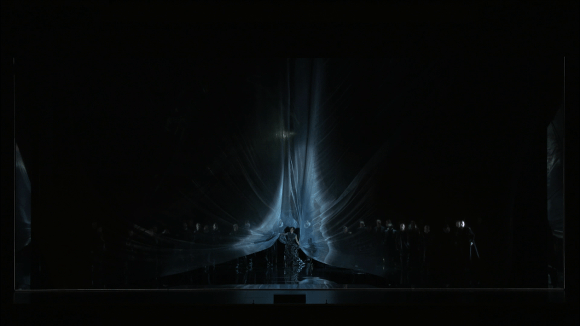
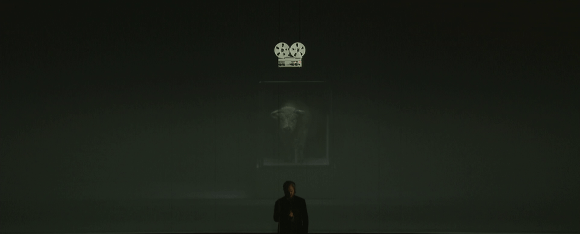
Schoenberg’s Moses und Aron is a very peculiar opera.  It’s pretty much an extended debate about the nature of God cast in highly abstract terms.  So who better to direct it than the almost unbearably cerebral Romeo Castellucci.  Previous encounters with his work have been puzzling, thought provoking (and WTF provoking) but never dull.  All those terms could be deployed to describe the production recorded at L’Opéra nationale de Paris in 2015.

1.tape

Continue reading

The other Otello

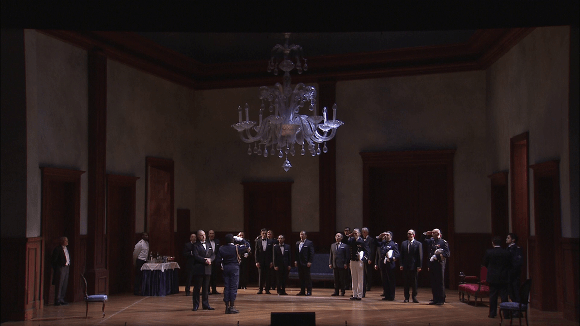
Just as Rossini’s version of Il barbiere di Siviglia completely eclipsed Paisiello’s version, so Verdi’s Otello sounded the death knell for an earlier version; ironically enough by Rossini.  It’s a bit surprising as the Rossini version is not bad at all despite having a rather patchy libretto and being hard to cast.  The first thing one notices is that the story isn’t even close to Shakespeare/Verdi.  This is because the libretto was based on a French play by Jean-François Ducis that was popular in the 18th century.  I don’t know whether the plot’s weaknesses are due to Ducis or the librettist but there are a few.  There’s no Cassio so the motivation for Jago’s plotting is unclear.  All the Venetian notables (bar perhaps the Doge) hate Otello but Jago doesn’t seem to have any special reason for animosity.  Between the end of Act 2 and the beginning of Act 3 Otello is exiled.  There is no explanation.  The finale is abrupt and weak.  Immediately after Otello kills Desdemona the gang of notables burst in to the room and appear to be completely reconciled to Otello and to him marrying Desdemona, despite having spent the rest of the opera chewing chips about this.  In fact one could argue that the happy ending variant (yes, there was one) is the more plausible as it would only take the guys to arrive about ten bars sooner for that to be the logical outcome.  As it is, Otello listens with incredulity to the change of heart and, not unreasonably, kills himself.

1.ballroom

Continue reading

Completing the Bechtolf trifecta – Le nozze di Figaro

Sven-Eric Bechtolf’s stagings of the Mozart/da Ponte operas in Salzburg concluded in 2015 with Le nozze di Figaro.  I think it’s the most successful of the three.  Bechtolf’s strengths lie in detailed direction of the action rather than bold conceptual statements and Nozze is probably the least in need of, and the least amenable to, the big Konzept.  There aren’t any real dramaturgical problems to solve.  It just works as written.  I don’t think that’s so true for Don Giovanni or Così.

1.sketch

Continue reading

Bechtolf Round Two – Don Giovanni

Sven-Eric Bechtolf’s second Mozart/daPonte for Salzburg was Don Giovanni which premiered in 2014.  There are some similarities with his Così fan tutte.  He uses a symmetrical unit set again and shows a fondness for creating symmetrical tableaux vivants but there the similarities pretty much end.  I could find a consistent, believable set of humans in Così but not so much in Don Giovanni.  The problem is really the man himself.  Bechtolf, in his notes, seems to be arguing that Don Giovanni can make no sense in an age of pervasive accessibility and exposure to all things sexual.  Da Ponte’s Don requires a climate of sexual repression for his essence; to Bechtolf a kind of Dionysian force (he cites Kierkegaard), to make any sense as a human.  I think I get that but then, I think, the challenge becomes to create a Don Giovanni who does make sense to a 21st century audience as, in their different ways, do Guth and Tcherniakov.  Bechtolf seems to treat the character not so much as a human rather than as a kind of energy focus who exists by igniting aspects of the other characters; whether that’s lust or jealousy or hatred.  He caps off this idea at the end by having Don Giovanni reappear during the final ensemble as a kind of mischievous presence still chasing anything in a skirt, even if it’s, perhaps, from another world.  It’s an idea that I could not really buy into.

1.stab

Continue reading