The clutter of bodies

The latest Handel oratorio to be given the operatic treatment by Glyndebourne is Saul, which played in 2015 in a production by Australian Barrie Kosky.  It’s quite a remarkable work.  The libretto, as so often the work of Charles Jennens, takes considerable liberties with the version in Samuel and incorporates obvious nods to both King Lear and Macbeth as well as more contemporary events.  David’s Act 3 lament on the death of Saul, for instance, clearly invokes the execution of Charles I.  What emerges is a very classic tragedy.  Saul, the Lord’s anointed, is driven by jealousy and insecurity deeper and deeper into madness and degradation and, ultimately, death.  This is the basic narrative arc of the piece.

1.head

Continue reading

Another fine Cesare

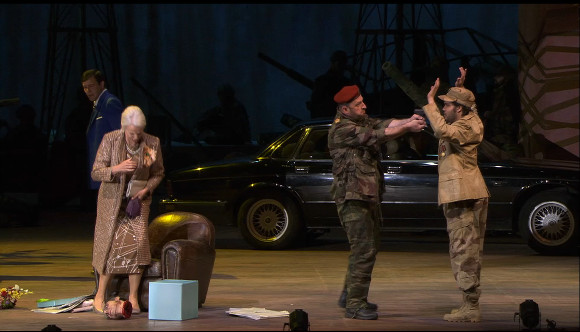
Handel’s Giulio Cesare is pretty well served in terms of video recordings.  The very fine Glyndebourne and Copenhagen versions get some serious competition from the 2012 production that inaugurated Cecilia Bartoli’s reign as director of the Salzburg Whitsun Festival.  The production is by Moshe Leiser and Patrice Caurier.  It’s set in somewhere like Iraq in an immediately post-war period.  It’s quite dark, probably darker than Negrin’s in Copenhagen and world’s away from McVicar’s almost RomCom version.  There’s a lot of violence and some pretty sleazy sex.  A lot of this centres around Tolomeo who is portrayed as beyond revolting.  There’s a scene where he rips guts out of a statue of Caesar and starts to gnaw on them and there is a fair bit in that vein.  Caesar and Cleopatra are portrayed ambiguously too.  Sure they are the “heroes” of the piece but Cleopatra’s delight in flogging off her country’s oil wealth to the Romans shows a degree of cynicism.  This is not a production for the Konzept averse but I think all the choices made have a point and the overall effect is coherent.  It’s not without humour either.  Cleopatra sings V’adore pupille in a 70s blonde wig while riding a cruise missile with Caesar watching through 3D glasses.

1.head

Continue reading

The Rake at 35

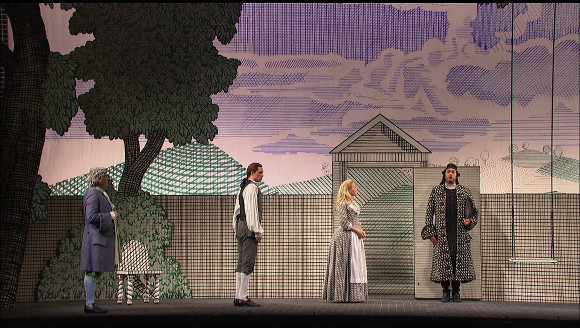
David Hockney and John Cox’s production of Stravinsky’s The Rake’s Progress first saw the light of day at Glyndebourne in 1975 and there’s a video of it from back then.  It’s been revived umpteen times since, all with Cox directing rather than an overawed revival director.  It was done again in 2010, with Vladimir Jurowski conducting, recorded and issued on Blu-ray and DVD.  It’s fascinating.

1.garden

Continue reading

400

It’s taken since May 16th 2014 to get from 300 to 400 recordings in the DVD review database.  But now we are there with 84 Blu-rays and 316 DVDs.  Surprisingly the Toronto Public Library is still a major source of material though one can see that the statistics are perhaps skewing a little more to my personal tastes.  This despite someone at TPL having a taste for 19th century turkeys from French and Belgian regional houses.  So, here’s the round up of the summary stats.

language400Italian is still the most common language with 30% of recordings but German has moved up relatively from 24% to 27%.  Perhaps surprisingly the proportion of recordings in English has hardly changed at all at 13%.  I would have thought that the proportion of contemporary works, many/most in English would have impacted the stats more.

Continue reading

Rienzi

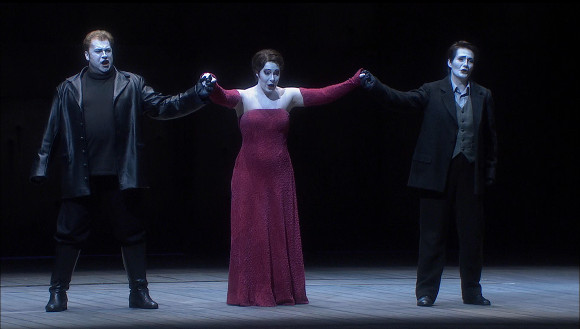
Wagner’s Rienzi is really quite an interesting work.  It follows the conventions of the French grand opera rather than the more integrated structure of most of the later works, although as presented in Toulouse in 2012 some of those elements, for example the ballet, have been removed in the interests of cutting the work down to manageable size.  Even with the Toulouse cuts it runs three hours.

1.trio

Continue reading

Palestrina and the prattling prelates

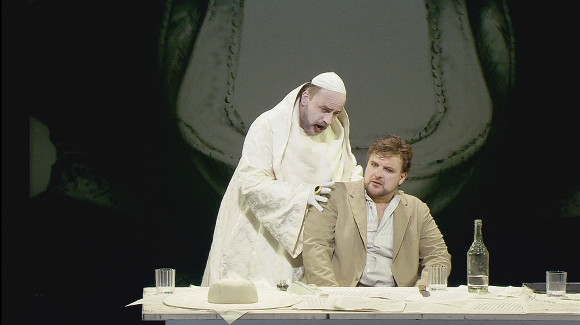
Pfitzner’s Palestrina has had some pretty extravagant claims made for it.  Bruno Walter said “The work has all the elements of immortality”.  I’m not so sure.  The music is very appealing but it’s structurally problematic.  It’s ostensibly about Palestrina and the struggle to convince Pius IV that polyphony had a legitimate place in church music but while the first and third acts are just that they frame a second act that’s about the various squabbles at the Council of Trent, of which the question of music was but one.  I think it’s meant to be a satyr on church politics of the time but it feels heavy handed, overly long and introduces a vast number of minor characters.  These are not only confusing but probably make the work unstageable for all but the very richest houses.  There are over 40 named solo parts but only one is a woman (and she’s dead) so major Bechdel fail here too.  I think if one took a chainsaw to Act 2 a pretty decent opera might come out of it because the human story is quite affecting and the music is distinctive and rather good.  Although premiered in 1917 it’s stylistically anti-modern and would likely appeal to a lot of people who are not normally drawn to 20th century opera.

1.borromeo

Continue reading

Puzzling Genoveva from Zürich

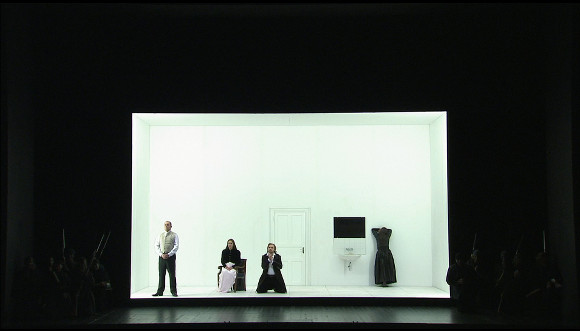
Schumann’s Genoveva is a rarity. It premiered in 1850 and quickly slipped into obscurity.  Recently it has been championed by Nikolaus Harnoncourt who has gone so far as to call it “the most significant opera of the second half of the 19th century”; a slightly eye popping claim.  So what’s it about?  On the face of it it’s a pretty typical German opera of the period, set during the wars against the Moors in Spain.  Siegfried (Graf in the libretto but mysteriously translated as Duke in the disk subtitles) is recently married but must lead his men off to the war leaving behind his young, beautiful, pious and virtuous bride Genoveva. He leaves Golo; a knight but a bastard so apparently not OK for active service, to guard his lands and wife.  Golo has the hots for Genoveva but when she rejects his advances he concocts, with the aid of a witch, a plot to make it appear that she’s having an affair with an elderly retainer.  She’s locked up by the servants and word is sent to Siegfried; returned from Spain but recovering from wounds in Strasbourg, of what has transpired.  He gives Golo his sword and ring and tells Golo to kill Genoveva.  Instead Golo tries to get her to run away with him but she refuses and he disappears.  The servants too are happy enough to humiliate Genoveva but pretty slow about killing her.  This gives time for Siegfried to arrive, having learnt of his wife’s innocence, and save the day.  All sing a hymn of praise to God.  Along the way there’s a magic mirror, a ghost, a magic potion and a whole lot of cloying sentimentality and piousness.
1.quartet Continue reading

A weirdly eclectic Fidelio

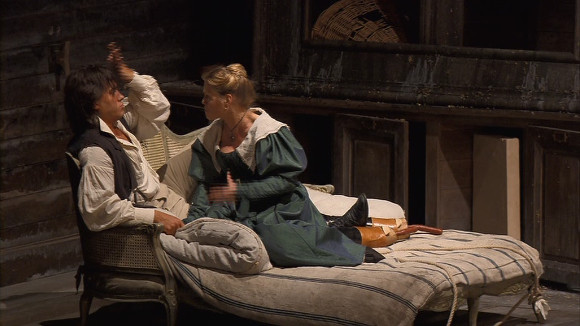
I’m really not sure what to make of Jürgen Flimm’s 2004 production of Fidelio for the Zürich Opera House.  It’s not offensive and it doesn’t really get in the way of the story but it seems quite devoid of originality beyond mixing styles in a way one might describe as anachronistic if one could figure out when synchronistic would be.  Rocco wears a sort of frock coat with, apparently, goatskin pants, Marzellina’s dress looks probably 20th century, bolt action magazine fed rifles are apparently muzzle loaded and metal cartridge cases filled by hand.  Then to cap it off when Don Fernando shows up he looks like he’s stepped straight out of a Zeffirelli production of Der Rosenkavalier.  So “nul points” for coherence.  For once one rather appreciates that so much of the action takes place in the dark.

1.marzfid Continue reading

Weint! Weint! Weint! Weint!

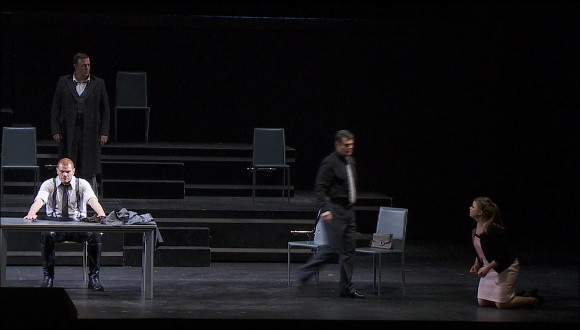
Aribert Reimann’s Lear is a pretty good example of how to create a thoroughly modern opera within a thoroughly traditional framework.  It’s a classic story of course.  Here librettist Claus Henneberg has taken the classic German translationof the Shakespeare play and condensed it in a highly intelligent fashion; retaining all the emotional drama while sacrificing some fairly peripheral narrative.  Reimann’s score is modern though not strictly twelve tone.  He creates a distinct musical voice for each character; speech/Sprechstimme for the Fool, weird coloratura for General etc. This is reinforced by many of the characters having a tone row that serves as a sort of leitmotiv.  Atonality and quarter tones are used for varying effects from the violence of the Blasted Heath scene; apparently inspired by the composer’s experience, as a nine year old, of the bombing of Potsdam, to the shimmering, ethereal quarter tones of Lear’s final monologue.  For anyone with even a vague tolerance for “modern” music it’s a fascinating listen.

1.learcordelia Continue reading

Hands on Figaro

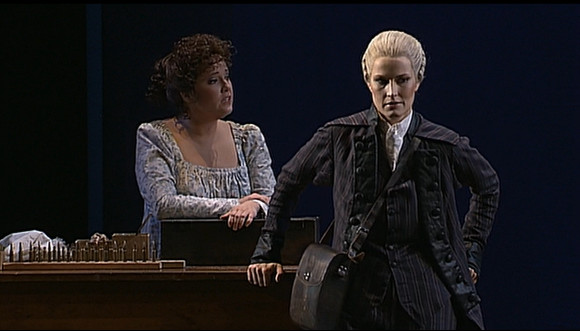
In the booklet accompanying David McVicar’s production of Le nozze di Figaro, recorded at the Royal Opera house in 2006, there’s an essay by the director in which he raises all kinds of questions about the rise of the bourgeoisie, the nature of revolution and romantic conceptions of love.  He even appears to draw a parallel between Joseph II and Tony Blair. Then he declines to explain how he has embodied all these ideas on the stage and challenges us to “Watch, listen, participate”.  Well I did and I’m none the wiser.  What I see here is an essentially traditional approach; transferred cosmetically to 1830s France but so what?  It’s darker than some Figaro’s but not nearly as dark as, say, Guth.  Curiously, the main “extra” on the disks “Stage directions encoded in the music” tees this up much more clearly than the essay.

1.figarosusanna Continue reading