What is this anguish that each of us carries inside?

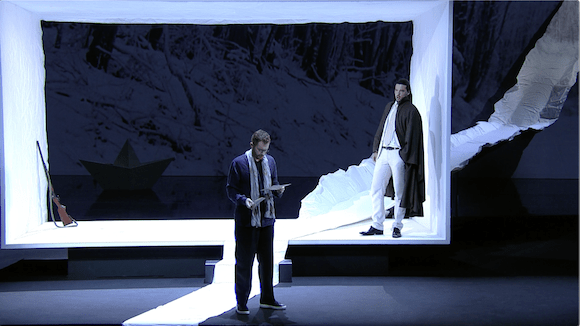
What is this anguish that each of us carries inside?  That’s the central question of Thomas Larcher’s chamber opera Das Jagdgewehr that premiered at the Bregenz Festival in 2018.  It’s based on a 1949 novel by Yasushi Inoue about a hunter, the three women in his life and the poet to whom he sends the women’s letters.  It’s a stark, intense tale of love, death, secrecy, loss and betrayal told in a prologue and eleven scenes over about an hour and a quarter.
1.letter

Continue reading

Another fifties Falstaff

Directors seem to see the 1950s as the logical time period to stage Verdi’s Falstaff though they come up with very different 1950s.  Robert Carsen set his in a rather dark world that pits the nouveau riche against a declining gentry.  Richard Jones went for a sort of Carry on film aesthetic that was entirely English.  Laurent Pelly in his production filmed at the Teatro Real in Rome in 2019, despite some overtly English elements in the set design,  gives us a distinctly continental European feel.  Indeed Falstaff, Pistola and Bardolfo might easily be hangovers from the more criminal end of the French resistance.  There’s much less of “class struggle” in Pelly’s rather straightforward production.  In fact it seems like a fairly light comedy with the darker aspects emerging only rarely.

1.gang

Continue reading

Double dwarf

The Deutsche Oper’s production of Zemlinsky’s Der Zwerg, recorded in 2019 in Berlin, is directed by Tobias Kratzer who seems to be the rising star among young German opera directors.  I can see why.  This is a thoughtful and clever production that really does have something to say without being unduly gimmicky.

1.piano

Continue reading

King Arthur in Berlin

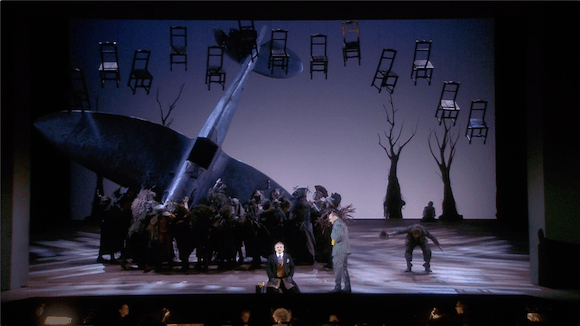
Purcell’s King Arthur contains some wonderful music but it also poses real staging issues.  How much of the play that the music supports does one include?  How to contextualise the unfamiliar version of the King Arthur story?  How to deal with the rather crude nationalism?  Sven-Eric Bechtolf and Julian Crouch come up with a very interesting approach for their 2017 production at the Staatsoper Berlin.

1.spitfire

Continue reading

Respighi’s Sleeping Beauty

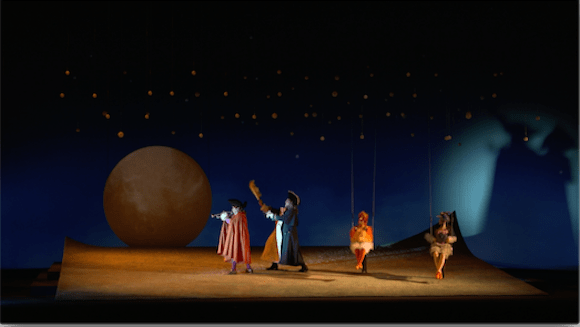
Resphigi’s La bella dormente nel bosco (libretto by Gian Bistolfi) is a take on the Charles Perreault fairy story.  It was originally written for a puppet theatre and later adapted for human performers.  Its heritage shows in it that it’s very much a numbers opera and it’s quite short.  The three acts come in at around eighty minutes.  Musically it’s a bit of a hodge podge.  It’s mostly quite atmospheric and colourful (similar to Resphigi’s better known orchestral works) with elements of parody.  One can sort of hear echoes of Debussy, Stravinsky and Strauss.  It finishes up with a cakewalk and a Broadway style finale which is decidedly odd.

1.birds Continue reading

Grim Trovatore

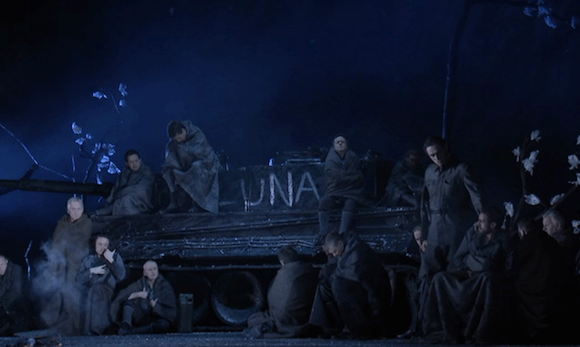
Verdi’s Il Trovatore is always pretty grim.  It’s hard to lighten up an opera with multiple executions, suicide and babies being barbecued.  David Bösch in his Covent Garden production (remounted and recorded in 2017 with Julia Burbach directing), probably wisely, doesn’t even try.  This is as grim as Grimsby on a wet Sunday in February with extra gratuitous violence.  The setting is some roughly contemporary civil war.  The Conte di Luna’s troops are a scruffy lot but they have a pretty cool looking tank.  The gypsies are a bit gayer though Azucena’s caravan is disturbingly plastered with baby dolls reflecting her obsession.  It’s all quite dark.  Really only Leonora (and her maid) stand out as they wear white in contrast to the greys of pretty much everyone else.  The story is told straightforwardly enough and the sets and costumes do provide some kind of moral differentiation between the two camps with Leonora sort of standing above and apart from the violence.

1.soldiers

Continue reading

Abstracting the Dutchman

Olivier Py’s production of Wagner’s Der fliegende Holländer, filmed at the Theater an der Wien in 2015, is quite unusual.  Usually opera productions either play the story more or less straight or work with a concept of the director’s that is not obviously contained in the libretto.  Py doesn’t really do either of these.  What he does is present the narrative as Wagner wrote it but with visuals that act as a sort of commentary on, rather than a literal depiction of, the action being described.  One of the things this does is make the viewer realise just how much Wagner is describing!  There is much more tell than show.

1.satan

Continue reading

Pique Dame in Salzburg

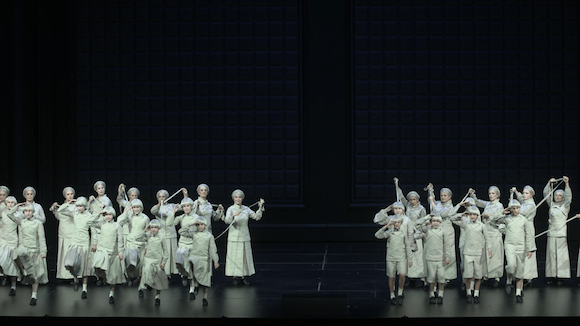
Tchaikovsky’s Pique Dame is a rather odd opera.  It’s not just that the main plot turns on a pretty bizarre tale of the supernatural but that it also contains a significant number of big set piece numbers that don’t advance the plot at all; the “military children” in Act 1, the Pastoral in Act 2 and the bizarre “Glory to Catherine” chorus in Act 3 aren’t the only ones.  One assumes that they are there so that the composer could interpolate some suitably “Russian” bits because without them it’s just any other opera that happens to be in Russian.

1.children

Continue reading

Tcherniakov’s Khovanshchina

Mussorgsky’s Khovanshchina is a bit of a weird opera.  It’s ostensibly based on a series of not entirely related events that unfolded during the succession crisis following the death of Tsar Fyodor III (which took about 12 years to play out) into a story that takes place in a day.  It’s complicated by the fact that key players in the story; the Tsars Peter and Ivan and the Tsarevna Sofia don’t actually appear because the Russian censorship would not allow members of the dynasty to be portrayed on stage.  Perhaps unsurprisingly Tcherniakov isn’t much interested in the details of the history and uses it to make some, not always entirely obvious, points about modernity vs tradition, personal power and the nature of religious cults.

1.opening

Continue reading

Butterfly in the 1950s

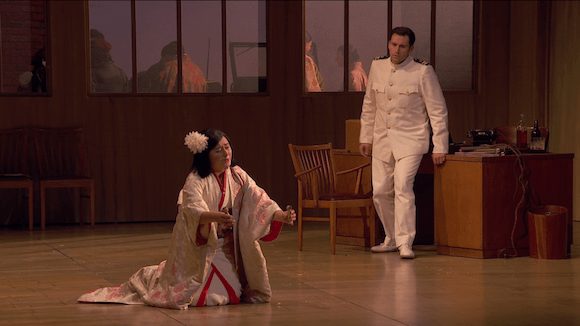
My quest to find a production of Puccini’s Madama Butterfly that has anything insightful to say about the piece continues.  This time it’s the 2018 production from Glyndebourne directed by Annilese Miskimmon.  I was interested to see how a female director would treat the obvious problems with the piece.  Miskimmon’s solution is to shift the setting to early 1950s Nagasaki and to treat Butterfly as one of many real and fake war brides.  Apparently there was a thriving fake war bride business at the time.  The obvious problem of a Nagasaki setting is just ignored.

1.butterflypinkerton

Continue reading