Tcherniakov’s Khovanshchina

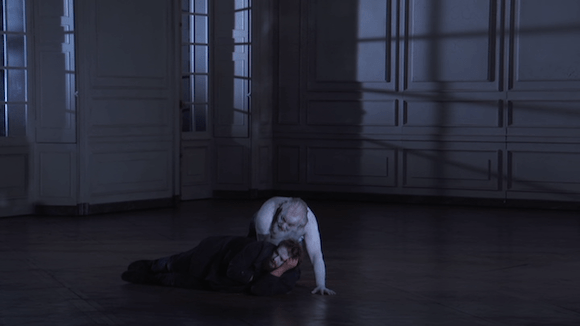
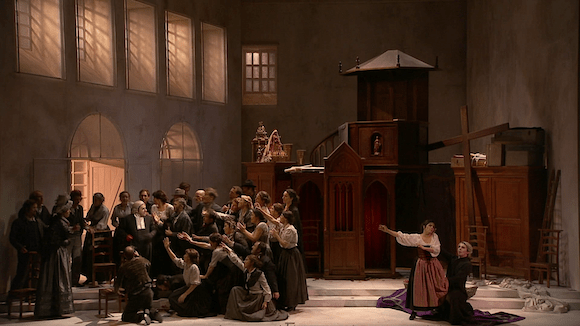
Mussorgsky’s Khovanshchina is a bit of a weird opera.  It’s ostensibly based on a series of not entirely related events that unfolded during the succession crisis following the death of Tsar Fyodor III (which took about 12 years to play out) into a story that takes place in a day.  It’s complicated by the fact that key players in the story; the Tsars Peter and Ivan and the Tsarevna Sofia don’t actually appear because the Russian censorship would not allow members of the dynasty to be portrayed on stage.  Perhaps unsurprisingly Tcherniakov isn’t much interested in the details of the history and uses it to make some, not always entirely obvious, points about modernity vs tradition, personal power and the nature of religious cults.

1.opening

Continue reading →

Butterfly in the 1950s

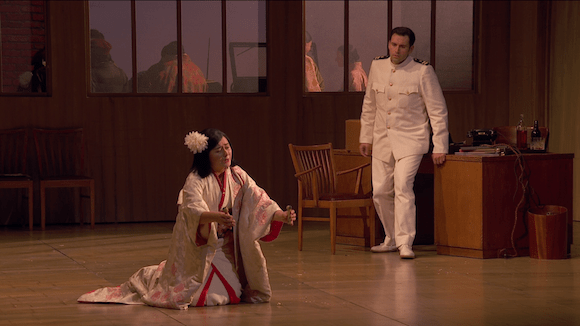
My quest to find a production of Puccini’s Madama Butterfly that has anything insightful to say about the piece continues.  This time it’s the 2018 production from Glyndebourne directed by Annilese Miskimmon.  I was interested to see how a female director would treat the obvious problems with the piece.  Miskimmon’s solution is to shift the setting to early 1950s Nagasaki and to treat Butterfly as one of many real and fake war brides.  Apparently there was a thriving fake war bride business at the time.  The obvious problem of a Nagasaki setting is just ignored.

1.butterflypinkerton

Continue reading →

Brett Dean’s Hamlet on DVD

I reviewed Brett Dean’s Hamlet when it was first broadcast from Glyndebourne on the BBC in 2017.  Somehow I managed to miss the subsequent DVD/Blu-ray release but I’ve now been able to get hold of the DVD and can provide some further insights. As far as the work itself, the production, the performance and the video direction I don’t have anything much to add to my original review.

1ghost

Continue reading →

Beatrice Cenci

Beatrice Cenci is an opera by Berthold Goldschmidt; a composer who moved from Germany to London in the 1930s for the usual reason.  Beatrice Cenci was written in 1950 but the orchestral style sounds rather earlier.  Comparisons with Mahler have been made though I don’t really see that.  Richard Strauss or Korngold perhaps?  In any event the work didn’t get performed at all until the 1980s and had to wait until the 2018 Bregenz Festival for its first fully staged production directed by Johannes Erat.  Curiously, though originally composed with an English libretto it was given in German in Bregenz.

1.grafcard

Continue reading →

An anti-Salome?

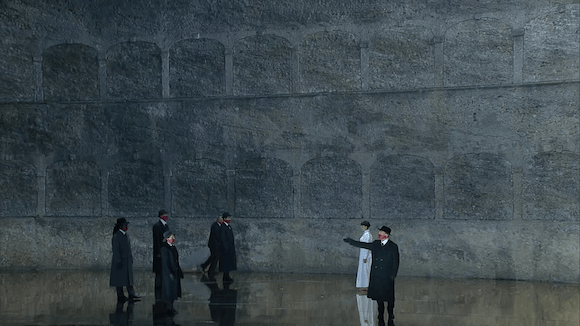
I’ve learned not to dismiss Romeo Castellucci’s work on first watching because it has a nasty habit of starting to make sense on reflection.  His 2018 production of Richard Strauss’ Salome for the Salzburg Festival may be a case in point.  Castellucci seems determined to destroy any preconceptions we have about the work and Franz Welser-Möst in the pit is a willing accomplice.

1.walls

Continue reading →

That survey

Blu-Ray-Disc-89676So a few weeks ago I asked readers to help me better understand how they viewed opera on video via a short survey.  The results follow though heavily caveated by the fact that only 22 people responded.

Most people use multiple methods to watch video with 86% using Youtube, 82% DVD, 59% Blu-ray, 50% free video streams and 28% subscription streams. but only 14% (not very surprisingly) using 4K video.

The primary method results are more interesting: 45% use the Internet, 54% use some kind of disk.  The former is dominated by Youtube.  On the latter DVD tops Blu-ray 2 to 1.

Continue reading →

Vanessa

Samuel Barber’s Vanessa doesn’t get performed much and the recently released recording of the 2018 Glyndebourne production is the only video version available.  It’s pretty interesting, if perplexing at times, and I’m not as convinced as many of the people interviewed in the “extras” portion of the disk that this is an “under-rated masterpiece”.

1.flashback

Continue reading →

Das Wunder der Heliane

The video recording, made at the Deutsche Oper in 2018, of Korngold’s rarely seen Das Wunder der Heliane is yet another lesson in holding off on making judgements on an opera or production until one has seen the whole thing.  I still don’t think it’s a lost masterpiece but I’m feeling a lot less derisive than I was at the end of Act I.

1.dress

Continue reading →

Reimagined Zauberflöte

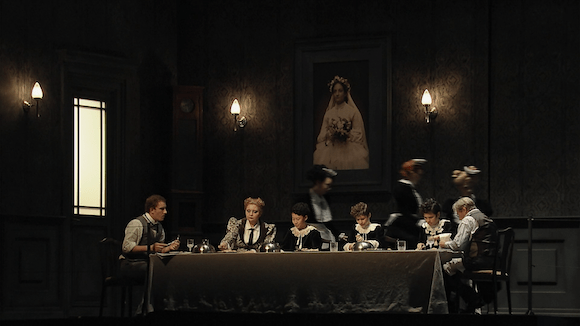
The 2018 Salzburg Festival production of Die Zauberflöte really pushes the envelope of reenvisioning the piece.  Is there anything to say about this piece that hasn’t already been said?  Lydia Steier thinks so and goes some considerable way tp making her point.  So what’s the big idea here?  Essentially the kicking off points are that it’s about (in a sense) a dysfunctional family and it’s a fairy tale.  So we open on the dining room of a rather depressing bourgeois Austrian family in the mid 1930s sitting down to dinner.  There’s the mother, the father, the grandfather and three boys; all rather formally dressed.  A portrait of a bride hangs behind the table.  The father has a hissy fit and storms out.  The mother, who appears to drink, starts breaking things.  The grandfather takes the boys off to the nursery to read them a bedtime story.

1.dinner

Continue reading →

A French Comte Ory

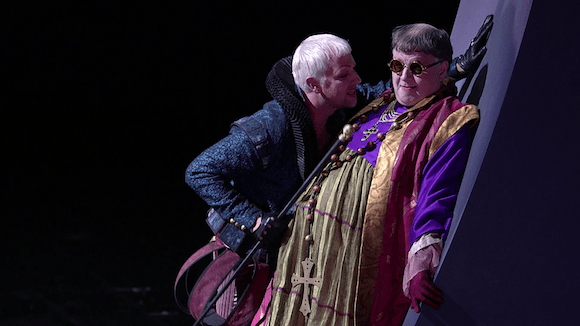
Rossini’s Le Comte Ory was written for Paris so it’s appropriate that there should be a recording from the Opéra Comique.  It’s directed by Denis Podalydès who chooses to set it around the time of the opera’s creation (1828) with the “crusader” element replaced by the French conquest of Algeria.  The sets and costumes are pretty conventional with a heavy emphasis on religious symbolism; some of it rather awry.  There’s also a heavy element of sexual frustration.  The comedy is all very much there but it’s not too slapstick and there’s none of the annoying cheesiness of Bartlett Sher’s New York version.  It all feels very French.

1.hermit

Continue reading →