Ekstasis

Ekstasis is a multi-media collaboration between Kaija Saariaho and Jean-Baptiste Barrière.  There are six pieces on the Blu-ray disk.  Three were written by Saariaho with the visual elements added later by her husband.  The Barrière works were conceived from the outset as multi-media pieces.

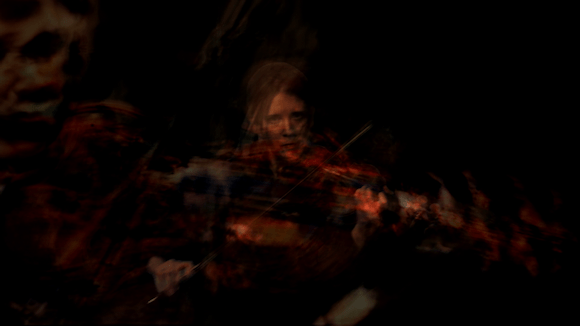
The three Saariaho pieces come first.  There’s Nocturne for solo violin which is the only piece that doesn’t include electronics.  It’s played by Allisa Neige Barrière and is a kind of meditation for extended violin techniques.  The video element is the violinist sort of semi superposed on a rippling pond.  It’s typical of all the visuals.  An image, often the player, is combined with another image, often, as here, of a landscape element.  The images merge and flicker in a sort of kaleidoscopic way.
1.nocturne Continue reading

Creepy Wozzeck

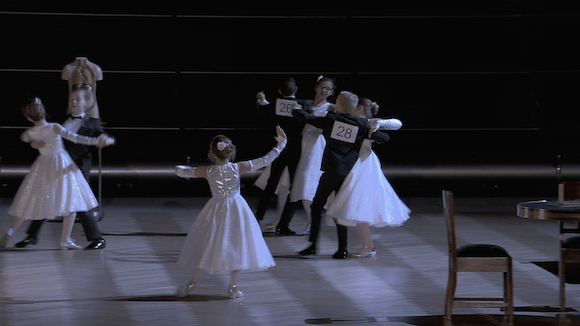
Alban Berg’s Wozzeck seems to attract just about every possible treatment from directors other than a straightforwardly literal one.  Krzysof Warlikowski’s approach, seen at Dutch National Opera in 2017, is to go back to the original story on which the Büchner play, in its turn the source for the opera, is based.  Wrapped around that are several interesting ideas which I can’t fully unpack but which make for a rather creepy but compelling production.  Alas, the disk package has nothing to say about the production so, interpretively, one is on one’s own.

1.dancers

Continue reading

More Lessons in Love and Violence (and frustration!)

I requested a review copy of the Blu-ray release of George Benjamin’s Lessons in Love and Violence when it came out in December.  There was a bit of a hiatus in supplies from them which resumed again recently but when several packages arrived without the Benjamin piece I decided I was out of luck so I wrote a review based on a copy of the BBC’s broadcast of the work.  That was two days ago.  Today the Blu-ray arrived!  I’ve watched enough of it to convince myself that I only need to make minior changes to the review which I have done.  The revised review is here.

Lessons in Love and Violence

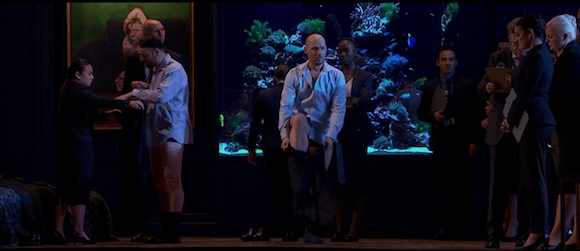
George Benjamin’s latest opera Lessons in Love and Violence debuted at Covent Garden last year.  It was broadcast on the BBC and is still available on the web from Arte and has also been released on DVD and Blu-ray.  This review is based on the Blu-ray version.

1.trousers

Continue reading

The actual Paris Orphée

Gluck’s Orfeo/Orphée is one of those works where things get a bit complicated because an Italian and a French version wre produced and then all kinds of mash ups of the two versions.  It’s a bit like Don Carlo/Don Carlos or Guglielmo Tell/Guillaume Tell.  The original Orfeo ed Euridice, which premiered in Vienna is quite short and has Orfeo written for a castrato.  The Paris version spreads the piece out over three acts, adds both new vocal music and lots more dance music and has Orphée written for haut-contre.  Today, when people do the French version they usually cut some of the new music and use the higher Orphée music; casting either a mezzo or a counter-tenor.  This is true of both recordings  (Paris 2000 and Munich 2003) which have come my way in the past.

1.opening

Continue reading

Karajan’s Walküre – 50 years on

To quote a quite different opera, “it is a curious story”.  In 1967 a production of Wagner’s Die Walküre, heavily influenced by Herbert von Karajan [1] who conducted the Berlin Philharmonic for the performances, opened the very first Osterfestspiele Salzburg.  50 years later it was “remounted” with Vera and Sonja Nemirova directing.  I use inverted commas because it’s actually not entirely clear how much was old and how much new.  It might be more accurate to describe it as a homage to the earlier version.  In any event, it was recorded, in 4K Ultra HD, no less and released as one of the very first opera discs in that format.

1.tree

Continue reading

Dream Cendrillon

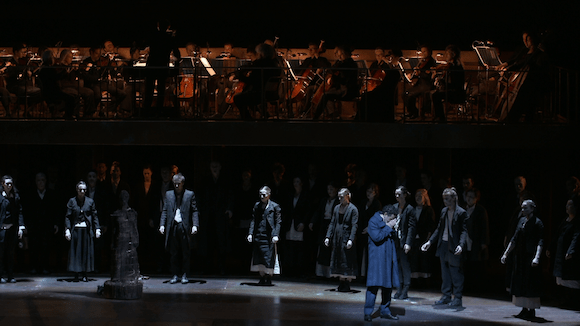
Massenet’s Cendrillon is an interesting take on the Cinderella story.  There are a lot of references in the libretto, especially in acts 3 and 4, to suggest that it’s all really a dream. So maybe it’s not unreasonable for Barbara Mundel and Olga Motta in their 2017 Freiburg production to riff of that and give us elements that don’t, at first blush, make sense.  Dreams are like that. It would also explain why, in many scenes, Lucette seems to be more of a spectator than a participant.

1.knife

Continue reading

Nabucco a la Visconti

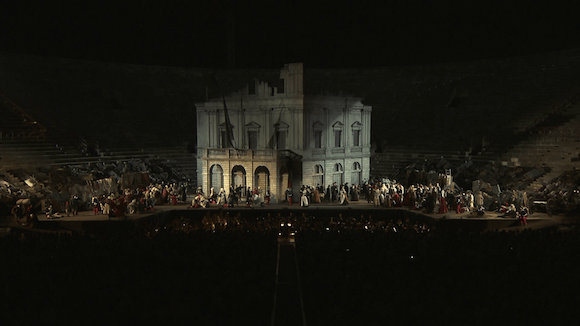
I guess Verdi’s Nabucco is even more closely associated with the Risorgimento than his other works so it’s not perhaps surprising that, for his 2017 production for Verona, Arnaud Bernard made the connection explicit.  We are in Milan during the Five Days.  La Scala; which does duty as the Temple, the Hanging Gardens and itself, stands in the middle of the huge performance space of the Arena di Verona.  Italian and Austrian soldiers, including cavalry, ride around the arena or clamber over the terraces.  It’s wild and spectacular but it’s more than that.

1.lascala

Continue reading

Send in the clones

Stefano Poda’s production of Turandot (he is also responsible for the sets, costumes and lighting) for Teatro Regio Torino, recorded in early 2018, is one of the most visually effective productions of this (or perhaps any opera) that I’ve seen.  I don’t know whether it makes “sense” (but I’m also not sure that any Turandot does) and, if it does, I doubt one would be able to unpack it in a single viewing because there’s a lot going on (but see comment at the end).

1.cube

Continue reading

500

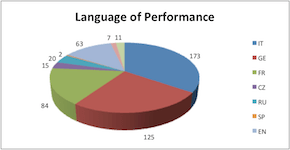
I reached the milestone of 400 DVD/Blu-ray reviews on June 20th 2016.  The 500 mark came up last weekend.  Let’s see how the stats have evolved.

500-languageItalian has increased its lead to 35% with German now on exactly 25%.  English has dropped marginally to 12%, despite its prominence in contemporary works.  I think multiple Salzburg Mozart cycles are playing a role here. Continue reading