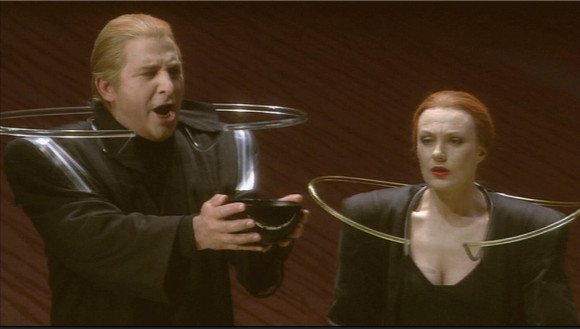
Despite having seen many Magic Flutes and pretty much every Bergman movie it’s only now that I’ve got around to watching his famous film of the Mozart opera, or rather Bergman’s version of the opera, because it differs in important ways from Shikaneder’s libretto. The basic concept is that Pamina is Sarastro’s daughter, who he has removed from the evil influence of her mother. He intends Pamina to inherit his kingdom and leadership of the Brotherhood but only after he’s found a suitable chap to keep her out of trouble which is, of course, where Tamino comes in. So whatever else has changed, the misogyny is intact. There are other changes too. Monostatos is almost written out of the script and a good deal of dialogue is changed or omitted, as are some musical numbers. The whole thing comes in at 135 minutes so maybe 30 minutes of material have been cut. None of this seems very radical today but must have raised a few eyebrows in 1975.
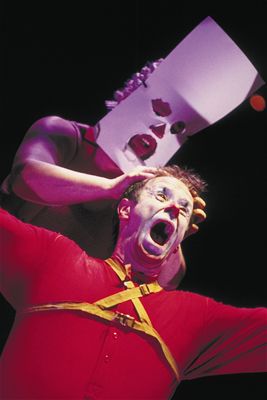
Production photos from Uncle John
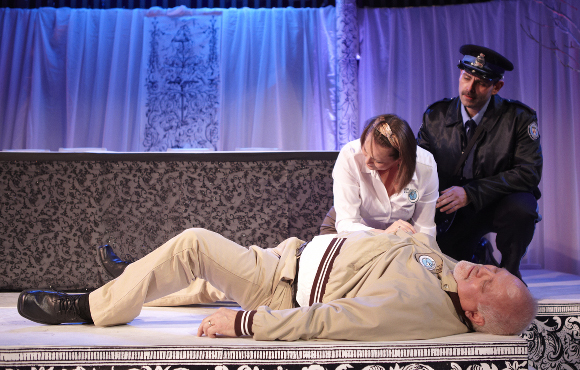
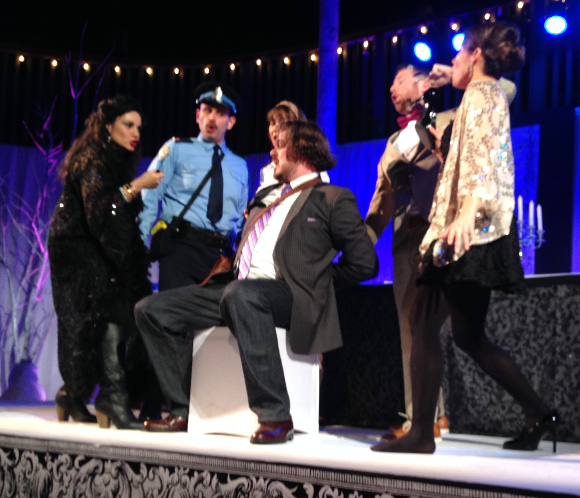
OK, here are some proper production photos of Against the Grain Theatre’s Uncle John. All photo credits are Darryl Block.
Uncle John
Against the Grain Theatre opened their new show last night on the worst day of the winter so far. Over 15cm of snow fell and the TTC was in utter chaos. It’s becoming a habit. Last year’s Messiah opened in weather almost as bad. Uncle John is the latest modern, Toronto based, adaptation of the Mozart/da Ponte trilogy. It follows on from last season’s smash hit Figaro’s Wedding and was created and produced with support from the COC and the Banff Centre. It will be followed by A Little Too Cosy next season. The formula is basically the same. It;s ataged in a non traditional spave; in this case a rock concert venue on Queen West. The libretto is in English and differs in detail from da Ponte while respecting the basic spirit of the original. It’s also very Toronto and a little bit Toronto opera scene insiderish. Much of the recitative is replaced by spoken dialogue. There’s no chorus and accompaniment to the singers is provided by piano and string quartet. It’s a musical solution I like. It adds enough weight and colour that one hardly misses the full orchestra while being, of course, much more affordable. It all works really well and if you can you should see it. I’m putting my more detailed thoughts under the cut because they contain lots of spoilers which you may not want to read if you are going.
Apparitions
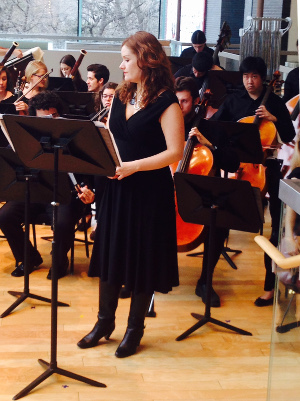
Conductor Brian Current and the Glenn Gould School New Music Ensemble presented three pieces, one of them a world premiere, today in the Richard Bradshaw Amphitheatre. The performances were prefaced by a really rather informative and informal chat by Brian on “how to listen to contemporary music”. It was engaging and totally non-patronising.
And so to the music. The first piece was Marco Stroppo’s 1989 piece élet… fogytigian, dialogo immaginario fra un poeta e un filosofo; a piece evoking an imaginary dialogue between a Hungarian poet and an Italian philosopher who never actually met, or so the composer told us. The first movement was bright and aggressive, very much in the European manner of the 70s and 80s with the second even more explosive before, in the third movement, settling into an exploration of string colour. The composer explained this as being like three walls of a house, painted different colours, slowly rotating. It’s the kind of piece one needs to hear more than once.
A future for NYCO?
Jennifer Rivera has a very interesting interview with Roy Niederhoffer who is leading a project to put NYCO back in business. On the fsace of it, all the necessary elements seem to be there. Full interview.
Daniel Cabena and Stephen Runge at Hart House
I was at a bit of a loose end yesterday so I made a very last minute decision to catch countertenor Daniel Cabena and pianist Stephen Runge in recital in the Great Hall at Hart House. It was a free concert and I hadn’t seen a program listing so I was pleasantly surprised to find a rather varied mix of early 20th century Canadian and English art song as well as piano pieces by York Bowen. I guess I was expecting baroque and earlier material since that’s what countertenors do!
Guglielmo Tell in concert
The operatic forces of Teatro Reggio di Torino are on a four city tour of North America. Last night, at Roy Thomson Hall, they performed a concert version of Rossini’s Guglielmo Tell. It was strictly concert style without any of the “semi staging” touches that are normal here so just music stands at the front of the stage and concert dress. It’s in some ways a very odd way to experience a piece like this because some of the most dramatic scenes aren’t sung but are accompanied by the orchestra. Take the canonical scene where Tell shoots the arrow off his son’s head. We get the build up and it’s fairly obvious what the hushed orchestra is all about and then we get the chorus announcing basically “Gee by golly, he did it”. Maybe the supertitles could be used as a commentary track at such points? Continue reading
Transcendent Tristan
There may be better video recordings of Tristan und Isolde than Daniel Barenboim and Heiner Müller’s 1995 Bayreuth collaboration but I haven’t seen one. It combines a deeply satisfying production, outstanding conducting and brilliant performances from the principals; Siegfried Jerusalem and Waltraud Meier. The only downside, and it’s not serious, is that, as a 1995 recording, it’s a bit short of the latest and greatest in audio and video quality.
Toronto needs a second opera stage
“Toronto needs a second opera stage” is , in some ways, a very weird thing to write. There’s no lack of opera companies or opera performing spaces in Toronto. Besides the 800 pound gorilla of the COC we have a specialist “baroque” company, innovative indies like Opera 5 and Against the Grain and a surprisingly flourishing Canadian contemporary opera scene with Tapestry and Soundstreams. We also have two very decent student programs and any number of companies competing for the “concert peformance of mainstream rep with piano accompaniment and journeyman singers in a hall of questionable acoustics” market. So what am I talking about? I’m talking about the lack of opportunity to see staged performances with orchestra of less known works, even fairly mainstream 20th/21st century works plus contemporary opera from outside Canada. The COC seems to have settled into a pattern of doing one “modern” work per season for some definition of “modern” that covers anything post Puccini basically. Given the need to sell 15,000 tickets per run that tends to translate into fairly safe fare like Britten and Richard Strauss most of the time. I’m not grumbling (much). It’s an economic imperative but it means that works as mainstream as Wozzeck or Lulu come around about once every twenty years at best.
Upcoming shows
Toronto Operetta Theatre have announced casting for their production of Gilbert and Sullivan’s The Mikado which runs December 27, 28 (mat), 31 (New Year’s Eve Gala), 2014 and January 2, 3, 4, (mat), 2015 t the St. Lawrence Centre for the Arts. Evening performances start at 8 pm and matinees at 2pm. The cast is headed up by Lucia Cesaroni as Yum Yum; which is kind of the effect she has on a lot of people, including Adrian Kramer who will sing Nanky Poo. Joseph Angelo takes the role of KoKo, the beleaguered Lord High Executioner and David Ludwig takes on Poo Bah, the Lord High Everything Else. Mia Lennox will be Katisha, the Daughter in Law Elect of the Mikado of Japan who will be sung by Giles Tomkins. Also featured are Greg Finney and Domenico Sanfilippo as Pish Tush, Brittany King as Pitti Sing and Daria Bukhman and Kaili Kinnon as Peep Bo. Derek Bates conducts and Guillermo Silva-Martin directs. For tickets and information call the Box Office at 416-366-7723 or 1-800-708-6754 or online at http://www.stlc.com.