
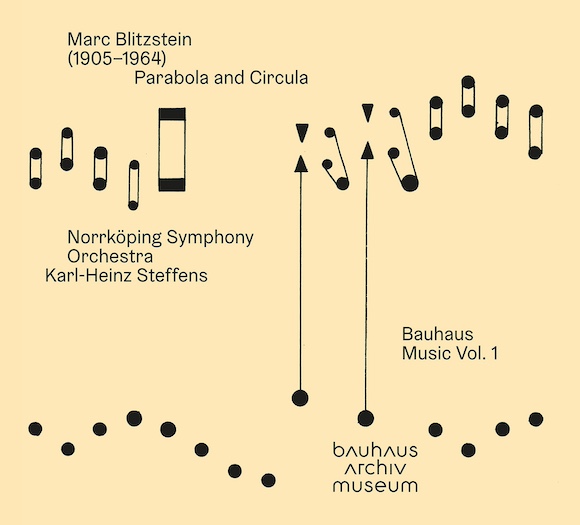
 The Bauhaus is usually associated with architecture and industrial design but it also had a musical side. The musical archive is mostly unexplored but there’s now a project to publish and record as much as possible. The first recording to be released is Marc Blitzstein’s 1929 opera Parabola and Circula to an English libretto by George Whitsett. What’s really unusual is that all the characters are geometric shapes (or maybe concepts, since a point and a line don’t have “shape). These characters interact on a series of planes. It makes me curious to know whether composer or librettist were familiar with Edin Abbott’s Flatland though the opera is about love and philosophy rather than geometry and class (*).
Basically Parabola and Circula are deeply in love and much admired by their adopted children Rectangula and Intersecta. This old-fashioned and unphilosophical approach to life is derided by Linea, Prism and Geodesa. Accepting their criticism, Parabola throws a very strange weapon (shades of The Brahmastra perhaps?) which destroys Circula. Order, or symmetry, or something, is restored.
Musically it’s a bit eclectic’. It’s basically tonal with tinges of the neoclassical, particularly in the various ballet sequences. The vocal line is essentially accompanied recitative which is quite varied but with no real arias and only the occasional duet. The orchestral writing though is colourful and rather effective.
Norwegian baritone Aleksander Nohr sings Parabola with some feeling and excellent control and there is real chemistry with Circula, sung by the rather bright voiced Norwegian soprano Mari Eriksmoen and with the children, sung by American tenor Matthew Newlin and Swedish soprano Hanna Husáhr. Gritty Swedish bass Henning von Schulman leads the presentation of the case for philosophical detachment as Geodesa supported by Dutch tenor Linard Vrielink as Prism and the somewhat more sympathetic Chinese mezzo Hongni Wu as Linea. The orchestra, which is really good, is the Norrköping Symphony Orchestra and the conductor is Karl-Heinz Steffens. All in all I think this recording makes a good case for the work but reading the staging notes in the libretto I really rather regret not being able to see it.
The recording was made in the Berlin Philharmonie in 2025 and the 44.1kHz/24bit digital version I listened to is very acceptable, if not perhaps up to some even higher resolution recent releases. It’s clear and well balanced. It’s due for digital only release on November 6th 2026 and it’s also available in 44.1kHz/16bit lossless and MP3. The digital booklet has lots of information on the Bauhaus project as well as the full libretto with stage directions.
(*)FWIW Flatland had a pretty big effect on 12 year old me and probably played a part in my decision to pursue mathematics as my main academic focus.
Catalogue information: Capriccio C5564

