
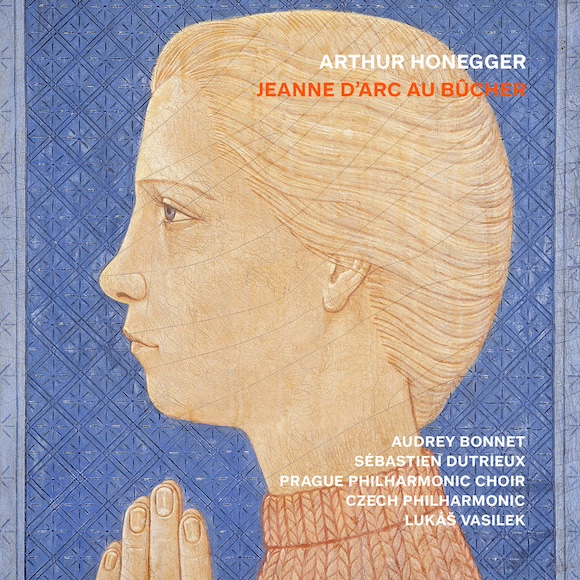
 Honegger’s Jeanne d’Arc au bûcher is a rather peculiar work. It’s scored for orchestra, adult and children’s choruses, solo singers and actors. There’s a lot of spoken word, usually accompanied by the orchestra or interleaved with singing. It’s important too, as Jeanne and her confessor, Brother Dominic, are both spoken roles. The text is a mix of French and Latin and the mood varies wildly from sombre, to grand, to liturgical, to reflective, to farcical. Each scene (there are eleven plus a prologue) is very much it’s own thing. The music is basically tonal, with some chromaticism, but it varies widely in mood to suit the needed atmosphere for each scene.
I’ll try and give a flavour by describing a few scenes. Scene II is almost entirely a spoken dialogue between Jeanne and Brother Dominic about her interrogation and the wicked role that Dominicans played in that process but in Scene III he is transformed into her accuser while the choir and a tenor soloist repeat the charges against her in Latin. There’s a farcical trial scene where she is tried by a pig and an ass with a sort of jury of sheep. But there’s also the final scene where Jeanne confronts death but her Voices assure her of Salvation. Along the way we get heavy satire against the doctors of the Sorbonne and a weird card game in which the Kings are the protagonists in the Hundred Years War (plus Death), the Queens are sins and the Knaves are the Kings’ henchmen, such as Bedford. It probably helps to have a decent understanding of the back story to follow what is happening and, even more, what is being alluded to. It’s a bit weird but oddly compelling.
The recording was made in the Rudolfinum in Prague in February 2025 using the Czech Philharmonic Orchestra and the Prague Philharmonic Choir and Children’s Choir with Lukáš Vasilek conducting. The role of Jeanne was taken by French stage and screen actor Audrey Bonnet and she is fantastic. She is particularly affecting in the final scene. Brother Dominic is played by Sébastien Dutrieux who seems to specialize in this kind of role. He’s also excellent. Jean-Baptiste Le Vaillant, Thomas Gendronneau and Anna John Schmidtmajerová cover a plethora of spoken roles.
For me, the standout singer is tenor Kyle van Schoonhoven whose vocal acting as the pig/judge Porcus is rather special. There’s fine singing too from Veronika Rovná, as Marguerite and Anna Goryachova, as Catherine; the two Voices that speak to Jeanne. They work really well together and contrast nicely with the rather fuller voice of Susanne Bernhard as La Vierge. Dovlet Nurgildyev and Zachary Altman round out the singers.
The orchestra and choruses are excellent and the recording is well engineered. It’s released as a two CD physical set, CD resolution and 96kHz/24bit lossless digital and MP3. The hi-res digital is really excellent; transparent, rich, detailed, naturally balanced. It’s immediately noticeably better than the CD resolution version. I almost always prefer higher resolution recordings but in this case the difference is particularly marked. There’s a booklet with full texts and English and Czech translation.
I wasn’t familiar with this piece before listening to this recording but I came away loving the piece and loving this recording.
Catalogue information: Animal Music ANI 153

