The Diary of The One Who Didn’t Disappear

The on/off saga of the Ensemble Studio’s promised Janáček’s The Diary of One Who Disappeared came to an apparent conclusion yesterday.  It had been postponed at least once and even this morning the COC website is advertising a complete performance with two soloists and a small chorus.
cocIt didn’t happen.  What we got was a recital by Owen McAusland singing some excerpts from the Janáček plus Vaughan William’s The House of Life and Britten’s Les Illuminations.  It was his last performance as a member of the Ensemble Studio during which time, among many other things, he sang several main stage performances as Tito covering for a sick Michael Schade.
Continue reading

Colourful Vixen from Glyndebourne

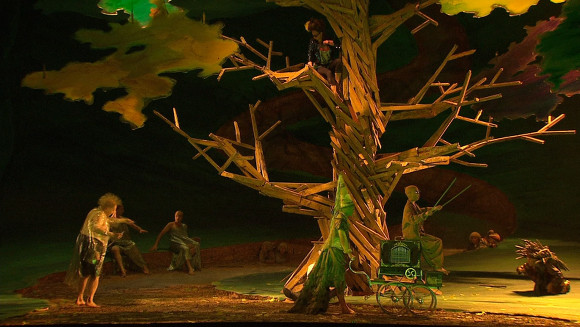
Melly Still’s 2012 Glyndebourne production of Janáček’s Cunning Little Vixen is straightforward and rather beautiful.  Certainly the staging matches the magic of this extraordinary score.  There are really two ideas underpinning the designs.  The animals are very human rather than the furries sometimes seen.  Their specific nature is hinted at rather than made terribly explicit.  They are differentiated from the humans by being very boldly coloured.  In contrast, the human world is a sort of monochrome 1920’s Moravia; all greys and browns.  Within this framework there are some neat touches.  The foxes carry their tales and use them to great demonstrative effect.  The chickens are portrayed as sex workers with the cockerel as, sort of, their pimp.  It’s not overdone and it’s very effective.  The sets are centred round a stylized tree with other structures as needed being erected on the fly with flats so the action never really stops.

1.forest Continue reading

Another classic re-release

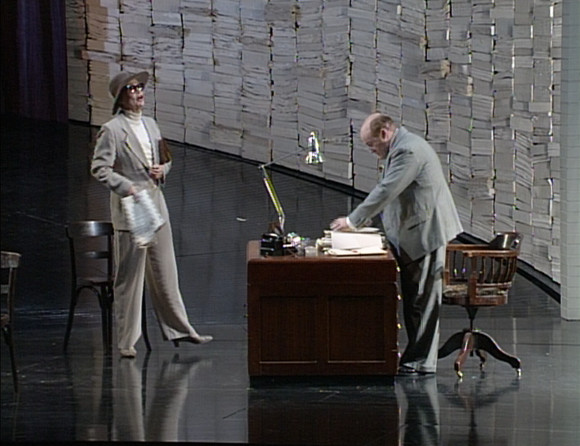
For the longest time the classic 1995 Glyndebourne recording of Janáček’s Věk Makropulos was the only video option.  It’s now been re-released on DVD and Blu-ray in a completely remastered version.  I watched the Blu-ray and it’s as well restored as the companion recording of Peter Sellars’ equally classic Theodora.  As it’s drawn from a Channel 4 broadcast the picture is 4:3 and it’s presented here formatted for wide screens in what is, apparently, called “pillarbox” mode in the UK.  At any event, the picture is excellent; certainly the equal of many more recent recordings, if not quite of the best HD quality.  The sound, stereo only, is decent but  a bit “boxed in” and the voices often seem to balanced a long way back.

1.office Continue reading

Charming Vixen from the Glenn Gould School

ggsopera3_365sq_0This year’s opera offering from the Glenn Gould School at the Royal Conservatory is Janáček’s Cunning Little Vixen.  It’s a pretty good choice for a student production with a wide variety of roles and it’s a great vehicle for showing off  the excellent Royal Conservatory Orchestra.  The school has chosen to present the work in English translation which probably makes sense given the difficulties of training a whole new cast in Czech even though it somewhat undermines the composer’s extremely tight linkage of text and music.

Continue reading

Stark Jenůfa from Madrid

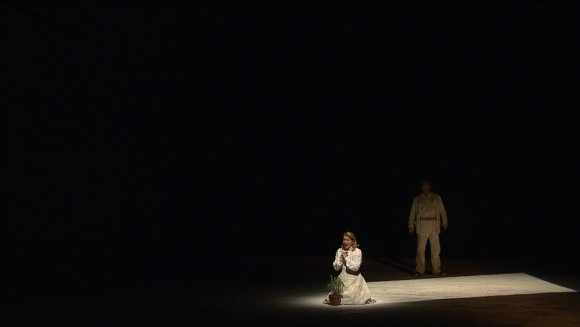
Stéphane Braunschweig’s production of Janáček’s Jenůfa, recorded at Madrid’s Teatro Real, is austere and effective.  The sets are almost empty.  Mill sails appear from a slot in the floor to suggest the family mill, there’s a cot for the baby in Act 2 and some church benches in Act 3.  That’s it.  The rest of the “setting” is carried by a very effective lighting plot.  I don’t think there are any big ideas here but it’s an effective, straightforward way of telling the story.  Braunschweig also makes effective use of the chorus, especially in Act 1.

1.plant Continue reading

Best of 2013

So what was I most impressed with on the opera and related scene in in 2013?

Big house opera

frau1The COC had a pretty good twelve months.  I enjoyed everything I saw except, maybe, Lucia di Lammermoor.  Making a choice between Christopher Alden’s probing La Clemenza di Tito, the searing opening night of Peter Sellars’ Tristan und Isolde; the night when I really “got” why people fly across oceans to see this piece, Robert Carsen’s spare and intensely moving Dialogues des Carmélites or Tony Dean Griffey’s intense and lyrical portrayal of the title character in Peter Grimes is beyond me.  So, I shall be intensely disloyal to my home company and name as my pick in this category the Metropolitan Opera’s production of Die Frau ohne Schatten.  Wernicke’s production is pure magic and Anna Schwanewilms was a revelation.

Continue reading

More upcoming shows; old and new

The Ontario Philharmonic and Richard Margison are doing a show of Italian opera “greatest hits”.  There are two shows; December 10th at Koerner Hall and the Regent Theatre, Oshawa on December 7th.  Full details.

Up in Montreal a new outfit, Stu and Jess Productions, are doing Menotti’s The Medium with a cast drawn from current McGill graduate students.  That runs from November 7th to 9th in a converted church in Verdun.  Full details

Last, but not least, the Glenn Gould School annual production at Koerner Hall has been announced.  It’s The Cunning Little Vixen by Janáček and it plays at Koerner Hall on March 19th and 21st.  I’m interested to see how they handle the dance elements.  More details.

Cunning Little Vixen short on magic

The 2009 Florence recording of Janáček’s The Cunning Little Vixen is bright, colourful, straightforward and fun but it doesn’t quite have the magic of the older Théâtre du Châtelet version.  Laurent Pelly’s production is quite straightforward with attractive sets and costumes and interesting choreography from Lionel Hoche.

1.vixen_frog Continue reading

Watery Kat’a Kabanová

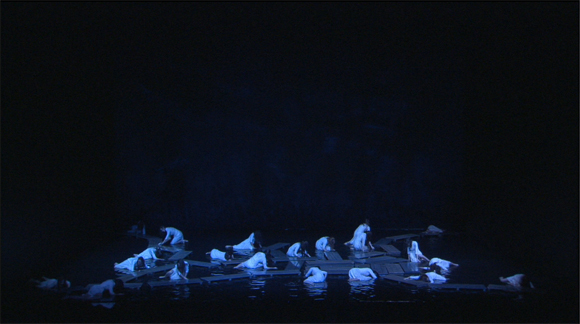
Robert Carsen’s producton of Janáček’s Kat’a Kabanová is typically simple and elegant.  Recorded at the teatro Real in Madrid it features a flooded stage with a large number of wooden pieces, like palettes, that are rearranged to form the set.  At the beginning of Act 1 the pieces form a pathway through the water simulating the banks of the Volga.  Later they are rearranged int a square at centre stage to represent the claustrophobic Kabanov house.  All this rearrangement is done by the ladies of the chorus who roll around in the water in white shifts.  No breaks are needed between scenes, just the intermezzi the composer provided for the purpose.  A mirror at the back of the stage reflecting the water and an elegant and effective lighting plot complete the staging.

1.water Continue reading

From the House of the Dead

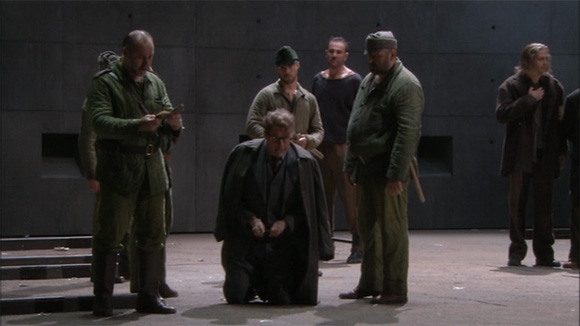
Janáček’s last opera, From the House of the Dead, is a curious piece.  It sets certain episodes from Dostoevsky’s account of his life in prison into a collage of stories that doesn’t have a straightforward narrative arc at all.  It’s quite brutal, as one might expect, and very male dominated.  Few characters stand out as individuals and so the piece becomes very much an exercise in ensemble musical theatre.  The music is unusual too.  In Pierre Boulez’ words it is “primitive”.  Certain phrases are repeated over and over with minimal development to create a sort of “expressionist minimalism”.  It’s extremely interesting to listen to and a great sonic match for the brutal and repetitive nature of prison camp life.

1.arrival Continue reading