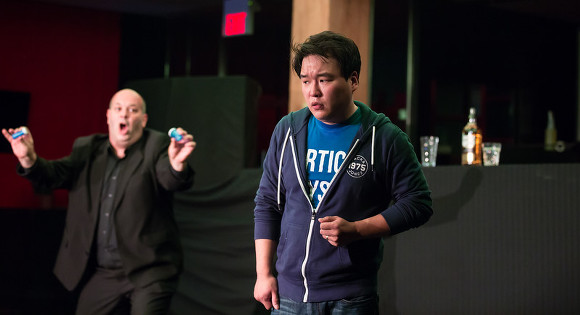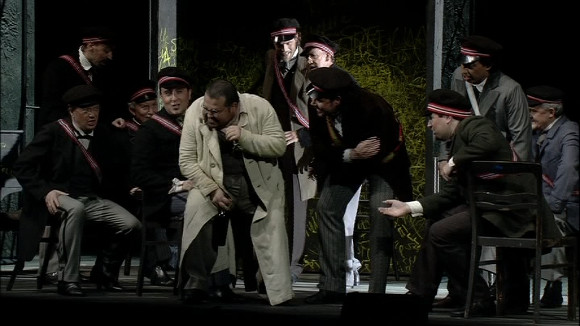
Opera America recently awarded a series of grants to opera companies for audience development. Most of these grants went to mainstream opera companies; usually “the big guy in town”. $35000 though went to Toronto’s Tapestry Opera. Yesterday I met with artistic director Michael Mori to find out what it was all about.
Heroes, Gods and Mortals
The Talisker Players’ latest show is pretty typical of what they do best; partner with some excellent singers and an actor to create an interesting program of words and music on a given theme. Last night, as the title suggests, the theme was classical mythology; a rich enough seam for almost anything! Most of the musical works chosen were twentieth century or later with only excerpts from a Pergolesi cantata harking back to an era that drew more heavily on these sources.
The first piece was Alan Hovhaness’ Hercules for soprano and violin performed by Carla Huhtanen and Elizabeth Loewen Andrews. This was so very Hovhaness; haunting, disturbing and very beautiful. It seems as rooted in the pre-classical world as the Heroic Age but perhaps that’s just a kind of timelessness. It’s a perfect fit for Carla and the violin playing was beautiful too.
All change for Seville
Last night saw the alternative cast for the COC’s Barber of Seville take the stage for the first time. Almaviva, Rosina, Bartolo, Basilio are all changed and, last night, owing to illness Joshua Hopkins was replaced as Figaro by Clarence Frazer which, in turn meant Jan Vakulik sang the Officer.
Back to Bartók
I was back at the Four Seasons Centre last night for another look at Duke Bluebeard’s Castle or, perhaps more accurately, another listen. I really enjoyed the production again and I don’t have much to add to my earlier review. It was the music that had much more impact this time. I often find that with “modern” scores I get much more out of them on a second listening and that was true here. First time round I felt so battered by the loud bits, especially the section where the fifth door (Bluebeard’s empire) is opened with it’s extra brass and JohnWilliams on acid crescendos, that my brain somewhat discounted the quieter bits. Last night I was struck mainly by the meditative nature of much of the music. The influence of Débussy, especially Pelléas et Mélisande, seems clear. The little repeating figures for the woodwinds; there’s one that’s usually given (I think) to the flutes and or oboes) and another descending figure in the bassoons, are quite haunting. It’s really quite lovely when it’s not being brutal.
I also appreciated the relationship between Bluebeard and Judith more. This isn’t Perreault’s tale of a brute and an innocent. Gubanova’s rather fierce Judith is running the show. Maybe there is an element of hubris in this Judith. Relyea’s Duke by contrast is almost an observer and commentator; acquiescing in what must be. Some of this, of course, is in the libretto. Bluebeard isn’t killed and Judith shares the fate, whatever it is, of the other wives. But here she seems to do so willingly.
I’m glad I saw this again.
Photo credit: Michael Cooper
Bluebeard’s Castle/Erwartung
Robert Lepage’s 1993 double bill production of Bartok’s Duke Bluebeard’s Castle and Schoenberg’s Erwartung was the iconic director’s first foray into opera and it has been argued tht it put the COC “on the map” as a serious international opera company. It was revived last night with François Racine directing.
Thirteen songs in search of an audience
This morning I went to the COC website to see what Josh Hopkins would be singing at lunchtime. Bottom line, he wasn’t. His recital had been replaced by a hastily put together program of pieces to be sung by Owen McCausland, Karine Boucher and Aviva Fortunata. Given that Liz Upchurch said it was pieces they were looking for an audience for I’d guess it’s audition/competition rep that they are working on and therefore, to some extent, work in progress.
Sad news
Canadian soprano Clarice Carson died on the weekend aged 85. In her career she sang a range of roles ranging from Mozart to Wagner including Tosca on Radio-Canada televeision with Louis Quilico as Scarpia (and we’ll never see that again). She sang in many major houses including The Metropolitan Opera, San Francisco and Venice’s La Fenice.
Ms. Carson was an active member of the Board of the International Resource Centre for Performing Artists, for which she often gave wardrobe consultations to young artists, mentored singers and acted as consultant for their careers. Clarice donated her musical scores and recordings to the IRCPA reference library planned to open in her name in the fall of 2017. Canadian Donations for this library can be made directly to the IRCPA website at Canada Helps: www.ircpa.net.
Sing unto the Lord a new song
Hubert Parry’s 1888 work Judith got its North American premiere yesterday in a performance by Pax Christi Chorale at Koerner Hall. It’s a typical English high Victorian oratorio, commissioned by the Leeds Choral Society Birmingham Festival (Wikipedia strikes again). It’s got some very grand choruses and some tuneful solos (one was later used for the hymn tune Repton setting the words “Dear Lord and Father of Mankind”). If one like’s that sort of thing, and Peter Simple’s Alderman Footbotham of the Bradford Tramways and Fine Arts Committee would certainly have approved, it’s very enjoyable. And if that’s not enough, there’s human sacrifice, seduction and murder to keep one’s interest.
Hands on Figaro
In the booklet accompanying David McVicar’s production of Le nozze di Figaro, recorded at the Royal Opera house in 2006, there’s an essay by the director in which he raises all kinds of questions about the rise of the bourgeoisie, the nature of revolution and romantic conceptions of love. He even appears to draw a parallel between Joseph II and Tony Blair. Then he declines to explain how he has embodied all these ideas on the stage and challenges us to “Watch, listen, participate”. Well I did and I’m none the wiser. What I see here is an essentially traditional approach; transferred cosmetically to 1830s France but so what? It’s darker than some Figaro’s but not nearly as dark as, say, Guth. Curiously, the main “extra” on the disks “Stage directions encoded in the music” tees this up much more clearly than the essay.
Führerbunker
Andrew Ager’s Führerbunker is a short chamber opera depicting the events leading up to Hitler’s suicide in April 1945. It’s a tautly constructed work in which many short scenes are woven into a seamless and compelling whole. It flies by and its 45 minute length seems even shorter. The score is spare, even brutal, as befits the subject matter. The composer told me he had initially envisioned something Wagnerian but feared that that must descend into pastiche. He made the right decision. So, the piano line is minimalist with elements of serialism and very little support for the singers. It’s a style that has perhaps been largely discarded (in north America at least) but here it was startlingly effective. Perhaps the crappy Tranzac Club piano contributed to the effect!