
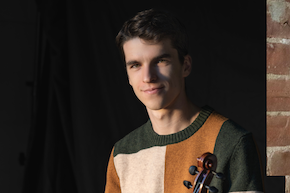
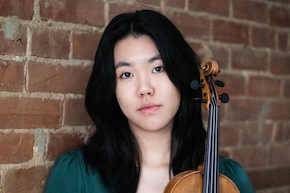
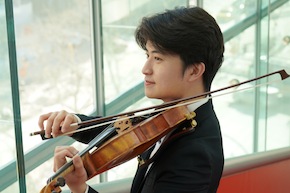
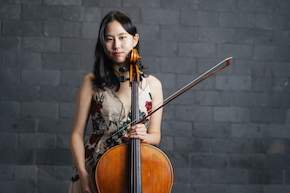
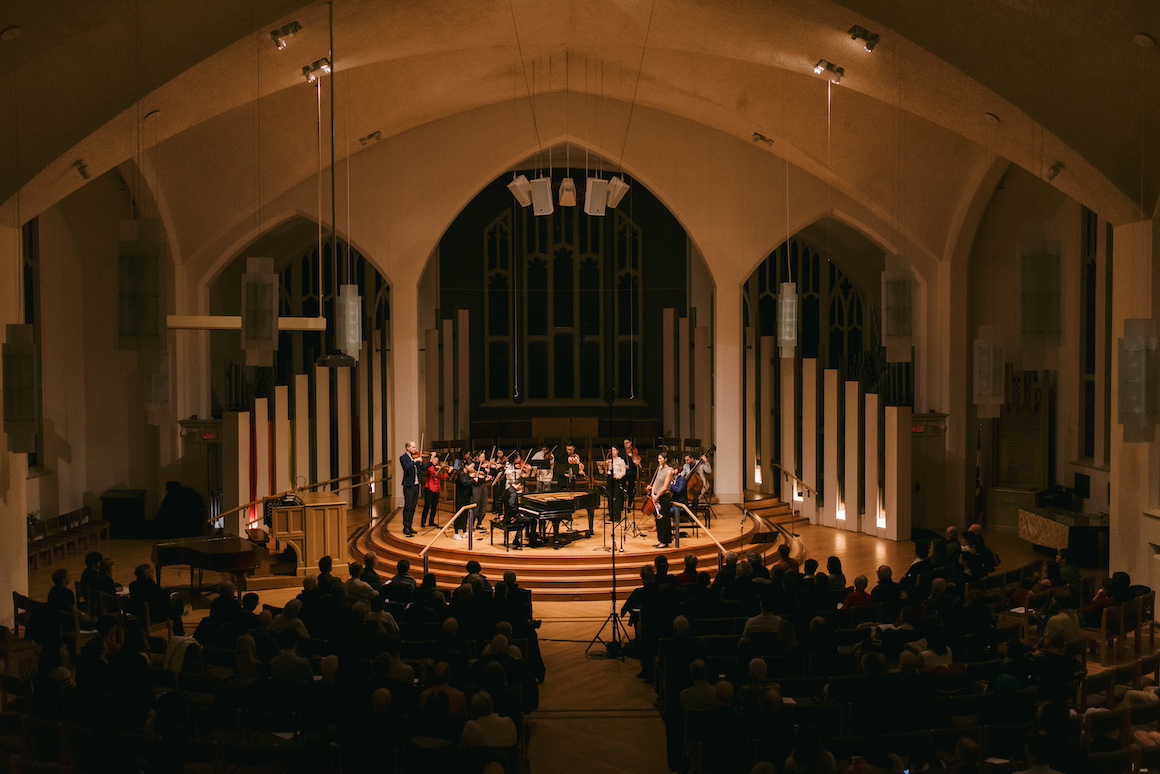
Wednesday’s lunchtime concert at Heliconian Hall; part of Toronto Summer Music, featured two pieces of chamber music by Beethoven and Shostakovich. The first was the third movement of Beethoven’s String Quartet No. 15 in A minor, Op.132. It was played by Justin Saulnier, Ashley Tsai, Bill Ko and Claire Park. It’s an unusual movement, especially taken out of context. It intersperses intricate, very slow passages where phrases are passed between the players without too much in the way of obvious clues for where the music is going. It’s profound and quite ethereal. These sections arr interwoven with livelier sections where the “cues” are more obvious. I would think it’s difficult to get just right at the best of times and for what amounts to a “scratch” quartet to handle it as well as they did is admirable. It feels like the sort of music that one needs to play with the same colleagues for twenty years! Incidentally, the same team is playing all four movements of this work tomorrow at noon.

 The Toronto Symphony’s 2024/25 season is the usual mix of mainstream symphony/concerto rep, Pops, film music, kids’ concerts etc. My sense is that it has got more “popular” since the pandemic and that therefore there’s been less that’s caught my eye. That’s my story anyway!
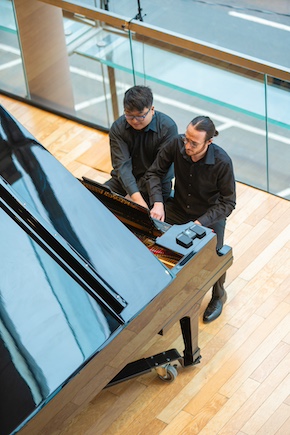
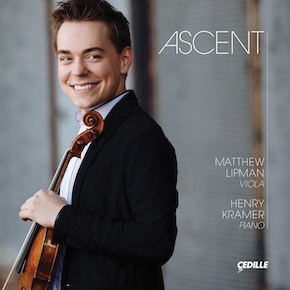 Having been impressed by violist Matthew Lipman at the two OPUS IV concerts earlier this week I decided to check out his CD, Ascent, which consists of a number of works for viola and piano with pianist Henry Kramer (currently faculty at Université de Montréal).
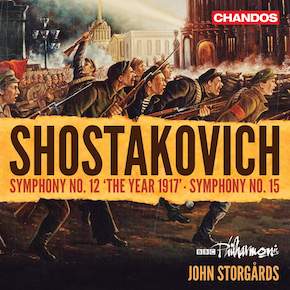 The latest release from the BBC Philharmonic and conductor John Storgårds is a generous coupling of two Shostakovich symphonies; Symphony No. 12 in D Minor (The Year 1917) and Symphony No.15 in A Major. That’s a total of 85 minutes of music. It’s also an SACD release from Chandos so technically it’s exemplary.
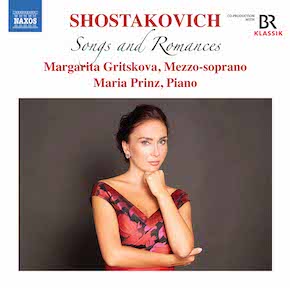 I’ve listened to a lot of music for voice and piano and a lot of music by Shostakovich but it was only on listening to this new album by Margarita Gritskova and Maria Prinz that I realised that I had hardly heard any of Shostakovich’s art songs; except for a few with orchestra. So I was glad to discover the interesting collection on this CD. There are twenty songs taken from twelve different works. (most of DS’ song cycles seem to require multiple voice types. I guess labour was cheap in the USSR). The pieces are drawn from right across Shostakovich’s career from Op.4 to Op.145. The evolution of style is as clear as in his chamber or orchestral music.
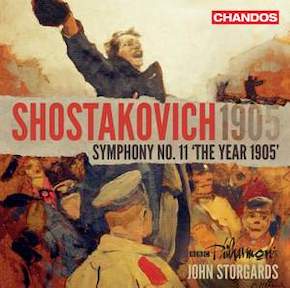 One of the “selling points” of John Storgårds’ new recording of Shostakovich’s 11th Symphony (The Year 1905) with the BBC Philharmonic is that it uses real church bells rather than orchestral tubular bells for possibly the first time since the original recording by the Leningrad Phil. They are interesting but that’s not the main reason to buy this disk. There are two far stronger ones. It’s extremely well played. Storgårds conjures up an almost unbearable amount of tension and it never really relaxes. This is a performance that will have you on the edge of your seat throughout. Needless to say, he’s very well backed up by the BBC’s Salford based orchestra who produce exceptionally lovely string tone and brass that is emphatic without quite the “teeth on edge” quality of some Russian orchestras.
