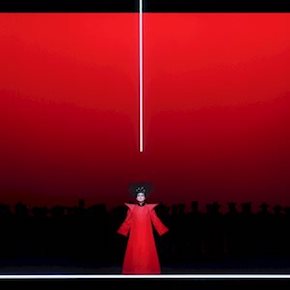
Richard Strauss’ Elektra opened last night in a revised version of James Robinson’s 2007 production. The setting is fairly straightforward and a bit drab; vaguely Victorian, or perhaps Gormenghast, which seems about right for the hagridden House of Atreus. The stage is severely raked; back to front. and stage left to right. There are a couple of walls with entrances. There’s a strange little hut which, it turns out, forms a sort of trap door to the palace. Costumes are either shapeless (ladies) or vaguely reminiscent of evening wear (gentlemen). In this setting the action plays out convincingly enough with even difficult scenes like Elektra’s “death dance” well handled. The tricky scenes between Elektra and Klytämnestra and Elektra and Orest have the appropriate degree of tension and suspense.


The annual Student Composer Collective opera at UoT is, as far as I know, unique. A libretto is written. The work is divided up and student composers write music for their assigned section(s). The finished work is presented fully staged with orchestra. In recent years the libretto and direction has come from Michael Patrick Albano, as was the case with this year’s effort presented in the MacMillan Theatre yesterday afternoon. Who Killed Adriana riffs off Cilea’s Adriana Lecouvreur. Adriana Amaro, a very divaish diva, is making her Covent Garden debut as Adriana. In the first half of the show, set backstage between Acts 2 and 3, we see her waspishly putting down all the other characters before making her grand entrance. This time though the poisoned violets of the final scene are just that and the second part is a whodunnit search for the murderer. Along the way no stock opera joke is left unused. Tenors are neurotic, understudies insecure, managers harassed, fans obsessive, there are fake Italians and so on. But in typical Albano style it works and provides a coherent, and at times very funny, plot line for the composers to work with. And some of the jokes were new. Adriana’s chauffeur, Umlaut, is revealed as the answer to every Austrian’s prayer; the inventor of musical strudel.
This year’s featured composer in UoT’s New Music Festival is Toshio Hosokawa. Last night saw performances of two of his one act operas in Walter Hall in productions by filmmaker Paramita Nath, with the composer in the hall. The first was a monodrama setting of Poe’s The Raven featuring Kristina Szabó and a student ensemble conducted by Gregory Oh. It’s an interesting piece. Hosokawa’s sound world combines the European avant-garde with Japanese elements so it’s unlike anything I’ve heard from a North American composer. It’s dramatic and atmospheric and works really well with fevered nature of Poe’s text. He also writes well for the voice with a variety of demands from whispering, through speech to full on singing. All of this coped with admirably by Szabó who, as ever, seemed perfectly at home with whatever the composer threw at her.
Jessye Norman is this year’s winner of the Glenn Gould prize. I knew that a while ago but I had no idea of the scale of events being arranged to honour the fact. TL;DR there are tons. So, I’m going to do what I almost never do, which is to reproduce the press release with the event schedule verbatim. Here goes:
The idea of recreating an accademia musicale (private concert) at the home of Roman artist/patron Pier Leone Ghezzi in 1723 and putting on works that might have been played at such an event is an intriguing one. Add to that that we were promised caricatures; Ghezzi being a noted pioneer of the form. Marco Cera, who conceived the show, seemed to be onto a good thing.
There are some interesting things coming up at the UoT Faculty of Music. On January 17th at 7.30pm there’s an opera double bill in Walter Hall featuring Toshio Hosokawa’s The Raven and The Maiden from the Sea (Futari Shizuka). Kristina Szabó features in the first piece with Xin Wang in the second.