September

princess2It’s September and the long, slow awakening after the annual aestivation begins.  There’s not a lot on yet but what there is is interesting.  The middle of the month sees Native Earth’s production of I Call myself Princess at the Aki Studio; previews from 9th to 12th September with official opening on the 13th and then shows until the end of the month.  My interview with playwright Jani Lauzon is here.  Also opening on the 13th is Tapestry Briefs at the Ernest Balmer Studio.  Hear the product of the LibLab, hear Stephanie Tritchew, Teiya Kasahara, Peter McGillivray and Keith Klassen and eat tapas.  It runs until the 16th.

Continue reading

Lenin’s Torah

The 2018 Ashkenaz Festival opened last night at Koerner Hall with a concert titled Yiddish Glory.  The background can be found in my preview post about it.  So last night four vocalists and an assortment of instrumentalists performed nineteen numbers from the collection.  They date from 1942; when the outcome of the Great Patriotic war was far from certain, to 1947; when it was already won.  The bulk date from 1944/5; when the outcome was clear though maybe not the costs still to be borne.

Continue reading

Not all smiles

I’m never quite sure what I really think about an operetta like Lehár’s Das Land des Lächelns.  I quite like the music, even if it can be a bit cheesey but I’m put off by the casual cultural appropriation (though it’s not nearly as bad as Puccini!).  I’m not sure what the best directorial approach is either.  Does one play it for froth?  Does one try and mine some deeper meaning?  Interestingly Andreas Homoki’s approach for his Zürich production filmed in 2017 is to play it straight and let whatever is there appear or not.  It works rather well.  It;s a typically lavish Zürich production with lots of colour and movement and he creates some spectacular visual effects.  But he also allows for a sinister element to appear in the Chinese scenes.  It may be over-interpreting but I think one can see shades of proto-Fascism here.  It’s reinforced by the score that really has some rather sinister elements that I hadn’t noticed before.  I think there’s even a nod to Siegfried’s Funeral March.  All in all, quite interesting without being wildly unconventional.

1.vienna

Continue reading

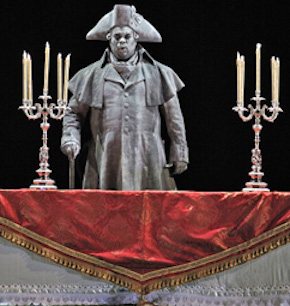
Guth’s Clemenza

Claus Guth’s Salzburg da Ponte cycle is certainly my favourite trifecta and they are right up on my list for top picks for all three operas so I was intrigued to see what he would do with the much less recorded La clemenza di Tito which he directed at Glyndebourne in 2017.  Bottom line, I’m not at all convinced by it.

1.video

Continue reading

UoT Faculty of Music @100

It’s 100 years since the beginnings of the Faculty of Music at UoT.  There’s a pretty fair line up of concerts to celebrate it.  The Opera Division, as ever has two main stage productions in the MacMillan Theatre,  November 22nd to 25th 2018 sees Weill’s Street Scene with Sandra Horst conducting and Michael Patrick Albano directing.  March 14th to 17th 2019 sees performances of Mozart’s rather too often seen La finta giardiniera conducted by Russell Braun and, again, directed by Albano.  Given that on October 17th Albano is giving a public lecture titled The Concept Ceiling: Has avant-garde operatic production reached it’s zenith? I’d expect both of these to be on the decidedly conventional end of the scale.  Albano and Horst are in tandem again for the Opera Student Composer Collective’s Who Killed Adriana?; a riff off Cilea’s Adriana Lecouvreur on January 20th 2019.  The OSSC’s piece is almost always one of the highlights of the Opera Division year.  There are also some other “excerpts” shows in the calendar.

EJB

Continue reading

COC free concert series

kramerThe 2018/19 free concert series in the RBA has been announced.  It includes the 1000th concert in the series which is pretty amazing.  There’s the usual mix of vocal, chamber/instrumental, jazz, world music and dance.  Concerts that particularly caught my eye include:

  • October 9th 2018: Ensemble Studio; Best of Rossini
  • October 25th 2018: Simone McIntosh and Rachael Kerr with Messiaen’s Harawi; Songs of Love and Death.  This may be the highlight of the whole season.
  • December 11th 2018: Against the Grain Retro
  • January 29th 2019: Michael Schade (tenor), Marie Bérard (violin) and Michael Shannon  (piano); Homage to McCormack and Kreisler
  • February 11th 2019: The Louis and Christina Quilico Prize Competition (this one is at 5.30pm)
  • March 5th 2019: Ian Cusson (piano/composer ),Marion Newman and Marjorie Maltais (mezzo-sopranos); Le Récital des Anges: Songs of Ian Cusson
  • May 14th 2019: Miriam Khalil (soprano) Topher Mokrzewski (piano);1001 Nights:Tales from the East
  • May 22nd 2019: Canadian Art Song Project with Michael Colvin and Stephen Philcox.

There are plenty of concerts by the Ensemble Studio including the annual collaboration with L’Atelier Lyrique and farewell concerts from Samuel Chan, Stephane Mayer and Lauren Eberwein.  Visiting artists include Oleg Tsibulko, Helene Schneidermann, Susan Bullock, Angel Blue and Andriana Chuchman.  There’s loads more of course.  Full line up here.  All concerts at noon unless otherwise indicated.

Courses this fall

Iain Scott has a bunch of opera courses coming up.  Links are there if you are interested

mnjccAt the U of T’s School of Continuing Studies
5 Thursday afternoons (3:00 – 5:00 p.m.)
Starting 13th September.
“FIVE ITALIAN OPERAS FOR PARIS”
https://learn.utoronto.ca/interactive-course-search#/profile/3510
(416) 978 2400

Continue reading

Yiddish Glory

YiddishGloryOK so it’s a bit off the Operaramblings beaten path but there’s a concert coming up at Koerner Hall on August 28th that intrigues me.  It’s called Yiddish Glory and it resurrects anti-fascist music that documents Nazi atrocities and Jewish resistance/partisan activities in the Soviet Union after the German invasion of 1941.  They were collected by a team of Jewish Soviet ethnomusicologists led by Moisei Beregovsky during the war, but shortly afterwards, during Stalin’s anti-Jewish purge, the members were arrested, their work confiscated, and they died thinking the music was lost to history.  In the early 2000s, a lucky coincidence brought University of Toronto Professor Anna Shternshis to Kiev, where she learned that the music had actually survived in the intervening decades following the researchers’ arrests, and in the years since, has led the research project to restore these songs.  There’s also a CD.  I’ve listened to a few tracks.  The music is clearly Jewish and very much of the time.  It’s redolent of horror and resistance and ultimately, hope.  I find it deeply moving.

Continue reading

Inventing the Opera House

inventingtheoperahouseInventing the Opera House: Theatre Architecture in Renaissance and Baroque Italy by Eugene J. Johnson is a scholarly but readable account of the prehistory and early history of the form we know today as an “opera house”.  It’s fair to say that the road to the horseshoe shaped auditorium with ground floor seating and tiers of boxes looking over an orchestra pit to a deep stage was far from straightforward, perhaps even tortuous, and Professor Johnson lays out that journey in some detail.

Johnson begins around 1480 in the ducal courts of Northern Italy.  At this point no purpose built theatre had existed since classical antiquity.  Despite that, princes competed in the magnificence of the “spectacles” they put on for events such as dynastic marriages (partly driven by the fact that many of the houses; Medici for example, were trying to obscure their rather recent origins by leveraging their great wealth into marriages with more distinguished lineages).  It was also, of course, a period of revived interest in all things Greek and Roman, including the theatre, and there was prestige in putting on a Roman, or Roman derived, comedy for example.  But how to stage it?  The theatres of antiquity had been open air structures built on a semi circular plan but 15th century Italian architecture was rectilinear and the preferred time of year for festivities, winter, precluded an open air setting.

Continue reading

Upcoming -Tapestry and AtG

Toronto - Distillery District Trinity StreetTapestry Opera has announced participants for this year’s LIBLAB.  This year’s librettists participants include  playwright Colleen Murphy, Kanika Ambrose and Guildhall artist-fellows Lila Palmer and Daniel Solon. Composers joining the 2018 program are: Rene Orth, composer in residence at Opera Philadelphia, Benton Roark, composer of last season’s Dora-nominated Bandits in the Valley, Ian Cusson August Murphy-King. The 2018 LIBLAB ensemble will be led by musical directors Jennifer Tung and Andrea Grant and director Michael Hidetoshi Mori.  Singers include soprano Teiya Kasahara, mezzo-soprano Stephanie Tritchew, tenor Keith Klassen, and baritone Peter McGillivray. 

 The results of LIBLAB will be presented September 13th-16th, in the Ernest Balmer Studio as Tapestry Briefs: Tasting Shorts, a program of opera vignettes, expected to range from poignant and topical to hilarious accompanied by a tasting flight of tapas.  Continue reading