Glenn Gould School’s Die Fledermaus

Die Fledermaus offers a lot scope for reinterpretation.  Like so many works involving spoken dialogue there is a tradition of reworking that dialogue to work in contemporary humour and geographic relevance to the point where there is no canonical version though there’s probably a set of general expectations.  Joel Ivany’s production for the Glenn Gould School, which opened last night at Koerner Hall, goes further than most to create a “play within a play” dynamic riffing to some extent on the difficulty of staging an opera in a concert hall.  He also makes the decision to use English dialogue but have the sung text in the original German (except for the finale).

GGS Opera 2018 Die Fledermaus #1; Lisa Sakulensky Photography

Continue reading →

Whitney Mather in recital

I went to see Whitney Mather sing yesterday afternoon.  It was her second masters degree performance at Walter Hall with David Eliakis at the piano.  (Probably the first time I’ve heard David play a proper piano!)

whitneymather

It was an interesting and well chosen program that allowed Whitney to demonstrate her musicianship and sensitivity to text.  For the most part it avoided overly obvious territory, starting with Purcell’s rarely heard The Blessed Virgin’s Expostulation which was followed by the obligatory CanCon.  In this case John Greer’s The Red Red Heart; settings of poems by Marianne Bindig.  The Purcell allowed some tasteful decoration and an opportunity to display appropriately baroque style.  The Greer, like so many modern songs, perhaps had more of interest in the piano line than for the voice but it did allow a brief coloratura flourish.

Next up were Respighi’s Quattro Rispetti Toscani to texts by Arturo Birga.  These are rather beautiful songs and should be heard more often.  Whitney brought out both the pathos and humour in the rather rustic (Tuscan dialect?) texts.

After the interval we were on more familiar ground with Schubert’s Der Hirt auf dem Felsen.  Tiago Delgado played the clarinet part quite beautifully and Whitney managed the crazy pace of the piece very well, managing to maintain a clear sense of shape and line.  She wrapped up with Milhaud’s Chansons de Ronsard.  These are a bit of a tour de force.  Some passages are really fast and much of the music lies high in the soprano range.  Whitney may not have the easiest, most beautiful, high notes ever but she does have all the notes and she hit them here with accuracy and without sense of strain.  She was particularly impressive in the crazy fast Tais-toi, babillarde.

All in all not a bad way to spend a late Saturday afternoon!

Water Passion

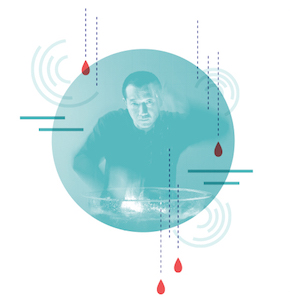
WaterPassion-v3Tan Dun’s Water Passion After St. Matthew, given last night by Soundstreams at Trinity St. Paul’s is very Tan Dun.  The work is in nine movements and scored for chorus, soprano and bass-baritone soloists, violin, cello, electronics and lots of percussion.  And bowls of water and rocks.  The texts broadly follow the Passion story finishing with a final Resurrection movement in which water is the symbol of rebirth, recycling and spiritual completeness.  There are also ritual elements.  Bowls of water laid out in a cruciform pattern are lit from beneath.  The musicians change position and the players, especially the percussionists, perform hieratic gestures with the water bowls and their contents.  It also involves a complex and dramatic lighting plot.
Continue reading →

Handel’s Alexander’s Feast

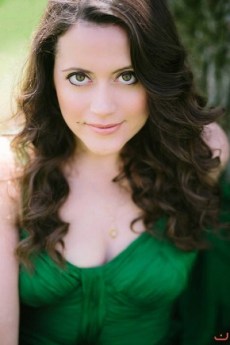
Amanda-Forsythe-Credit-Arielle-DonesonHandel’s Alexander’s Feast is an oratorio to a text by Newburgh Hamilton based closely on an earlier Dryden St. Cecilia’s Day ode.  The basic plot is that Alexander is feasting in captured Persepolis with his mistress Thaïs.  Inflamed by the music of Timotheus he decides to burn down the city in revenge for his fallen soldiers.  Cecilia descends from Heaven and substitutes music for the king’s barbarous intentions.  There are solo and choral numbers and a couple of duets and there are two concerti; one for triple harp representing Timotheus’ lyre playing and an organ concerto for St. Cecilia.  It’s all quite tuneful and interesting if not as inspired as some of the better known oratorios.
Continue reading →

Plug in

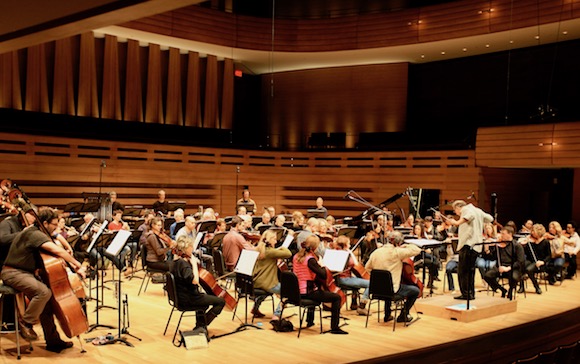
I went to see Esprit Orchestra’s show Plug in at Koerner Hall last night.  I don’t often go to purely orchestral concerts but Jenn Nichols was dancing and I have this feeling that I ought to listen to more contemporary music.

The first piece; Symphonie minute by José Evangelista, is a highly compressed “symphony” in four movements.  Each movement only lasts a couple of minutes and it uses a large orchestra.  It’s intriguing that in such a short time each movement has a clearly defined character.  It’s quite dissonant but very easy to listen to and doesn’t outstay its welcome.

Dress Rehearsal 2

Continue reading →

There are no words

Krystyna Zywulska was a Polish resistance fighter who was captured and sent to Auschwitz.  She took to writing lyrics and setting them to an eclectic mix of tunes as a way of coping with the horror of the camp.  Somehow this was pleasing to the powers that be and she found herself with a relatively soft job processing the possessions of arriving prisoners.  She survived to write a number of memoirs about her experience.  The story is oddly similar to that of Zofia Posmysz, who inspired Weinberg’s The Passenger.  This time the opera is Another Sunrise; a collaboration of Gene Scheer and Jake Heggie commissioned by Music of Remembrance and premiered in 2012.  There’s a companion piece by the same team; Farewell Auschwitz, which sets some of the Zywulska texts, in translation and reworking by Scheer, to a wide range of the kinds of music that Zywulska used.  Last night both pieces got their Canadian premiers in a production by Electric Bond Ensemble at Beth Tzedec directed by Aaron Willis.

IMG_1043

Continue reading →

Tap:Ex Forbidden

Tapestry’s new experimental show opened last night at the Ernest Balmer Studio.  It’s a “mash up” of Persian classical music and hip hop around the theme of The Child and The Stranger, who turns out to be Lucifer.  Lucifer seeks to show the child that authority and rules serve only to allow the powerful to abuse and punish others.  This is explicated in six short scenes using the various musical resources and styles available.

TapExForb-photobyDahliaKatz-1433_preview

Continue reading →

I due Figaro

Mercadante’s I due Figaro(1) is one of a number of operas that continue the story of Figaro, Almaviva etc into a third instalment.  It sets a libretto by Felice Romani based on Les deux Figaro by Honoré-Antoine Richaud Martelly.  It premiered in Madrid in 1835 but was lost for many years before being rediscovered in 2009 and given at the 2011 Ravenna Festival.  Yesterday in got its Canadian premier at VOICEBOX:Opera in Concert.

iduefigaro

Continue reading →

GGS Vocal Showcase in Mazzoleni Hall

It’s that mid point of the academic year when the GGS puts on a recital programme that features a fairly full selection of the available singing talent at the Conservatory.  This means one sees everything from first year undergrads to singers in the final stages of a master’s degree, who may already be singing professionally, so it’s a constant exercise in recalibration.  It wasn’t helped last night by the fact that I had serious TTC problems causing me to miss the first three numbers on the programme plus feeling a bit frazzled for the rest.  So, in no particular order, I’m going to write about what I particularly enjoyed.  Omission should not be over-interpreted.

Continue reading →

All the Strauss

Yesterday’s Amici Ensemble concert in Mazzoleni Hall was an all Richard Strauss program featuring an array of guests.  First up was the Duett Concertino where regulats Joaquin Valdepeñas (clarinet), David Hetherington (cello) and Serouj Kradjian (piano) were joined by violinists Timothy Ying and Jennifer Murphy, violist Keith Hamm, Theodore Chan on bass and Michael Sweeney on bassoon.  It’s a program piece in which the clarinet represents a princess and the bassoon, a bear, who eventually, of course, transforms into a handsome prince.  There are lots of dance rhythms from the strings and some sly quotations from Der Rosenkavalier along the way.  It’s fun and it was very well played.  I almost wonder if it was too smooth.  The bear certainly seemed very suave and his transformation was not terribly abrupt.  Still, bear!

amici

Continue reading →