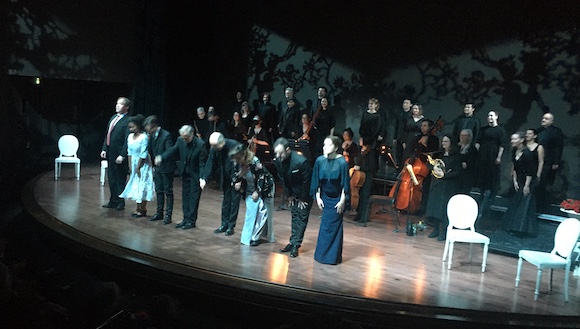
My review of Ian Cusson and Kanika Ambrose’s new opera Of the Sea is now up at Opera Canada.
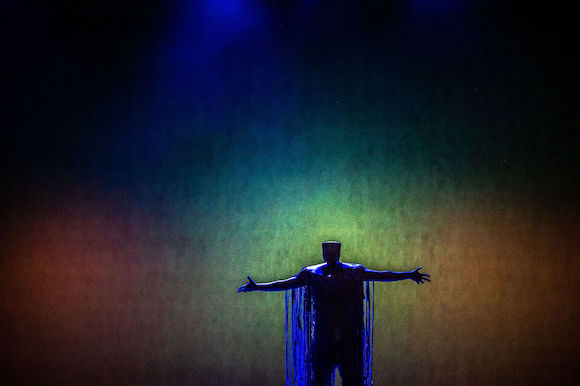

My review of Ian Cusson and Kanika Ambrose’s new opera Of the Sea is now up at Opera Canada.
Voicebox: Opera in Concert’s most recent production is Joseph Bologne, Chévalier de St, Georges’ 1780 opéra comique, L’amant anonyme. It was given in OiC’s usual style; i.e concert dress but some blocking, a few props and no music stands. The dialogue was given in English with the musical numbers in French with surtitles. Accompaniment was a 10 piece chamber reduction of the original score by Stephen Hargreaves. David Fallis conducted.
On Saturday evening the Toronto Mendelssohn Singers gave a very beautiful, carefully constructed and thought provoking concert. To start with it was at the Church of the Holy Trinity which, as most Torontonians will know, is a sort of social hub servicing the spiritual and material needs of Toronto’s homeless as best they can. All the more ironic as it sits in the shadow of that iconic temple of consumer capitalism the Eaton Centre.

Thursday lunchtime in Walter Hall saw the winner of the 2023 Norcop Song Prize, Jamal Al-Titi give his prizewinner recital accompanied by Koldolsky Prize winner Indra Egan. It was an interesting selection of material for baritone in English, French, Italian and Russian. Starting off with Butterworth’s Loveliest of Trees and Vaughan Williams’ Silent Noon was bold. The standard for these songs is particularly high and I don’t think they are Al-Titi’s sweet spot. We would see laster in the recital a leaning towards a very operatic approach that didn’t work so well here.

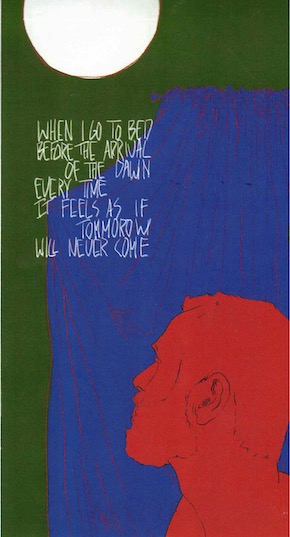 To the intimate (i.e. tiny) Array Space last night for a concert by the Happenstancers who, in this iteration, consisted of Brad Cherwin – clarinet, Madlen Breckbill – viola and Micah Behr – piano. and, in the first number, viola.
Part 1 of the programme was called Dream Images and was intended to evoke the discontinuous and illogical. It began with Du Yun’s dreams-bend for taped speech, two violas and clarinet as a sort of intro to the main event. This consisted of Schumann’s Fairy Tale Narrations and Kurtág’s Hommage à R. Schumann; these being two of the very few works for clarinet, viola and piano. Added to these was a new work; Abstractions by Nahre Sol. The pieces were played with the movements in the right order but with the composers mixed up so, for example, the first four movements went Kurtág, Sol, Schumann, Kurtág and so on. I like this approach. The styles contrast. The Kurtág is spikey and dissonant, the Schumann structured and Romantic and the Sol playful, tonal (mostly) and rhythmically varied. Listening to them interspersed somehow focusses attention on their particular qualities and has a kind of focus that the conventional way of doing things doesn’t.
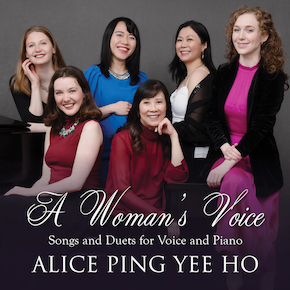 Confluence Concerts’ show last night at Heliconian Hall was titled A Woman’s Voice. It was, after a fashion, a CD release concert in two halves. The first half featured music by Alice Ping Yee Ho from the album A Woman’s Voice and featuring the same performers; Vania Chan, Katy Clark, Alex Hetherington, Maeve Palmer and Jialiang Zhu. I’ve already reviewed the album and I don’t think last night changed my opinion much so I’ll not do a detailed rundown. What I can say is that last night it was mostly opera excerpts; Lesson of Da Ji, Chinatown, The Imp of the Perverse, and a live concert gave an opportunity for a bit of staging which was definitely an enhancement, especially in The Imp of the Perverse scene. “Café Chit Chat” and “Black” also benefitted from visual interaction between the singers. I like the CD a lot. Getting a chance to see some of the music live was great. Continue reading
UoT Opera Division’s production of Arthur Benjamin’s A Tale of Two Cities, currently playing at the MacMillan Theatre, is really rather good. Its partly the work itself which surely deserves to be better known. It’s a 1950 work to a libretto by Cedric Cliffe. It was written for the Festival of Britain and was considered a success at the time. It is in many ways typical of mid 20th century English opera (though Benjamin was a peripatetic Australian rather than a Brit). It’s colourful and uses a large orchestra with lots of brass and percussion and combines lyricism with some fairly heavy dissonance. It also includes a few good arias, notably one for Lucie Manette, the romantic female interest.
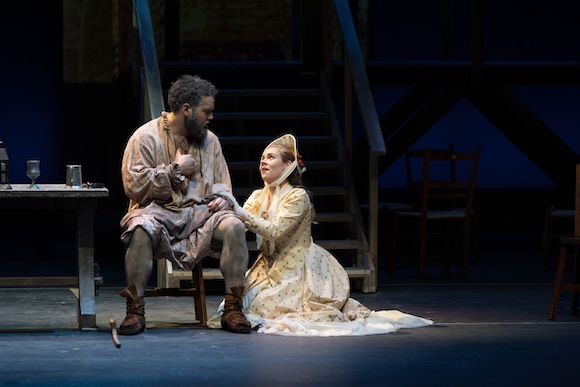
Dr. Manette (Burak Yaman), Lucie Manette (Emily Rocha)
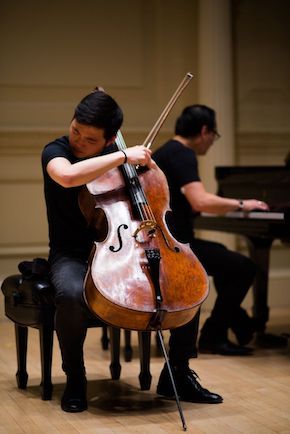 I found out quite late about OPUS Chamber Music and their current short concert series so I was only able to attend the last show on Sunday evening at Grace Church on-the-Hill. Pianist Kevin Ahfat is the driving force behind these concerts and he was able to marshal an impressive line up including recent Indianopolis Violin Competition gold medallist Serena Huang.
The first half of the programme was essentially French. Brannon Cho joined Kevin for Poulenc’s Sonata for Cello and Piano. It has a lively first movement with jazzy dance rhythms and lots of interaction between the players which showed excellent mutual understanding. The second movement is more limpid and languorous and drew some rather elegantly beautiful sounds from both cello and piano. The third movement is marked “Ballabile” which was new to me. Apparently it refers to a dance by the corps de ballet. I can see that. It’s fast and intricate with lots of pizzicato from the cello. The finale is almost like back to the beginning with more playful interaction between the instruments. Lovely playing in both the livelier and the more lyrical passages with an appropriate sense of Frenchness. Continue reading
Thursday’s concert in the Music in the Afternoon series at Walter Hall was curated by Canadian-Icelandic composer Fjóla Evans and had a distinctly Icelandic flavour (fortunately not fermented shark flavour).

 Cherubini’s Médée is a French opéra comique (i.e. with spoken dialogue) which premiered in March 1797. It’s based on Euripides by way of Corneille whose Médée of 1635 was written, as one might expect, in alexandrines. So its roots, and the work itself, are very much in the French classical tradition. The complication is that the work is much better known in its Italian version with sung recitatives (not authorised by Cherubini) and has developed as a “show off” vehicle for star sopranos; notably Maria Callas and, more recently, Sondra Radvanovsky. Along the way it’s lost a lot of its classicism and become almost verismo like. So I was intrigued to see how much Guillermo Silva-Marin, in presenting the work “in concert” at the St. Lawrence Centre, would try, and how much he would succeed, in reclaiming the Cherubini of a Paris tipping from revolution to Bonaparte.