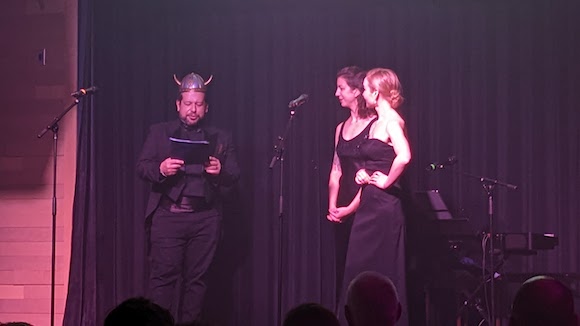
Last Night at the Cabaret Yitesh

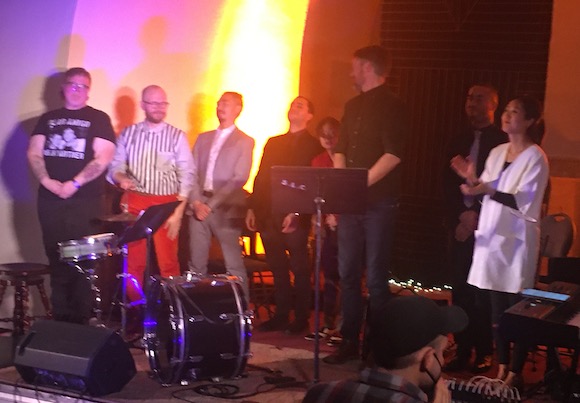
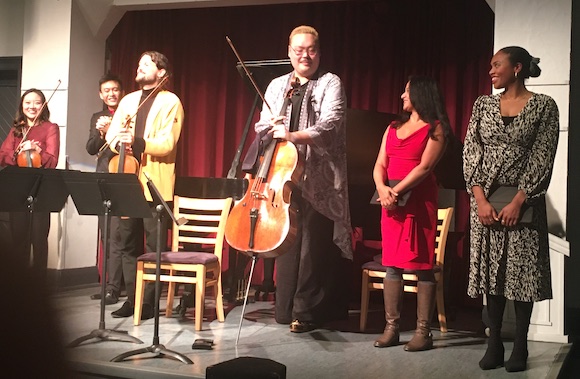
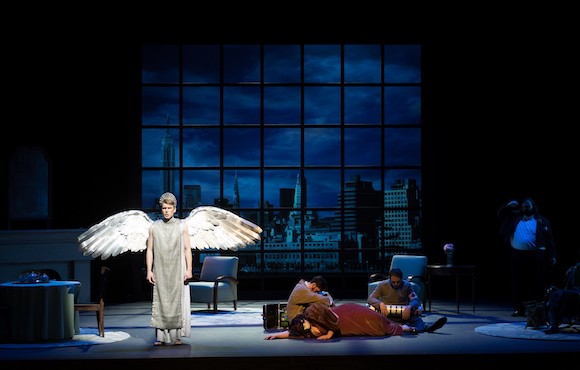
Last Night at the Cabaret Yitesh is playing at the Ashkenaz Festival at Harbourfront.  It’s a crazy mix of cabaret and other influences from the wild and wacky pen of Michael Wex.  The back story is that it’s 1938 and the last night that the Yiddish language Cabaret Yitesh will perform in Warsaw before being, in effect, deported.  So, no longer dependent for their continued existence on the whims of the censor’s office they can let rip.

Cabaret-Yitesh

Continue reading

Bas-Sheve

Last night, as part of the Ashkenaz Festival, we got to see Henekh Kon’s Bas-Sheve.  It’s the only known pre Holocaust Yiddish opera and there’s quite a saga involved in it getting to a staging.  The work dates to 1924, when it premiered in Warsaw then disappeared.  In 2017 Dr. Diana Matut unearthed an incomplete piano score version which was completed and orchestrated by librettist Michael Wex and composer Joshua Horowitz to create an hour long piece that premiered in August 2019 as part of the Yiddish Summer Weimar festival.

opERA4

Continue reading

Songs in Time of War

musicgardenThe season finale for the Music Garden this summer was a performance of Alec Roth’s Songs in Times of War.  These are settings of poems by Du Fu translated by Vikram Seth.  Du Fu was a Chinese court poet who lived through times (8th century CE) when millions died or were displaced by rebellion and civil war.  Although more allusive than direct (most of the time), the poems are grim but have an elusive beauty which is reflected in Roth’s setting.  Originally scored for tenor, guitar, harp and violin we got to hear a new version (by the composer) with violin replaced by erhu; a two stringed bowed instrument.  Tnere’s no doubt in my mind that the erhu adds a really effective cross-cultural timbre that the violin version can’t quite match.

Continue reading

Tanya’s Secret

Tanya’s Secret is a queer-trans adaptation of Tchaikovsky’s Eugene Onegin.  It’s a production by Opéra Queens who seem to be a Montreal based group created during the pandemic and doing their first show in Toronto; in this case at the Betty Oliphant Theatre.  Actually it’s not a particularly radical adaptation compared to, say, some of Against the Grain’s transladaptations.  It’s sung in Russian (with some Ukrainian interpolations including a Lysenko art song) with subtitles on screens either side of the stage).  The plot isn’t really changed at all though the ball scene in Act 3 gets a sort of drag queen competition element.  The big change is that some roles are assigned to the “wrong” gender.  Tatiana is sung extremely well and acted even better by Mike Fan.  Catherine Carew is a strongly sung and impressive Gremin doubling as the very different Madame Larina. Christina Yun’s Lensky is ardent and she makes a nice fist of “Kuda, kuda”.  (Who needs tenors?)  Oddly this doesn’t really come across as all that radical.  The necessary transpositions occasionally create the odd awkward high note but it’s very singable and generally well sung.

Copia de TanyasSecret.byElanaEmer.9EE08126

Continue reading

Gould’s Wall

It was March 2017 and I was interviewing composer Brian Current over lunch.  He mentioned having seen Geoff Sirett bouldering on the wall of the Royal Conservatory atrium and how he had an idea for a site specific opera based on the life of Glenn Gould.  Eventually this became Gould’s Wall with a libretto by Liza Balkan.  Announced and rescheduled more than once due to COVID it premiered last night under the auspices of Tapestry Opera and the conservatory’s 21C series.

*Lauren Pearl and Roger Honeywell _ Gould_s Wall _ Tapestry Opera _ Photo by Dahlia Katz(3)

Continue reading

Nordic Voices and Marion Newman

The Gryphon Trio pulled out of Wednesday night’s Toronto Summer Music concert for, one supposes, the usual reason.  This forced a reorganisation of the concert.  Elliot Britton’s new piece was cut and instead we got an extended set from the Nordic Voices as the first part of the concert.  Actually the first piece was for a very extended Nordic Voices.  Andrew Balfour’s Omaa Bindig supplemented the vocal sextet with Marion Newman and Jamie Parker (piano) plus a number of string players and voices lined up down the sides of Walter Hall.  It’s one of those soundscape works that envelops you in a variety of sounds and techniques.  I wish I could find the text but I can’t (surtitles used last night as they have been all through TSM… yay!)

7 TSM Sofia_Lebovics_July_27_Nordic_Voices_2

Continue reading

Inspirations

Last night’s Toronto Summer Music concert at Koerner Hall featured two works played by the TSM Festival Orchestra conducted by Nicolas Ellis .  The first was Keiko Devaux’ Arras.  It’s a sort of tone poem for chamber orchestra.  The base material is drawn from Keiko’s family’s musical and other heritage; agriculture, weaving, plainsong, Buddhist chant, chansons, Japanese-American pop and so on.  Samples are rewoven, looped, distorted etc and mixed to form a “tapestry” (hence the title).  The effect is quite hypnotic and rather soothing though there’s not much to get a “handle” on, which may be the point.

3 TSM 20220728-Z50_1011

Continue reading

The Americas

Last night’s Toronto Summer Music offering in Walter Hall was American themed in the broadest sense.  The New Orford Quartet kicked things off with three pieces for string quartet.  The first was Piazzolla’s Tango Ballet in Bragato’s arrangement for string quartet.  It’s kind of tango/jazz fusion and great fun.  Jessie Montgomery’s Strum is a sort of homage to the southern American tradition of a different kind of string instrument.  Lots of complex pizzicato and other effects.  Carmen Braden’s Raven Conspiracy is a three movement work for spoken voice and quartet dealing with both the mythical and biological raven.  It’s playful and extremely virtuosic.  I was struck by the fact that the New Orfords are not just a very fine ensemble but a very flexible one.  Nothing seems to faze them!

neworford

Continue reading

Appl and Rieger

Baritone Benjamin Appl and pianist Wolfram Rieger gave us Die schöne Müllerin with a twist at Walter Hall last night.  The twist was a companion/introductory piece by David Lang called flower, forget me based on one of the Müller poems that Schubert didn’t set with fragments of other flower related Schubert song texts.  If death is a major theme in the main cycle it’s an obsession in the new piece!  It’s also very low for a baritone with some really difficult phrasing.  One had to admire Appl’s skill in navigating its lugubrious depths but there was an almost tangible sense of relief in the audience when the duo launched into the sunnier and more familiar territory of “Das Wandern”.

applerieger

Continue reading