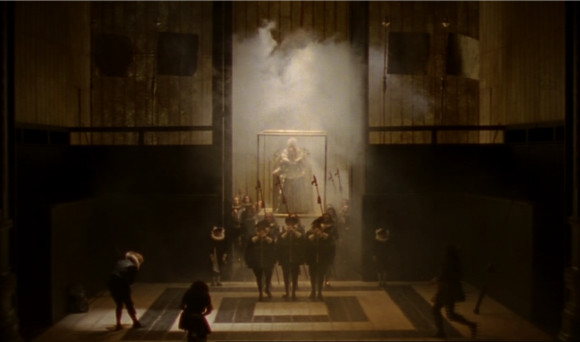
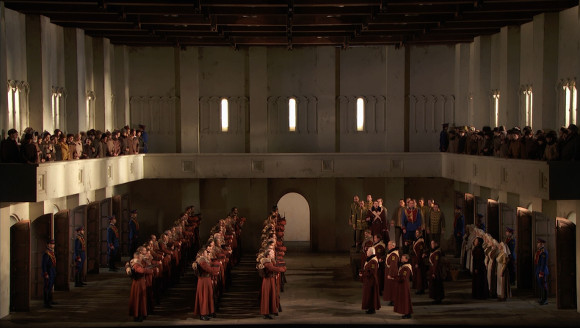
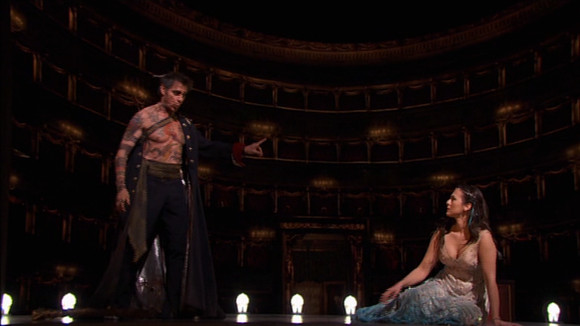
Matthias Hartmann’s staging of Carmen for the Opernhaus Zürich recorded in 2008 is starkly simple but very beautiful and provides a perfect vehicle for the considerable talents of Vesselina Kasarova and Jonas Kaufmann. The set consists of a plain backdrop and a raised elliptical disk, reminiscent of a bull ring. A few, very few, props are added as needed. A dog lies asleep at the front of the set (replaced by a cattle skull in the final act).
Category Archives: DVD review
The Met’s Prince Igor
Earlier this year the Metropolitan opera staged Borodin’s Prince Igor for the first time in nearly a hundred years with an HD broadcast and a DVD/Blu-ray release to boot. It’s an odd work. It’s quite long; a prologue and three acts running over three hours and it’s very episodic. The prologue takes place in Ptivl; the principality of which I gor is prince. He’s about to lead his army against the invading Polovtsians. There are dark omens. The next thing we see, as Act 1 opens, is that Igor is defeated and a captive of Khan Konchak who’s daughter is now in love with Igor’s son. It’s all just happened. Cue lots of exotic Polovtsiania. In Act 2 we are back in Ptivl where Galitsky is making trouble for his sister, Igor’s wife, who has been left as Regent. Mostly the trouble seems to be drunken partying and when the Polovtsian army arrives at the gates the brother, Galitsky, drops dead. In Act 3 the city has been sacked and everybody is kind of mooning around in the rubble until a pretty depressed Igor shows up and implores the other Russian princes to get off their arses and do something (unspecified). All the important stuff happens off stage and there really isn’t any resolution. There is some great music though.
Keine Ruh’ bei Tag und Nacht
At the Christmas 2012 Against the Grain Christmas party I won a mega box set of Dietrich Fischer-Dieskau goodies which included a couple of DVDs of opera extracts including some footage of him singing the title role in Don Giovanni auf Deutsch. The full recording from which those excerpts were taken has recently been released on DVD. It’s a TV broadcast from the opening of the rebuilt Deutsche Oper Berlin in 1961. It’s the earliest recorded in a theatre, in front of an audience, TV opera broadcast that I have seen. It wasn’t, apparently, broadcast live. The recording was made during the final dress and broadcast the following evening simultaneously with the first performance proper.
Spuren der Verirrten
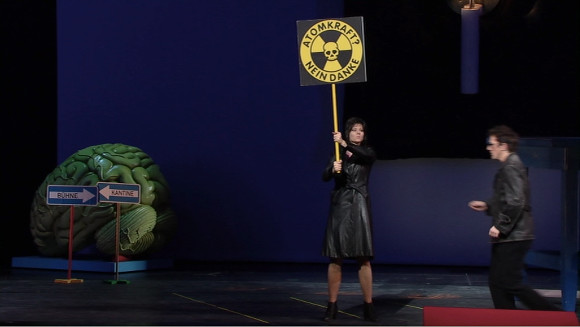
Spuren der Verirrten (The Lost) is described on the box as an opera by Philip Glass. That’s pretty misleading. It’s more a theatre piece/ballet by David Pountney and Amin Hosseinpour with a soundtrack by Philip Glass. It was created for the opening of the new Landestheater Linz at the instigation of Artistic Director Rainer Mennicken (carefully trimmed beard, wire rimmed glasses) who wanted a piece that would encapsulate all the various theatrical forms the new building would stage, as well as show off its technical capabilities. Mennicken also wrote the “libretto” based on a highly abstract play by Peter Handke which seems to deal with the hopelessness of the human condition in some sort of post apocalyptic world. There’s no plot as such and the work unfolds in a series of scenes. For example there’s a ballerina point shoeing across the stage followed by a “spectator” in the auditorium commenting on the action followed by dancers with roadsigns followed by a Gumby like couple sitting under a table followed by more narration. Then come more dancers in Hosseinpour’s signature “jerky” style followed by a woman with an anti-nuclear sign having a row with her boyfriend in front of a giant green brain. And that’s just the first ten minutes of a piece that goes on for nearly two hours. Along the way we get a reality TV show in which the characters discuss whether a serial killer is worse than a goalkeeper who lets in a soft goal, a confrontation between the patriarch Abraham and a giant rabbit and a scene where a naked woman cuddles a human head while two dancers do the fish slapping dance around her. The piece concludes with the orchestra on stage and the chorus in the pit miming playing instruments and singing “blah, blah, blah” which actually fits the music pretty well.
All who were lost are found
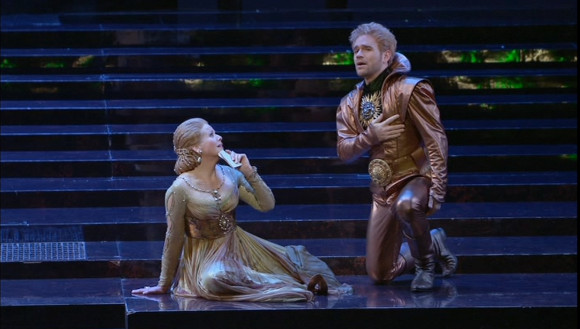
Thomas Adès’ 2004 opera The Tempest was given at the Metropolitan Opera in 2012 in a new production by Robert Lepage. It got an HD broadcast and a subsequent DVD release. It’s an interesting work which, on happening, was compared to Peter Grimes as the “next great English opera”. Whether this early hype will turn into a sustained place in the repertoire is yet to be seen. Musically it’s not easy to characterize. Adès very much has his own style; mixing lyricism with atonality and, in this piece, setting one of the roles, Ariel, so high it’s surprising anyone has been found to sing it. Certainly it’s a more aggressively modern style than most of the work currently being produced in North America. The libretto two is unusual. Shakespeare’s own words were, apparently, considered too difficult to sing though, of course, Britten famously set great screeds of unadulterated bard in A Midsummer Night’s Dream. For the Tempest, Meredith Oakes has rendered the text into couplets; rhymed or half rhymed. It works quite well with only the occasional touch of Jeremy Sams like banality.
Porgy and Bess at SFO
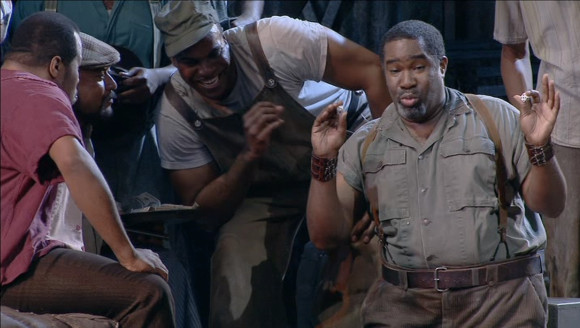
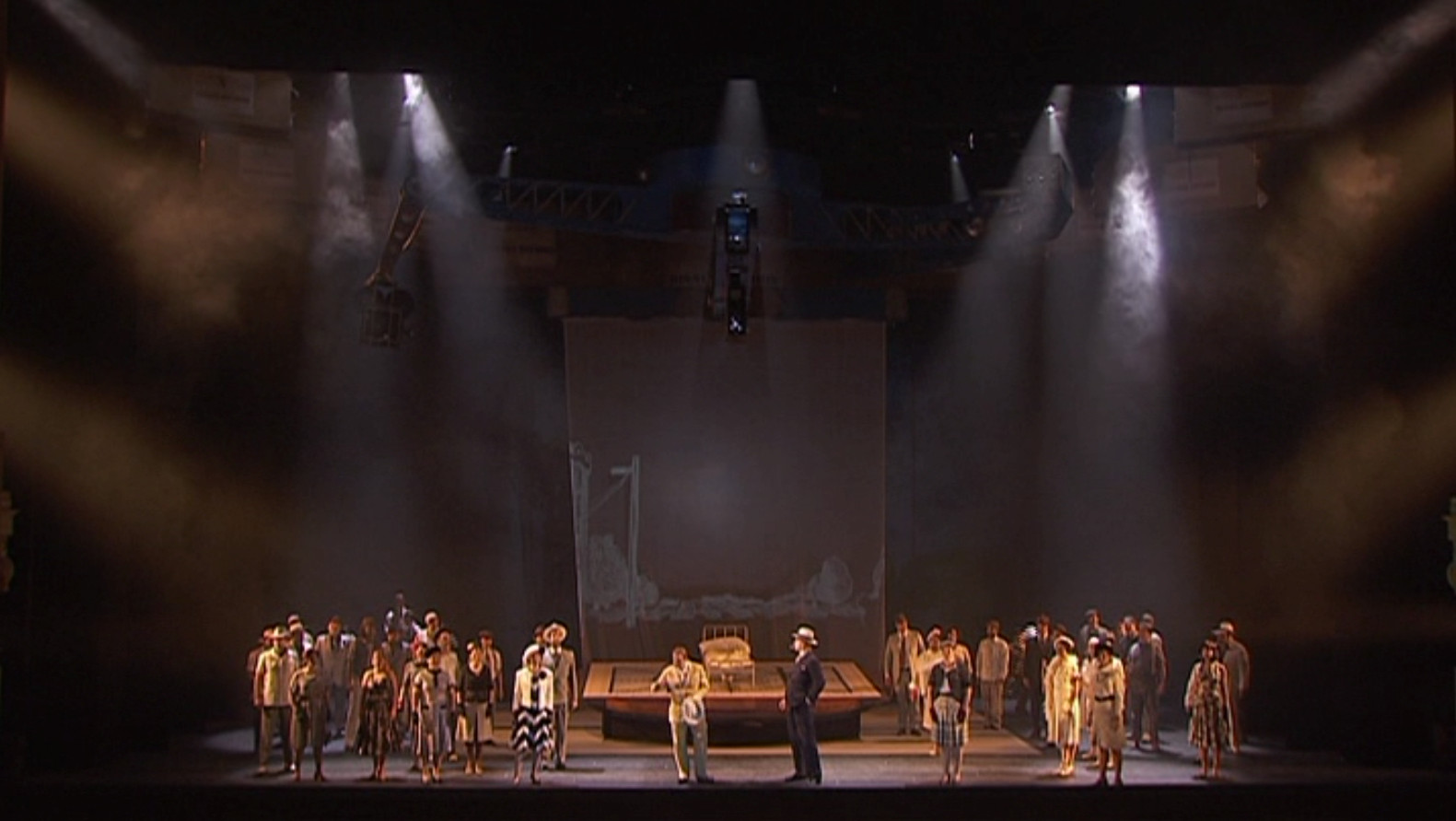
Gershwin’s Porgy and Bess has a really interesting history. It was always intended as a “grand opera”; pretty much the first American one. It was written for the Metropolitan Opera but not performed there until 1985 and between it’s Boston debut in 1935 and a production in Houston in 1976 it was virtually always performed in a much cut edition designed for Broadway. In fact by the time of the Houston production it was being done much at all; being seen as dated and dealing with issues of race that were particularly highly charged in Civil Rights Era America. It took a bold, young Deneral Manager, David Gockley, and a Gershwin enthusiast, John DeMain, to recreate an opera rather than a musical. It’s been following them round ever since and so, not very surprisingly, Gockley, now in charge in San Francisco, chose to stage it there last year in a new production by Francesca Zambello with DeMain conducting.
Don Tom
There are over 40 video recordings of Don Giovanni in the catalogue, dating back to 1954, and Thomas Allen sings the title role in quite a few of them. This one was recorded at La Scala in 1987 and features a very strong cast in a careful, traditional staging. It’s also pretty decent technical quality for the era. The director was Giorgio Strehler in a comparatively rare opera outing. His sets and costumes are of some vague aristocratic past with liveried footmen, big hats and twirling capes. It’s quite handsome but not in any way revelatory. Nor is any aspect of the production really. We are clearly in an aristocratic milieu. Tom Allen’s Don Giovanni is arrogant and proud with plenty of swagger. There’s no hint of ambiguity about Edita Gruberova’s Donna Anna or Ann Murray’s Donna Elvira and Francisco Araiza is a properly dutiful chump of a Don Ottavio. It’s all quite serious with comic relief only in the most obvious places. Having said that, there are some very effective scenes; especially the ending which has a an interesting lighting plot and manages not to be anti-climactic.
The Perfect American
The Perfect American is the ironic title of Philip Glass’ latest opera which premiered in Madrid last year. It’s about Walt Disney and set at the end of his life looking back at his life and forward to his death. It’s a not very flattering portrait. It depicts Disney as blinkered, racist, virulently anti-Communist and, in fact, only comfortable with a sort of Leave it to Beaver America; though passionate about that.
Are you my mother?
Donizetti’s Lucrezia Borgia is based on one short episode in the storied life of the famous female pharmacist. In it she twice poisons her son; once at the insistence of her husband, the second time by accident. The second time her son refuses the antidote preferring to die with his equally poisoned buddies but learns in his dying breath that Lucrezia is indeed his mother. It’s pretty unusual for a bel canto opera in that the leading female role (a) has agency, (b) doesn’t go mad and (c) doesn’t die.
With tender pity swells
Here’s another fine example of how well Handel’s oratorios can work when staged. It’s a recording of Hercules made at Paris’ Palais Garnier in 2004. The staging is by Luc Bondy and William Christie and Les Arts Florissants are joined by a youngish cast of extremely good singers. It’s compelling stuff. I think what, for me, makes the oratorios much more interesting than most of Handel’s opera seria is structural. The operas tend to alternate recit and da capo aria with maybe a duet or chorus to close an act but they are pretty predictable. In the oratorios Handel makes much more use of ensembles and the chorus and, for me, that’s vastly preferable.