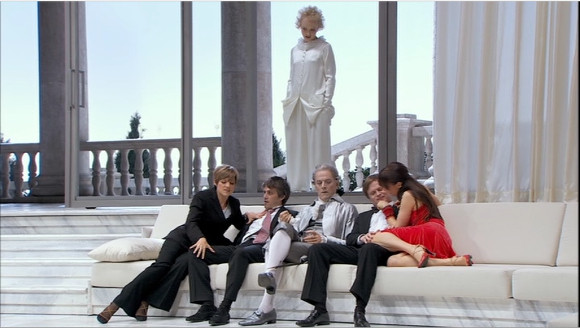
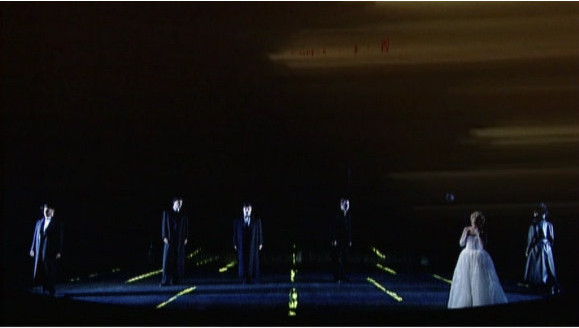
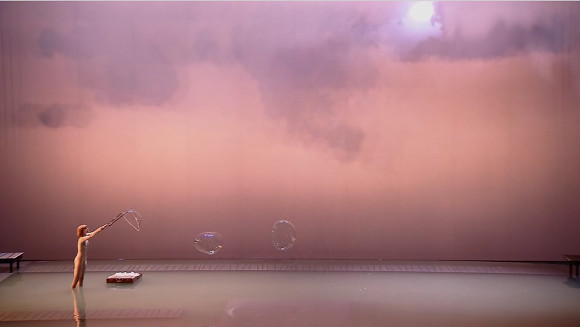
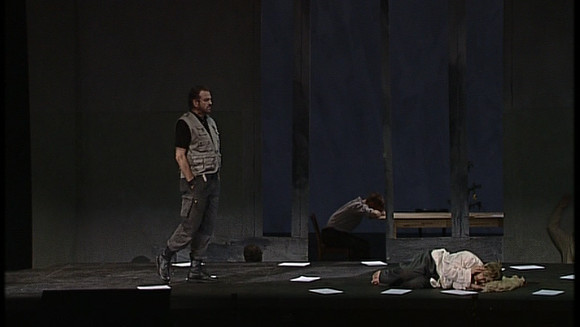
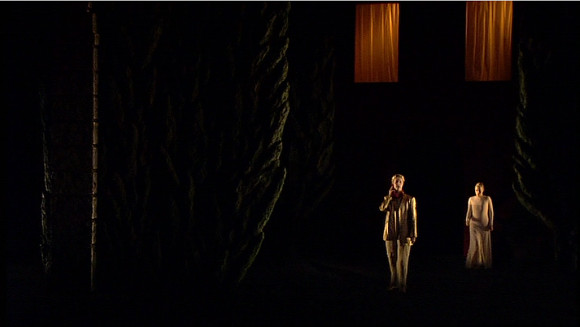
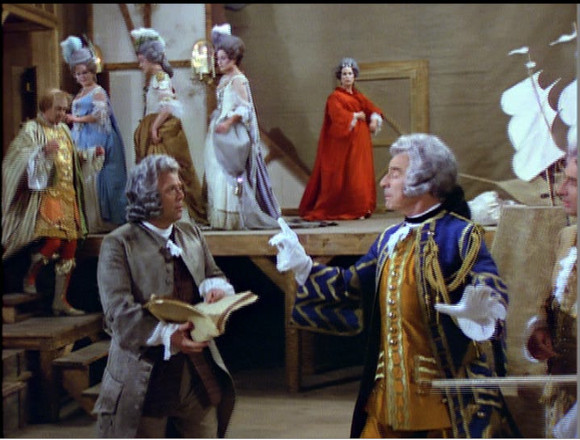
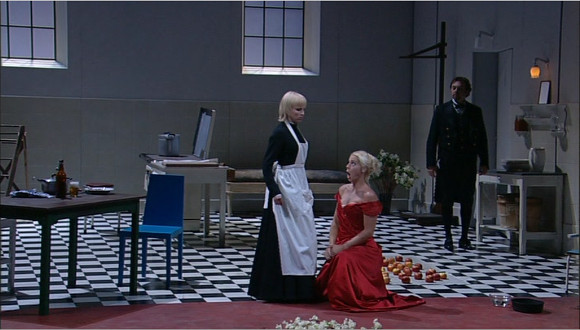
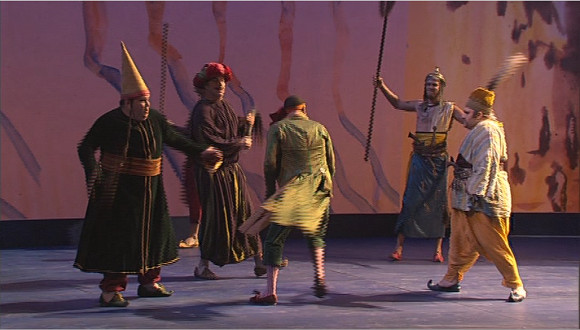
So sings the heroine of César Franck’s early piece Stradella, Léonor, during her abduction and imprisonment by the Duke of Pesaro. I felt pretty much the same watching the 2012 production from L’Opéra Royale de Wallonie. The company has a well deserved reputation for reviving neglected works from the French repertoire. I suppose once in a while if one does that one is pretty sure to come up with a complete turkey and, frankly, that’s how I’d classify Stradella. Franck left it in piano score and it was orchestrated recently by Marc van Hove so the 2012 Liège production is the premiere. The plot is essentially trivial. Stradella, a singer and protegé of the Duke of Pesaro is in love with Léonor, an orphan. They plan to marry secretly but the duke is also obsessed by the girl and has her kidnapped. Stuff happens and they both end up dead and the duke repents. Stradella and Léonor are united in Heaven. The music is rather dull and highly sentimental. The sentimentality is reinforced both by the injection of a bunch of morbid religiosity into the plot and the overuse of a children’s chorus. In fact I ended up wondering whether “Stradella” wasn’t the brand name for a Belgian artificial sweetener.
Category Archives: DVD review
In 1618 twelve million people lived in Germany
Sometimes one comes across a previously unfamiliar work that just blows one away. Karl Amadeus Hartmann’s Simplicius Simplicissimus did that to me. It’s a work written by Hartmann in 1934/5 as he watched the early years of Nazi power and the banning of “degenerate” art. By the time it got its premier in 1949 it’s story of a Germany physically and morally ravaged by war would seem all too prescient. It’s a simple story based on the early chapters of a novel by Grimmelshausen set during the Thirty Years War(1). It concerns a simple shepherd boy who is drawn into the conflict. There are three scenes. In the first, the entirely innocent boy witnesses the brutal destruction of the farm he works on by vagrant Landsknechten. In the second he is befriended by a hermit and undergoes a sort of moral education before once again being left abandoned by the hermit’s death. In the thirdhe becomes jester to the drunken and corrupt Governor; the idiot who tells the truth, until all is overthrown by a Peasant’s Revolt.
Poppea; stylised but stylish
Klaus Michael Grüber’s production of Monteverdi’s L’incoronazione di Poppea, recorded at the Aix-en-Provence festival in 2000, is both stylish and stylised. The stage and costume designs, by Gilles Aillaud and Rudy Sabounghi, are extremely elegant and, at times, very beautiful. The Seneca scenes at the beginning of Act 2, set in a sort of lemon grove, are especially effective as ai the use of painterly backdrops looking like Greek vase paintings reinterpreted by a fauviste. The director complements the designs with a somewhat formalised acting style that fits rather well. He also makes some changes to the narrative to tighten up the drama, dispensing with Ottavia’s nurse and ending with Pur tí miro, rather than Poppea’s coronation. Coupled with excellent acting performances it’s a straightforward but effective way to tell the story.
Gruberova’s Zerbinetta
A chance to see the young Edita Gruberova’s near legendary portrayal of Zerbinetta would be reason enough to watch the 1978 Vienna recording of Ariadne auf Naxos but, as it happens, there’s much more. For a start the cast includes Gundula Janowitz, Walter Berry, René Kollo and Trudeliese Schmidt plus Karl Böhm, a man who worked closely with Strauss, is conducting.
Makes me want to cut my throat too
Philippe Boesmans’ opera Julie; libretto by Luc Bondy and Marie-Louise Bischolberger after Früken Julie by August Strindberg, is unremittingly bleak. In fact, if it lasted much longer than its 75 minutes I could well imagine audience members cutting their throats long before the title character. That said, it’s pretty compelling stuff. It’s a tight drama about a young aristocratic woman kicking against the constraints of her privileged life aided and abetted by her father’s rather spineless valet Jean; a suitable occupation as he is one of nature’s lackeys. The only likeable character is Jean’s young fiancée Kristin, a cook in the household. Buried in this simple melodramatic plot of lust, betrayal and suicide are all kinds of ideas about heredity, social class and behaviour. Broadly speaking the message is “The rich man in his castle, the poor man at his gate” and woe betide you if your plebeian mother married above herself.
Abduction in Aix
Mozart’s Die Entführung aus dem Serail is perhaps the most difficult of his major operas to bring off successfully. I dealt with some of the issues in a review of Hans Neuenfel’s production so I won’t repeat myself here. Jérôme Deschamps and Macha Makeïff’s production for the Aix-en-Provence Festival, filmed in 2004, has several interesting features that cast an interesting light on the main characters. The most drastic is the treatment of Osmin. Here he’s rather dignified and far from the fat, brutal, somewhat comic lecher of convention. That side of his character is conveyed by five, mostly silent, sidekicks. These guys are everywhere, portraying both Osmin’s baser nature and the “walls have eyes and ears” aspects of the story. They are made to look rather dim and get some fairly funny business to play with. Next we have Bassa Selim played by a dancer. This makes it easier to portray him as sensitive but not a wimp through the use of extremely virile choreography. Clever! Finally, both Pedrillo and Blondchen are sung by people of colour. That can’t be a coincidence. It certainly puts a very interesting spin on the confrontation between Osmin and Blondchen about how English girls are different from Turks. These ideas are played out against rather dramatically colourful sets and costumes with lots of comic business to make a fast paced and enjoyable romp that makes one think just enough about the underlying meanings.
Ciboulette
Reynaldo Hahn’s 1923 piece Ciboulette is considered one of the last great French operettas. It’s certainly tuneful and highly sophisticated. I lost track of the number of times the word “raffiné” is used during the interviews with production team and cast. It’s certainly a highly involved piece of meta theatre running the gamut of operatic conventions and adding a few touches of its own. It’s just as well really as all of this is wrapped around a conventionally paper thin plot.
Bergman’s Magic Flute (Trollflöjten)
Despite having seen many Magic Flutes and pretty much every Bergman movie it’s only now that I’ve got around to watching his famous film of the Mozart opera, or rather Bergman’s version of the opera, because it differs in important ways from Shikaneder’s libretto. The basic concept is that Pamina is Sarastro’s daughter, who he has removed from the evil influence of her mother. He intends Pamina to inherit his kingdom and leadership of the Brotherhood but only after he’s found a suitable chap to keep her out of trouble which is, of course, where Tamino comes in. So whatever else has changed, the misogyny is intact. There are other changes too. Monostatos is almost written out of the script and a good deal of dialogue is changed or omitted, as are some musical numbers. The whole thing comes in at 135 minutes so maybe 30 minutes of material have been cut. None of this seems very radical today but must have raised a few eyebrows in 1975.
Transcendent Tristan
There may be better video recordings of Tristan und Isolde than Daniel Barenboim and Heiner Müller’s 1995 Bayreuth collaboration but I haven’t seen one. It combines a deeply satisfying production, outstanding conducting and brilliant performances from the principals; Siegfried Jerusalem and Waltraud Meier. The only downside, and it’s not serious, is that, as a 1995 recording, it’s a bit short of the latest and greatest in audio and video quality.
Dense and dramatic Ariadne
Claus Guth’s 2006 production of Ariadne auf Naxos recorded at the Opernhaus Zürich in 2006 is a compelling piece of theatre. It’s one of those Regietheater pieces that combines a workable concept with compelling Personenregie to create a whole that’s extremely illuminating. The entire Vorspiel is played out, in modern dress, in front of a grey curtain. We get an immediate idea of how Guth is going to explore/exploit metatheatricality as soon as the Haushofmeister appears. He’s played by none other than Zürich Intendant Alexander Pereira. Who is calling the shots? This is reinforced when he drops the bombshell that the opera seria must be combined with Zerbinetta’s farce. This speech is delivered by Pereira from among his guests in the Intendant’s box. It’s very clever. But there’s so much more going on during the Vorspiel. The Komponist is getting seriously deranged; perhaps even more so after he begins his infatuation with Zerbinetta. There’s a moment when it looks like a love triangle is being set up. The diva just gives one look that suggests that she’s got her eyes on the Komponist. It’s a typical moment. A look, a gesture, seems to convey so much. It all concludes with the deranged Komponist shooting himself.