
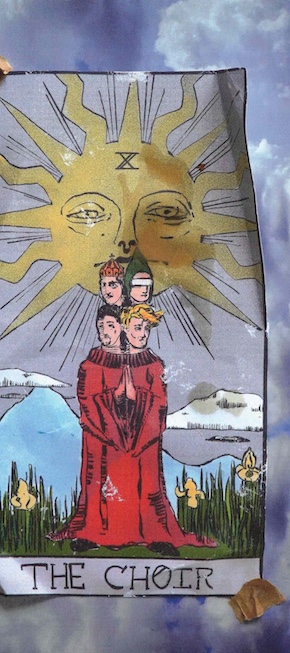
 This year’s West End Micro Music Festival opened on Friday night at Redeemer Lutheran with a programme titled Ecstatic Voices. It was a mix of works for eight part a cappella vocal ensemble and a couple of solo tuned percussion pieces.
There’s something a bit special about unaccompanied polyphony.that has fascinated composers ever since the (probably apocryphal) debate on the subject at the Council of Trent. I think a good chunk of it is the sheer versatility of the human voice which can do so much more than sing a tone. It can laugh, whistle, speak, grunt, chatter and all manner of other things and if the composers of the Renaissance were happy to stick to tonal singing more recent composers certainly haven’t been. Both were in evidence n Friday.
The ensemble was made up of eight singers (Sydney Baedke, Reilly Nelson, Danika Lorén, Whitney O’Hearn, Marcel d’Entremont, Elias Theocharidis, Bruno Roy and Graham Robinson with Simon Rivard conducting) all well capable of singing major solo roles. This was no semi-pro SATB group!
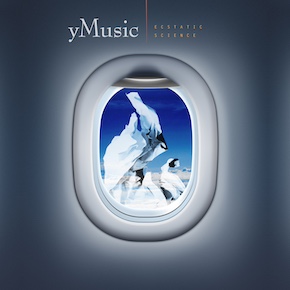 Ecstatic Science is the fourth album from New York sextet yMusic. They are a young group of really excellent instrumentalists noted for their collaborations with composers who defy easy classification. There is plenty for a composer to work with in terms of palette. The group consists of Alex Sopp – flute, Mark Dover – clarinet, CJ Camerieri – trumpet and horn, Rob Moose – violin and guitar, Nadia Sirota – viola and Gabriel Cabezas – cello. The music on the record is all by young(ish) American composers noted for their eclectic styles. So everybody involved is a first rate classically trained musician who isn’t afraid to go to non-traditional places.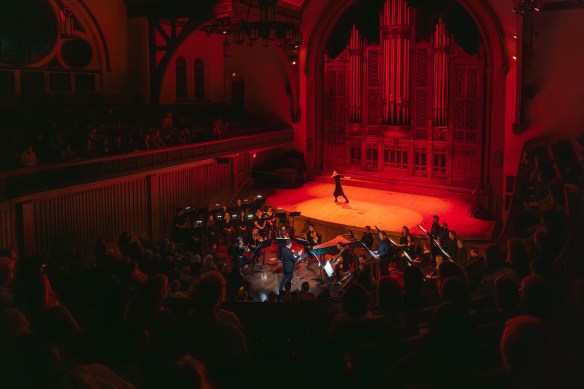
 Last night saw the final concert in this year’s West End Micro Music Festival. Once more the venue was the intimate and acoustically very good Redeemer Lutheran on Bloor West. The first half of the programme was the latest iteration of Nahre Sol (keyboards) and Brad Cherwin’s (clarinets) PAPER. Joined by Louis Pino on electronics, they improved on what paper is, sounds like, looks like and can be used for. There were electronic paper noises, crumpled paper, torn paper, piano prepared with paper and Brad creating a painting on paper and using it as an instrument. I suppose this is more “performance art” than music but it was pretty interesting.
 Back to the Royal Conservatory yesterday for the first time since the plague struck. Ironically the programme, which had originally featured the Dover Quartet with Davóne Tines, had to be rearranged at less than 24 hours notice due to one of the Dovers testing positive for COVID. What we got instead was two mini concerts. In the first half the New Orford Quartet performed works by Caroline Shaw and Mendelssohn and in the second Davóne Tines, with Rachael Kerr, performed excerpts from his Recital No. 1: MASS.

 operaramblings