Classics Reimagined

I’ve seen Robert Pomakov and the Gryphon Trio perform together a few times now and it’s always interesting.  Today’s lunchtime concert in the RBA was no exception.  Four of Mozart’s concert arias for bass and orchestra, arranged for string trio by Bohdana Frolyak, were interspersed with movements of Heather Schmidt’s Lunar Reflections; a 2008 piece commissioned by the Gryphons inspired by the moon in different seasons of the year.  It was stimulating.  The concert arias (K.432, K.513, K.512 and K.612) all showcase the bass voice with tectonic low notes and plenty of opportunity for virtuosity.  I think they suited Robert pretty well.  He’s perhaps not the most subtle of singers but he’s exciting (and loud!) and the trio accompaniment provided so much more than piano alone could.

The Schmidt piece was also enjoyable.  It’s fairly approachable and the five movements are quite varied.  The first two; Blue Moon and Pink Moon, are quite lyrical, even lush in a slightly post romantic sort of way then comes Wolf Moon which is in an altogether darker place; slower, louder and more dissonant with lots of work for the low notes on the cello.  Snow Moon continues in a slower, somewhat dissonant vein but is much lighter textured and the piece concludes quite violently with the aggressive and abrasive Thunder Moon which puts serious demands on all three players but especially the piano.  Unsurprisingly, I feel I’ve probably not done this piece justice.  I find I need to hear work of this kind more than once to fully appreciate it.

Requiem come to life?

Joel Ivany’s much anticipated “semi-staged” version of Mozart’s Requiem K. 626 finally saw the light yesterday evening at Roy Thomson Hall.  There were some interesting ideas but, ultimately, I didn’t think I came away with any new insight into the piece or life or death or anything really(*).  I’ll go into the reasons but first I should describe how it was performed.  The mass is prefaced by the slow movement from the Clarinet Quintet.  The lights go down.  The five players enter via the aisles in the audience lower level and take their seats (sadly to applause which we had been asked to refrain from).  As the quintet is played (and it was very beautiful) the players are joined by the rest of the orchestra, the choirs, conductor and soloists enter through the audience and from the wings and deposited slips of paper (I think) on two benches at front of stage left and right.  Names of the dead?  Probably and that’s a nice touch though scarcely original.  The quintet concludes.  More unwanted applause.  At this point the orchestra are seated , more or less conventionally, around the conductor with the choirs around them.  There are lots of fancy chairs.  The soloists are more or less in conventional position in front of the audience.  Everyone, except the mezzo and the soprano, are in black.  The very crowded stage is quite dimly lit in bluish tones.  As the mass progresses, the soloists interact in various ways.  The choirs gesture in rather obvious ways; the text says “king” so we pump our fists, the text talks of “writing” so we make scribbly gestures.  At some point the soloists start to rearrange the pieces of paper with the names of the dead in a sort of game of Dearly Departed Patience.  The soloists exit through the orchestra.  The lights go down.  The End.

TSO Mozart Requiem (Malcolm Cook photo)

Continue reading

The Hannigan show

Last night at Roy Thomson Hall Barbara Hannigan made her North American conducting debut with the TSO.  And, of course, she sang too.  She kicked off with Luigi Nono’s Djamila Boupacha for solo voice.  It’s a short but haunting piece inspired by a woman activist from the Algerian War.  I don’t think I’ve ever heard a solo, unaccompanied, voice in that hall and the effect is eerie.  It’s also a hell of a sing and to navigate it with utter precision is quite some feat.  As the last note died away (precisely on pitch) the violins came in with the opening Haydn’s Symphony no. 49 “La Passione”.  It starts off with an Adagio that’s curiously similar in mood to the Nono piece and Hannigan was conducting without score or baton.  In fact it was more like an interpretive dance than conventional conducting.  She has amazing arms and hands; the arms and hands of a ballerina in fact and as she summoned the strings to a sort of shimmering sound I couldn’t help but reminded of Swan Lake.  Corny perhaps but very real and quite disturbing.  And the orchestra, quite a small subset of the TSO, responded.  This was four movements of really lovely, chamber music like playing.

hannigan1 Continue reading

A lunchtime of Mozart, Strauss and Dvořák

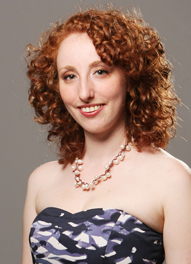
Rachel_KrehmSo there’s another free (well almost, $5 suggested donation) lunchtime concert series.  It’s Music Mondays at The Church of the Holy Trinity in Trinity Square (A most worthwhile institution which has long taken a leading role in the fight for social justice in Toronto and, on top of that, I used to play rugby with a former incumbent).  As it happens yesterday saw the last concert of the 2015 season featuring the Canzona Chamber Players, conductor Evan Mitchell, and soprano Rachel Krehm.  The Canzonas are a pretty big band, 53 players yesterday, for a chamber group (I guess they have big chambers in Canzona) and could be very loud in the rather resonant church acoustic.

Continue reading

September approaches

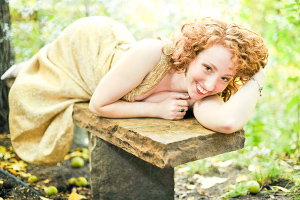
Rachel-66-pinwheel2It’s almost September which means there may even be stuff to write about soon.  Here’s what’s in my calendar so far.

August 31st at 12.15 pm there’s a concert in the Music on Mondays series featuring soprano Rachel Krehm and an orchestra conducted by Evan Mitchell performing Dove sono by Mozart, selections from Strauss Op 27 and Dvorak’s 8th Symphony.  It’s at Holy Trinity Church near the Eaton Centre. PWYC suggested $5.

Continue reading

Opera meet up

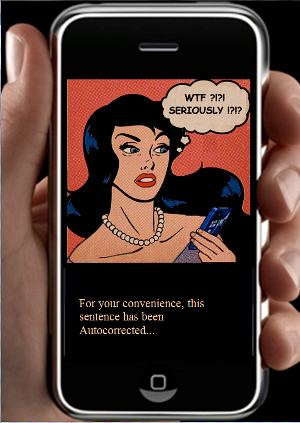
AC-handbill-frontApocalypsis was actually my second show yesterday.  Earlier in the day I was at an opera “meet up” organised by Alaina Viau of LooseTEA Music Theatre.  This was held at a bar on Bloor Street (actually inside the Intercontinental Hotel) and featured a performance of Love in the Age of AutoCorrect; an adaptation by Alaina and Markus Kopp of Mozart’s Bastien et Bastienne which first saw the light at Rosemarie Umetsu’s last August.

It was an interesting experience.  Being in a bar not closed off for the event meant that people wandered in from the hotel not expecting to be caught up in an opera performance (and they did look like typical weekend denizens of a luxury hotel).  It also meant that the performances were not exactly listened to with Mahlerian dedication.  There was a fair amount of chatter and it can’t have been easy for the trio of Greg Finney, Keenan Viau and the ridiculously cute Whitney Mather.  The acoustic wasn’t great either but these three were very funny and sang rather well and the piece is more fun Mozart’s original!

It’s a pretty cool idea really and I enjoyed it.  I wonder if it would work in a pub with decent beer rather than a bar with overpriced cocktails and crap wine?

Hands on Figaro

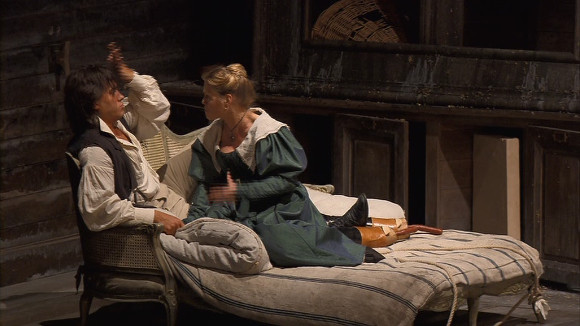
In the booklet accompanying David McVicar’s production of Le nozze di Figaro, recorded at the Royal Opera house in 2006, there’s an essay by the director in which he raises all kinds of questions about the rise of the bourgeoisie, the nature of revolution and romantic conceptions of love.  He even appears to draw a parallel between Joseph II and Tony Blair. Then he declines to explain how he has embodied all these ideas on the stage and challenges us to “Watch, listen, participate”.  Well I did and I’m none the wiser.  What I see here is an essentially traditional approach; transferred cosmetically to 1830s France but so what?  It’s darker than some Figaro’s but not nearly as dark as, say, Guth.  Curiously, the main “extra” on the disks “Stage directions encoded in the music” tees this up much more clearly than the essay.

1.figarosusanna Continue reading

Fatal attraction

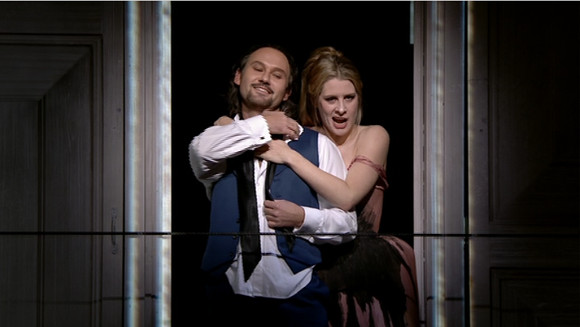
Kasper Holten’s Royal Opera House production of Don Giovanni, seen in cinemas, is now available on DVD and Blu-ray.  It’s a visually and dramatically complex production so it’s probably as well that there’s plenty of explanatory material on the disks and in the booklet.  Es Devlin’s set is a two storey structure that rotates and serves as a screen for a heavy use of video projections by Luke Halls.  These start wth the 2065 names of the women Don Giovanni has seduced and seem to be mostly about what’s going on in Don Giovanni’s head.  The sequence during Fin ch’han dal vino calda la testa is particularly spectacular.

1.balcony Continue reading

Calgary Opera announces 2015/16 season

calgaryCalgary once again offers three main stage performances.  The season opens with Delibes’ Lakmé.  It’s a Tom Diamond production so probably not very Regie.  Aline Kutan, seen as Queen of the Night in Toronto not so long ago, sings the title role with Andrea Hill as her sidekick Mallika.  Lakmé’s paramour, the handsome British officer Frederic, is sung by Canadian opera’s current answer to Rudolph Valentino, Cam McPhail.  Gordon Gerrard conducts.  There are three performances on November 21st, 25th and 27th.

Continue reading

Puzzling Così

The 2013 production of Mozart’s Così fan tutte from Madrid’s Teatro Real is one of German film director Michael Haneke’s comparatively rare forays into opera.  Naturally I was expecting a highly conceptual interpretation but, although his vision is far from conventional, Konzept found I not.  What I saw was a collection of ideas that didn’t quite cohere for me.  Costume and sets are a mix of 18th century modern.  We are in Don Alfonso’s inconsistently modernised mansion.  There are enormous 18th century paintings and chandeliers but also leatherette banquettes and the Giant Fridge of Booze.  The boys and girls wear contemporary party attire, including a rather fetching red dress for Fiordiligi, but Don Alfonso is in full 18th century gard and Despina seems to be dressed as Pierrot.  Perhaps it’s some sort of party where some of the guests have decided to do the costume thing and some haven’t?  When the boys go off to the army they do so in some sort of distant past opera version of military uniform; wigs and swords.

1.everyone Continue reading