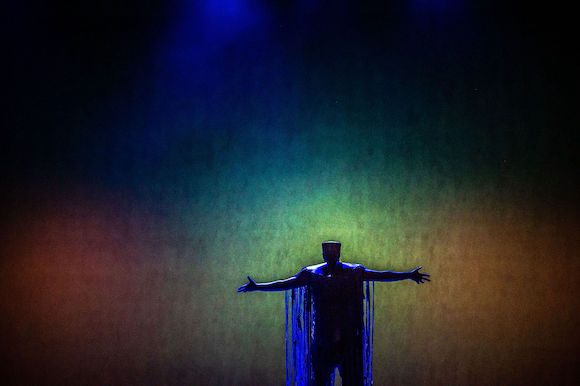
My review of Opera Atelier’s production of Handel’s La resurrezione is now up at Bachtrack. There are two more performances; tonight (8th April) at 7.30pm and tomorrow at 2.30pm.

Photo credit: Bruce Zinger

My review of Opera Atelier’s production of Handel’s La resurrezione is now up at Bachtrack. There are two more performances; tonight (8th April) at 7.30pm and tomorrow at 2.30pm.
Photo credit: Bruce Zinger
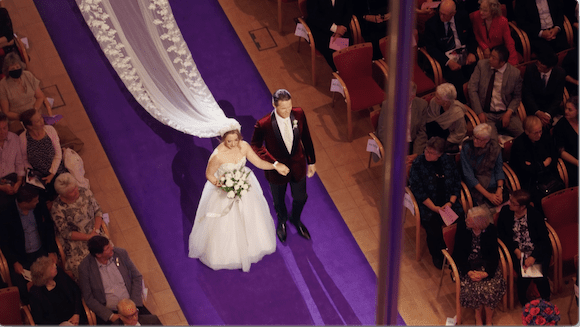
The recent recording of New Zealand Opera’s production of Handel’s Semele is unusual in several ways. First, the basis of the film is a performance in the Holy Trinity Cathedral in Auckland which leads to rather disturbing (depending on your taste I suppose) juxtapositions such as Jupiter and Semele on a bed in front of the High Altar making out like rabid weasels. The setting also makes it very hard to film because the audience is sitting in the pews and the action happens in various places in and around the audience which makes it nigh impossible for the film director to show us what the live audience saw.
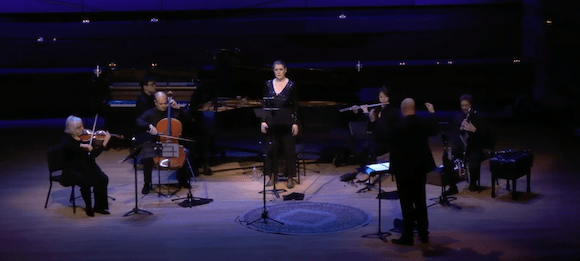
Way back in 2016 I attended a concert of Dean Burry’s music in Victoria College Chapel. The highlight of that evening was a performance by Krisztina Szabó and the Talisker Players with Bill Rowson conducting, of Dean’s setting of Alfred Noyes’ poem The Highwayman. It was performed more recently at Queen’s University, again with Krisztina, backed this time by an ensemble of Queens faculty members (flutist, Sarah Moon, clarinettist, Kornel Wolak, violinist, Gisèle Dalbec-Szczesniak, cellist, Wolf Tormann, pianist, Younggun Kim and conductor, Darrell Christi). This time it was also accompanied by some cool shadow puppetry. It was recorded for video and audio and will eventually be released on Centrediscs. This time it was preceded by chamber music by Debussy, Berg and Beethoven. The whole thing is available now on Youtube for free.
Most opera lovers will be familiar with the Drottningholm Palace Theatre near Stockholm. Less familiar is the Confidencen Theatre in the Ulriksdal Palace. It’s a small theatre (200 seats?) built in the 1650s and restored in the early 21st century. It now hosts concerts and operas and in August 2021 it played John Blow’s Venus and Adonis in a double bill with Henry Purcell’s Dido and Aeneas. The operas were recorded and issued on Blu-ray and DVD.
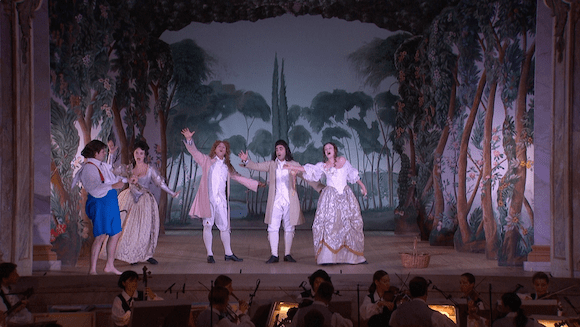
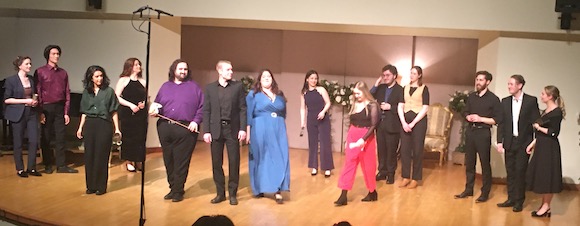
Yesterday there was an early evening performance in Walter Hall by members of the UoT Opera. Fourteen singers and two pianists in various combinations presented a total of eleven scenes. The scenes were blocked with some basic props but concert dress, or rather whatever part of the singer’s wardrobe evoked their character for them, which is probably more fun if you are singing Musetta than Dr. Bartolo.
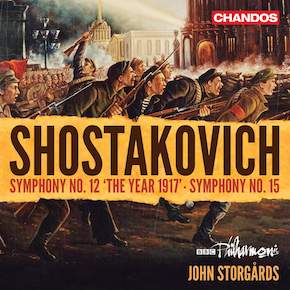 The latest release from the BBC Philharmonic and conductor John Storgårds is a generous coupling of two Shostakovich symphonies; Symphony No. 12 in D Minor (The Year 1917) and Symphony No.15 in A Major. That’s a total of 85 minutes of music. It’s also an SACD release from Chandos so technically it’s exemplary.
Really the quality of the music making and the quality of the recording reinforce each other. Shostakovich symphonies tend to be a combination of delicacy and detail coupled with stirring, even bombastic, climaxes. I was struck by just how delicate Storgårds makes his orchestra sound when he wants. There’s some really beautiful woodwind playing for instance. Then, just when I’m writing a note to myself that “this is a bit civilized for Shostakovich”, wham! In comes the brass and percussion in a shattering climax. And the contrast is so much more effective with the extended frequency and dynamic range that SACD affords. Tying it all together is a kind of restless energy that runs through both symphonies. It’s really good.
The recording was made at the BBC Media Centre in Salford in August and September 2022 and it was recorded, as Chandos do, in 24 bit, 96kHz resolution, which is what allows the full quality of SACD to emerge. The physical disk has the usual multi and 2 channel SACD mixes plus a standard res CD track. It’s also available digitally as MP# or standard and high res FLAC. The excellent booklet is also included in the digital release.
Catalogue number: Chandos CHSA 5334
Against the Grain Theatre’s presentation of Theatre of Sound’s production of Bartók’s Bluebeard’s Castle opened last night at the Fleck Dance Theatre. It’s in English translation (by director Daisy Evans) with chamber ensemble and it reimagines the piece as the story of an elderly man caring for a wife who has dementia. What’s extraordinary is that the libretto works extremely smoothly with no changes. The rooms in Bluebeard’s castle are replaced by a trunk with objects that evoke memories from the couple’s long life together. The “torture” of uncertain first love, military service, marriage, children etc. In each scene a silent, younger, Judith (there are three of them representing different ages and life stages) appears until at the end all three are on stage looking at themselves in mirrors. It’s very beautiful and very moving.

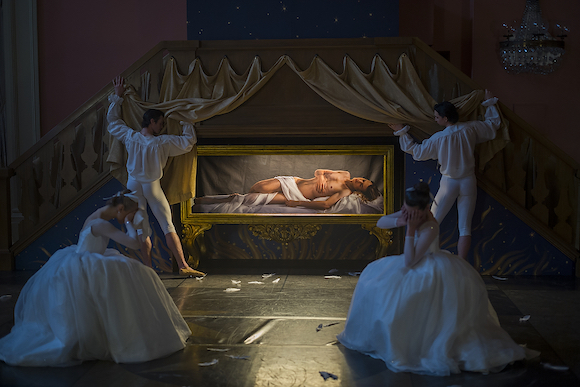
Ahead of Opera Atelier’s upcoming production of Handel’s The Resurrection (La resurrezione) at Koerner Hall next week (6th to 9th April) there was a lunchtime preview in the RBA on Tuesday. Later that day I sat down with director Marshall Pynkoski to find out more about the work, OA’s relationship to it and its rather tortuous journey to the Koerner Hall stage.
Here’s what’s coming up at Toronto Mendelssohn Choir/Singers next season.
There are a couple of shows for the TM Singers; the professional core of the TMC:

My review of Ian Cusson and Kanika Ambrose’s new opera Of the Sea is now up at Opera Canada.