Pomegranate premiere

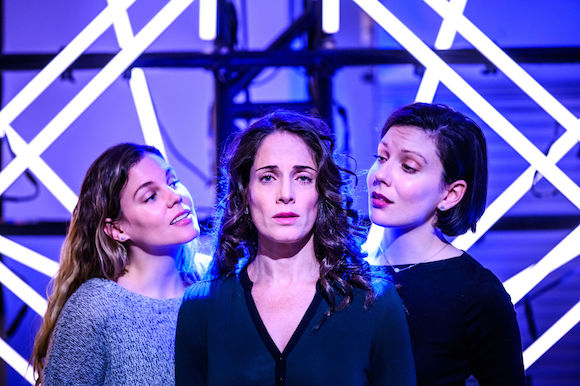
Last night Pomegranate; music by Kye Marshall, words by Amanda Hale, opened at Buddies in Bad Times.  Inspired by the Villa of Mysteries in Pompeii, it tells the story of two lesbian lovers.  Cass has broken up with Suzy in 1980s Toronto.  She visits Pompeii as a tourist and is carried back in time to meet her lover in a previous incarnation in the Temple of Isis.  There’s a whole act dealing with the Mysteries, Cassia and Suli’s burgeoning relationship and the attempt by the Roman state to suppress the religion.  Then Vesuvius erupts.  Fast forward to Act 2 in a lesbian bar in Toronto.  Suzy, an immigrant from some unspecified war zone is pressured by her family to break up with Cass.  There’s a slightly surreal byt dramatically satisfying epilogue where modern Cass reunites with Roman Sulli in the ruins of Pompeii.

Pomegranate-photobyDahliaKatz-1363

Continue reading

The Adventures of Pinocchio

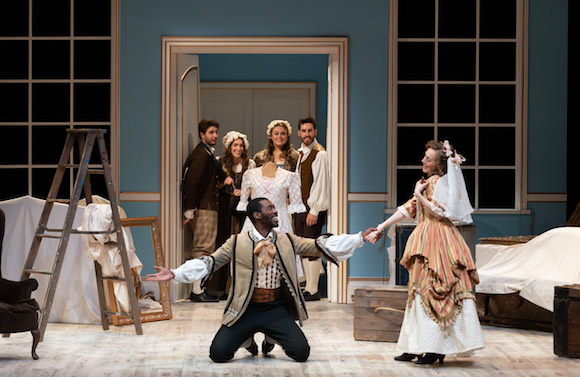
I’ve been impressed by Jonathan Dove’s art songs so I was glad to be able to take a look at one of his operas.  It’s The Adventures of Pinocchio and it was recorded in a production by Opera North at Sadlers Wells in 2008.  I feel a bit ambivalent about it.  I really like the music but I’m not hugely engaged by the libretto.  I think this is largely because of the subject matter so it may come off better for someone else.
1.pingep

Continue reading

Royal Conservatory 2019/20

ldspThe RCM 2019/20 season has been announced.  It’s the usual mix of chamber, orchestral, piano, jazz, world music, the completely indefinable and, of course, vocal.  There are 91 concerts in total.  With such a wide range of material it’s hard to imagine anybody being interested in all of it or, conversely, anybody unable to find something to their taste.  My tastes, of course, run largely to classical vocal music so what follows is what I find most interesting: Continue reading

Appropriate redress

ian-cusson__square

Ian Cusson

Two years ago when Harry Somers’ Louis Riel was revived in Toronto, Ottawa and Quebec there was considerable debate about the appropriation of a traditional Nsga’a morning song; the Kuyas.  Basically in the culture the song comes from transmission and use of songs are regulated by the traditional owners.  This particular music had been used to set the text of a lullabye that Riel’s wife sings to their child, originally without attribution.  In 2017 the decision was made to use it again though not without consultation, debate and acknowledgement.  See my comments about the issue on opening night here.

It’s fair to say that I don’t think anybody thought the status quo was really acceptable and a great deal of discussion has gone on leading to an announcement this morning that the music will be replaced in the opera by new music composed by Ian Cusson, who is of Métis and French-Canadian descent.  The whole story; whats, whys and wherefores, is contained in the linked COC press release.  It’s the right thing to do and it’s the right composer.

COC Media Release – Riel Update – FINAL

Charlotte

Two years ago Charlotte: A Tri-Coloured Play with Music was presented in workshop form (more or less) at Luminato.  It felt incomplete and rather muddled then and I didn’t write about it.  I saw the latest version yesterday at Hart House Theatre and it feels like a finished piece; indeed a rather accomplished one.

It’s a genre defying work.  Perhaps it’s closer to musical theatre than anything else but it’s not miked and there are some “operatic” moments worked into the plot.  Indeed there are some very funny musical moments and much cleverness in Aleš Březina’s score and Alon Nasman’s libretto.

Charlotte, Theaturtle

Continue reading

At the River

It was the last concert of Confluence’s inaugural season last night.  The theme was “At the River” and the venue the rather splendid (if somewhat popish) St. Thomas’ Anglican on Huron Street.  It rather epitomized what I have come to expect, and love, from this series.  The musical styles on display were eclectic; classical, folk song, pop/rock, jazz with East and South Indian, Middle Eastern and Indigenous elements all well to the fore.  There was also some poetry including an unintentionally hilarious piece in praise of the idyllic Don River.  There was also a large and accomplished ensemble and a lot of joy and sheer fun.

1200px-Madawaska_River_Whitney

Continue reading

Lutheran Masses

The final concert of this year’s Toronto Bach Festival at Saint Barnabas Anglican Church featured two of the little performed Latin masses written for Leipzig (or possibly for Count Franz Anton von Sporck of Lysá.  Sources vary).  In any event they are unusual for liturgical music.  Based on previously written cantatas for the most part, they incorporate elements not much seen in church music.

allbach

Continue reading

A second look at Shanawdithit

We went back last night for a second look at Shanawdithit.  We were sitting up much closer to the stage area this time and that did bring out some things I hadn’t noticed so much before.  It also made the role of the chorus much clearer.  That said I don’t think I’d write anything much different to my original review if I were doing so again.  But there are some additional thoughts that I want to share:

Shanawdithit2_small Continue reading

Unpacking Pandora

We went to see the opening performance of FAWN Chamber Creative’s new show Pandora at Geary Lane last night.  There’s a lot to like but it’s a dense and in some ways confusing show so I’d suggest that if you plan to go you do your homework.  So, don’t expect anything closely related to any of the many versions of the Greek legend.  That’s just a jumping off point to explain how both evil/malice and hope came into the world.  A very brief prologue in which a character discovers Pandora’s box (or jar or whatever) after centuries and releases Hope into the world sets up three scenes which each, in their own way, reflect the duality of Good/Evil, Despair/Hope or however you want to characterise it.  I strongly suggest reading the Director’s Notes and the Libretto before the show to understand what the three scenes are and where the transitions are.  There are no surtitles (money!) and not many of us can read a printed libretto in the dark.  Also, cast members change character sometimes without change of costume.  It’s helpful to know when that’s happening!  While there’s only one librettist, David James Brock, there are three composers but stylistic differences between them aren’t so obvious that one realises there has been a transition.

_DSC8799

Continue reading