
 I don’t spend a lot of time listening to disks of opera arias. I’s music I much prefer live and in context but right now a dose of good old fashioned verismo tenoring is very welcome! Piotr Beczala’s new CD Vincerò absolutely delivers it. There’s a reason this guy (normally) spends his time commuting between Vienna, Zurich, Salzburg and New York with the odd side trip to Bayreuth. He’s the real deal. There’s power to burn allied to control and proper ringing high notes. His diction is excellent too. There are no unnecessary histrionics, just top class delivery.
Vincerò
2
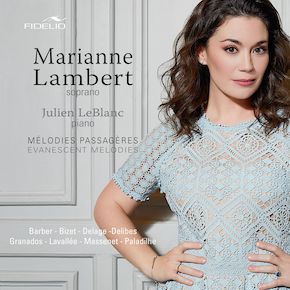 Mélodies Passagères is a new CD from Montreal based duo soprano Marianne Lambert and pianist Julien LeBlanc. Toronto folks may remember the latter as the music director/pianist for Against the Grain’s
  Living Room Music concert series is an eclectic series of events hosted by Isobel Leonard. As best I can tell they are likely to feature music in a variety of genres plus spoken word and dance. There’s a show called Grateful Embrace tomorrow at 7pm tha includes Toronto based baritone Jorell Williams. There’s lots more information on the whole series
  Those clever folks at Tapestry have just announced a “cancellation proof” 2020/21 season. Basically it’s set up so that shows can be given for a live audience or as a webstream or some hybrid solution as circumstances evolve.
 There are now many organisations and individuals regularly posting free online content to tide us over the “lockdown”. Here are some of the ones I’m keeping track of:
 There are a couple of new streams coming up today. At 3pm EST Opera North is releasing a recording of Bernstein’s Trouble in Tahiti from a couple of years ago. The main local attraction is that Dinah is played by Wallis Giunta. That one is on
  And the Snow did Lie is a multimedia artwork to be appreciated by both the eyes and the ears, using ten images for string quartet based on André Bergeron’s lithographs for Germaine Guèvremont’s French-Canadian classic, Le Survenant. The music is by Adirondack based Welsh composer Hilary Tann and it’s performed by the Sirius Quartet. It plays tonight on
 The Royal Opera House Covent Garden has started posting very high quality full length opera and ballet videos on its Youtube channel. So far there’s the
 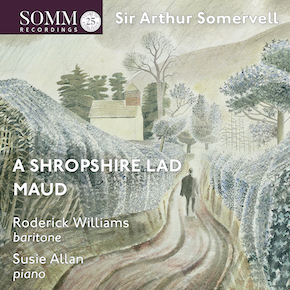 I was browsing the latest Naxos marketing material and was really intrigued by what claimed to be a disk of Tennyson and Housman settings by Sir Arthur Sullivan. It sounded too good to be true and it was. The music was by Sir Arthur Somervell; whose Housman settings I had previously encountered.
