
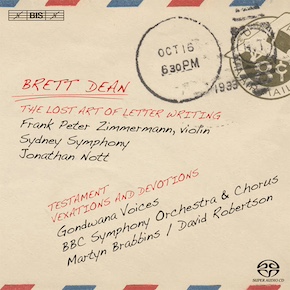
 The latest recording of Australian composer Brett Dean’s music on the BIS label contains three quite substantial pieces. The first is a violin concerto in three movements; The Lost Art of Letter Writing which is played by Frank Peter Zimmermann with the Sydney Symphony conducted by Jonathan Nott. The four movements are each inspired by a 19th century letter (the details can be found here). Collectively they form a fairly conventional concerto structure; a fast movement, a slow movement, a sort of scherzo and a very fast, busy and insistent conclusion. It’s complex, dense and chromatic music that sometimes builds tension much in the manner of Shostakovich though Dean’s way of resolving that tension is very different. It’s a really rewarding piece. Continue reading
Orchestral music from Brett Dean
Reply
 Dame Ethel Smyth’s one act opera Der Wald is certainly of some historical interest. It was the first opera by a woman given at the Metropolitan Opera. That was in 1903 and 113 years would pass before the Met did another one; Kaija Saariaho’s L’Amour de loin in 2016.
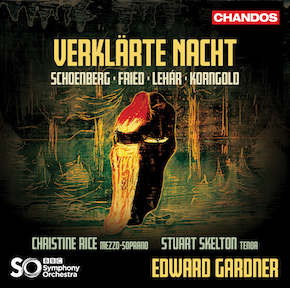 No, not Flanders and Swann but rather a well constructed new recording from Edward Gardner and the BBC Symphony Orchestra. It contains music by four composers exemplifying that lush territory that lies emotionally, if not always temporally, between Wagner and the Second Vienna School. The two central works were both inspired by Richard Dehmel’s Verklärte Nacht. The first is a 1901 setting of the text for mezzo, tenor and orchestra by Oskar Fried. It’s lushly scored and rather beautiful. The sound world is not dissimilar to Schoenberg’s Gurrelieder. Gardner gets a lovely sound from his players and some really gorgeous singing from Christine Rice and Stuart Skelton. The second Verklärte Nacht is the more familiar Schoenberg piece for string orchestra. It’s curious how without voices and with only strings it manages to sound almost as lush as the Fried.
 The latest release on the Chandos label from Sir Andrew Davis consists of three works by Sir Arthur Bliss; The Enchantress, Meditations on a Theme by John Blow and Mary of Magdala.
 That headline is taken from the eighth movement of Jonathan Dove’s 2016 work for orchestra and children’s chorus; A Brief History of Creation, which takes us in thirteen movements from the stars to man via, inter alia, rain, sharks, whales and monkeys. The text, by Alasdair Middleton, is clever, engaging and singable. The music is eclectic. There are elements of atonality but also intense lyricism. It’s by turns shimmery, frantic, doom laden and meditative. It engages beautifully with the text and Dove has a very sure sense of what is and is not reasonable to ask of a children’s choir. Some short text sections are left as spoken (with a very authentic Mancunian accent). All in all, it’s a witty and enjoyable piece that doesn’t outstay it’s 45 minutes or so.
 operaramblings