Kušej’s Elektra

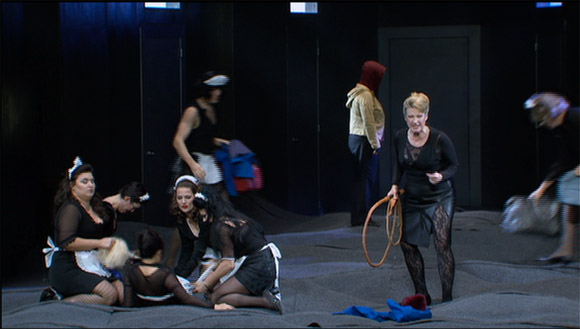
I don’t think Richard Strauss’ Elektra is an easy opera to stage.  The story is straightforward and really well known and the opera is constructed largely as a series of dialogues so designing visual and dramatic elements that enhance the drama is a real challenge.  In his 2005 production for the Opernhaus Zürich Martin Kušej tries hard to do so but rather comes up short.  Fortunately his detailed direction of the singers is effective and pretty much makes up for the “Kušej bingo card” elements of the production.
Continue reading

Chav Giovanni

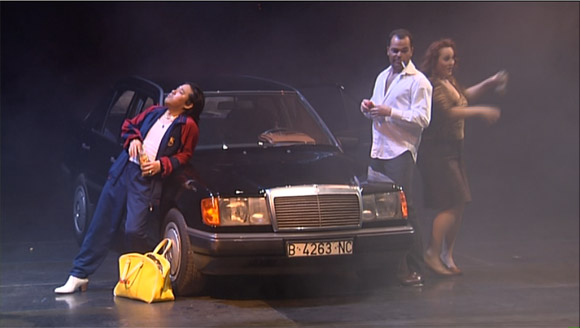
Calixto Bieito’s 2002 production of Don Giovanni from Barcelona’s Liceu theatre is a drink and drug fuelled nightmare. The general atmosphere will be familiar enough to anybody who has been around the “entertainment district” of a large city around chucking out time. Besides chemical stimulants and a great deal of enthusiastic bonking there’s also lots of violence, some of it quite disturbing, and buckets of blood but, as far as I could tell, only one rape.  It’s bold and never dull but I think it stretches the libretto to its very limits and perhaps beyond.

Continue reading

La Clemenza di Tito – Paris 2005

The Opéra national de Paris 2005 production of Mozart’s La Clemenza di Tito is very fine.  Ironically it’s actually quite a conventional production overall though one scene, the one where Tito makes his first appearance, is so weird that it provides the generic name used in some circles I frequent for an entirely inexplicable production element (see below).

Continue reading

Less than the sum of its parts

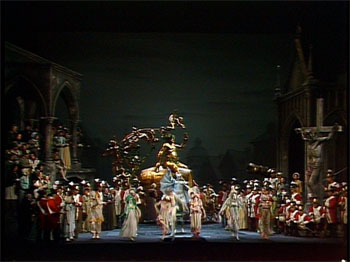
Ken Russell’s 1985 production of Gounod’s Faust at the Wiener Staatsoper makes an uneven and somewhat unsatisfying DVD.  The music making is fine, sometimes very fine, and the production has some very interesting and effective scenes but the overall concept doesn’t quite work.  Add to that quirky video direction and a picture quality that’s not good even by 1985 standards and the package as a whole just doesn’t quite make it.  It’s a shame as this is more interesting than most opera productions of the period.  Continue reading

Pavarotti and Freni in La Bohème

The audience at this 1988 San Francisco Opera production of La Bohème clearly thought very highly of it.  There is even some applause for the scenery.  I’m less impressed.  Seen as a star vehicle for Pavarotti and Freni it’s quite adequate, though both are decidedly on the mature side for Rodolfo or Mimi.  Other than that it’s rather dull, the video direction doesn’t help it any and the technical quality is no more than adequate.  Continue reading

Banned by the Nazis

Both Viktor Ullmann and Alexander Zemlinsky were among the group of composers persecuted by the Nazi regime. Ullman would die in Auschwitz, Zemlinsky in exile and obscurity.  This 2008 recording from Los Angeles Opera’s “Recovered Voices” series brings together two one act operas; Ullman’s Der zerbrochene Krug and Zemlinsky’s Der Zwerg.  in productions directed by Darko Tresnjak and conducted by James Conlon.

Continue reading

Claustrophobic and Intense Don Carlo

The first time I tried to watch Willy Decker’s 2004 production of Verdi’s Don Carlo at De Nederlandse Opera I failed to get past Rolando Villazón in doublet and hose. To anyone familiar with British TV comedy of a certain era the resemblance is just too close and I couldn’t get beyond the idea of Stephen Fry as Felipe II and Miranda Richardson as Elisabetta. This time around I watched the highly illuminating video introduction and read Wily Decker’s useful essay on his production concept before tackling the piece proper. I’m glad I did that and I’m glad I came back to this recording because it is very fine and it was very useful to have Decker and Chailly’s perspectives on the dramaturgy and the music.

Continue reading

Conspicuous Consumption

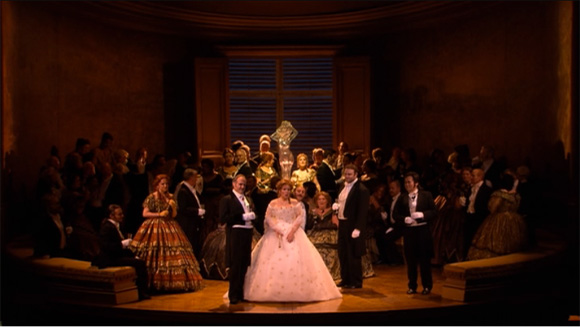
Richard Eyre’s production of La Traviata at the Royal Opera House, filmed in 2009, is a pretty good example of how to do a traditional production.  There’s nothing conceptual or thought provoking to it but the direction is careful and tells the story clearly and well.  The designs are mid 19th century with crinolines and tail coats but with the odd imaginative touch and a welcome refusal to succumb to the “more stuff” syndrome that plagues so many Verdi and Puccini productions.  Backed up by excellent music making it probably makes a near ideal introduction to the piece, even if it won’t entirely displace Willy Decker’s brilliant and disturbing Salzburg production in my affections.

Continue reading

Karajan’s Otello

So, another lip synched film from the 1970s. This time it’s Verdi’s Otello starring Jon Vickers and Mirella Freni.  What makes this one a bit different is that Herbert von Karajan not only conducts but directs as well.  It’s a curious piece with fantastic music making but no real production concept, continuity errors, some very dodgy acting and puzzling cinematography in places.  It’s never dull though.  Continue reading

Ballet/Opera Fusion

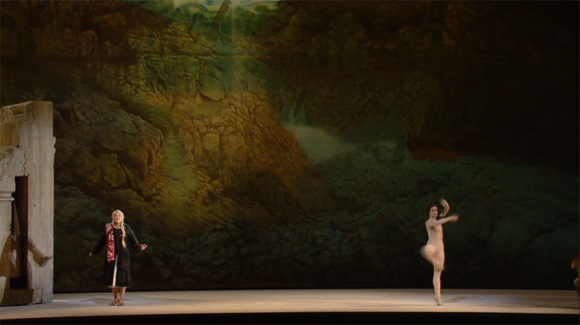
Handel’s Acis and Galatea is a peculiar piece in some ways.  It was written to be performed at Cannon’s, the Edgware residence of the then Earl of Caernavon, presumably for his guests.  Apparently the performance style was to have the singers sing from music stands in front of a painted backdrop.  So, a sort of oratorio with curtains.  It’s not uncommon to stage Handel oratorios as opera these days.  Theodora is done quite often and even Messiah has been staged so it’s no great surprise that Acis and Galatea should be given a similar treatment.  In fact Wayne McGregor’s 2009 Covent Garden production stages it as an opera and a ballet simultaneously combining the resources of the Royal Ballet and the Royal Opera.

Continue reading