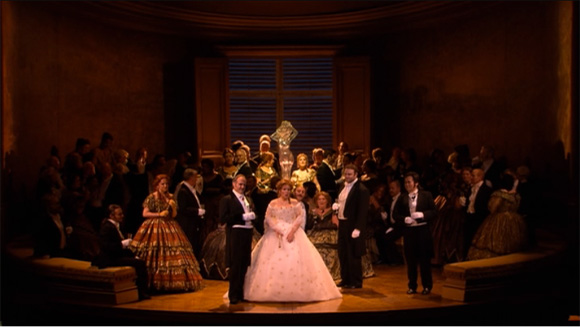
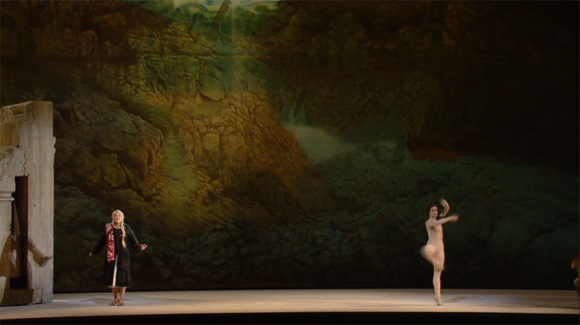
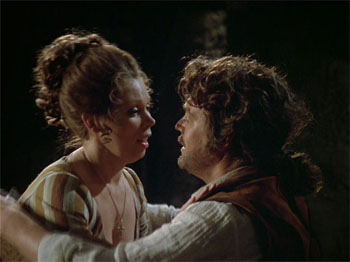
Both Viktor Ullmann and Alexander Zemlinsky were among the group of composers persecuted by the Nazi regime. Ullman would die in Auschwitz, Zemlinsky in exile and obscurity. This 2008 recording from Los Angeles Opera’s “Recovered Voices” series brings together two one act operas; Ullman’s Der zerbrochene Krug and Zemlinsky’s Der Zwerg. in productions directed by Darko Tresnjak and conducted by James Conlon.
Category Archives: DVD review
Claustrophobic and Intense Don Carlo
The first time I tried to watch Willy Decker’s 2004 production of Verdi’s Don Carlo at De Nederlandse Opera I failed to get past Rolando Villazón in doublet and hose. To anyone familiar with British TV comedy of a certain era the resemblance is just too close and I couldn’t get beyond the idea of Stephen Fry as Felipe II and Miranda Richardson as Elisabetta. This time around I watched the highly illuminating video introduction and read Wily Decker’s useful essay on his production concept before tackling the piece proper. I’m glad I did that and I’m glad I came back to this recording because it is very fine and it was very useful to have Decker and Chailly’s perspectives on the dramaturgy and the music.
Conspicuous Consumption
Richard Eyre’s production of La Traviata at the Royal Opera House, filmed in 2009, is a pretty good example of how to do a traditional production. There’s nothing conceptual or thought provoking to it but the direction is careful and tells the story clearly and well. The designs are mid 19th century with crinolines and tail coats but with the odd imaginative touch and a welcome refusal to succumb to the “more stuff” syndrome that plagues so many Verdi and Puccini productions. Backed up by excellent music making it probably makes a near ideal introduction to the piece, even if it won’t entirely displace Willy Decker’s brilliant and disturbing Salzburg production in my affections.
Karajan’s Otello
So, another lip synched film from the 1970s. This time it’s Verdi’s Otello starring Jon Vickers and Mirella Freni. What makes this one a bit different is that Herbert von Karajan not only conducts but directs as well. It’s a curious piece with fantastic music making but no real production concept, continuity errors, some very dodgy acting and puzzling cinematography in places. It’s never dull though. Continue reading
Ballet/Opera Fusion
Handel’s Acis and Galatea is a peculiar piece in some ways. It was written to be performed at Cannon’s, the Edgware residence of the then Earl of Caernavon, presumably for his guests. Apparently the performance style was to have the singers sing from music stands in front of a painted backdrop. So, a sort of oratorio with curtains. It’s not uncommon to stage Handel oratorios as opera these days. Theodora is done quite often and even Messiah has been staged so it’s no great surprise that Acis and Galatea should be given a similar treatment. In fact Wayne McGregor’s 2009 Covent Garden production stages it as an opera and a ballet simultaneously combining the resources of the Royal Ballet and the Royal Opera.
Frock Opera
Giordano’s Fedora is a sort of apotheosis of the 19th century Italian opera. It’s a melodramatic love story in an aristocratic Russian setting. There is murder and suicide and plots and a dead mother and brother. The music is dramatic, even bombastic, when the mood suits but finds time to give showpiece arias for the principals. There is not a single idea in libretto or score that could give anyone an uncomfortable thought. The Metropolitan Opera’s 1996 production by Beppe di Tomasi builds on this by playing it dead straight and setting it in a series of suitably opulent settings complete with extravagant frocks. The cherry on the already rather rich cake is casting Placido Domingo as Loris Ipanoff and Mirella Freni as Fedora Romazoff. I imagine it’s many people’s idea of the perfect night at the opera In it’s way it’s the polar opposite of, say, Bieito’s Wozzeck. Continue reading
A rather straightforward Cenerentola
Rossini’s La Cenerentola takes almost three hours to tell a very straightforward version of the Cinderella story. Generally directors, despairing of the this, either camp it up (for example the Els Comediants production seen, inter alia, in Houston and Toronto in recent years) or they try to find a few more layers of meaning as in Ponnelle’s film version. Michael Hampe does neither in his 1988 Salzburg production, preferring to tell the story as a straightforward morality tale. I guess if one really loves the music and it’s really well sung this could work but, ultimately, I found it rather dull. Continue reading
Pulp Figaro
Today’s Ponelle production is the 1976 Le Nozze di Figaro. It has the starriest cast of any of the Ponelle films I’ve seen to date; Herrman Prey in the title role, Mirella Freni as Susanna, Kiri Te Kanawa as the countess and Dietrich Fischer-Dieskau as the count. It even, rather bizarrely, has Maria Ewing as Cherubino. To round things out Karl Böhm conducts with the Wiener Philharmoniker and Staatsopernchor. As we shall see, musically it lives up to the casting. Continue reading
Superbly sung Butterfly with Mirella Freni and Placido Domingo
Continuing the Jean-Pierre Ponnelle marathon we come to his 1974 film of Puccini’s Madama Butterfly with Mirella Freni in the title role and a young Placido Domingo as Pinkerton. Musically this is the most satisfying of the Ponelle productions I’ve yet come across. Freni is superb. Radiant is not too strong a term, Domingo sings pretty much as well (we’ll come to points of dramatic interpretation later) and the supporting cast is flawless. There’s some serious luxury casting here with Christa Ludwig as a superb Suzuki. Robert Kerns is an excellent Sharpless and Michel Sénéchal equally good as Goro. Herbert von Karajan conducts. He tends to go for sheer beauty of sound rather than maximum drama but what beauty of sound! The soloists are wonderfully backed up by the Wirner Philharmoniker and the Staatsopernchor. Continue reading
In which I fail to ‘get’ dubbed opera films
I’ve reviewed a fair few films of operas on this blog. They have all been of a kind where a director rehearses a cast they record the opera in the studio and then film a lip synched version either on set or on location. There are also films where the opera is recorded in the studio thenan entirely different cast mimes the opera on location. Petyer Weigl’s 1988 film of Tchaikovsky’s Eugene Onegin comes into this category. It started life as a perfectly normal studio recording and then Weigl filmed it on location, presumably in Russia, and in the process cut nearly a quarter of the music. The approach doean’t work for me. However good the film actors are, they look like film actors miming someone else and in so doing much of the interpersonal drama is lost. The result is that it’s like listening to the CDs with eye candy. Continue reading