Creepy and claustrophobic Wozzeck

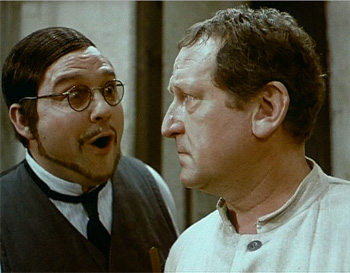
In 1970 Rolf Liebermann took the assembled forces of the Hamburg State Opera down to a castle in South Germany and made a film of Berg’s Wozzeck.  The production is pretty literal.  It’s set in Austria in the late 19th century and everything plays out very literally per the libretto but it’s far from being a routine or dull reading.  A combination of brilliant conducting, slightly over the top acting, pointing up the Expressionist elements in the music and really good cinematography make this a very tense, creepy and claustrophobic experience.  It’s simultaneously rather repellent and hard to watch and deeply engaging.  Continue reading

A gentler Lady Macbeth?

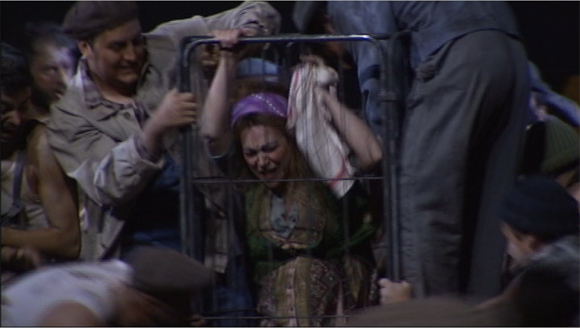
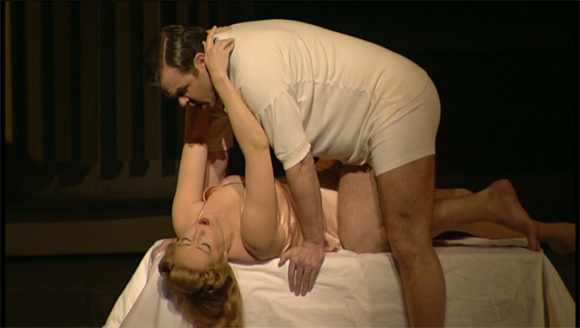
Stein Winge’s 2002 production of Shostakovich’s Lady Macbeth of the Mtsensk District at Barcelona’s Liceu is fairly straightforward in a minimalist sort of way.  The first scene establishes the tone for sets.  There’s a bed and a window and that’s about it.  The succeeding eight scenes are equally stark.  There’s an unusual, and disturbingly creepy, sexual tension between Katerina and Boris Ismailov; played here less boorishly than usual by Anatoli Kotcherga.  The three “difficult” scenes; the rape of Aksinya, the seduction and the death of Katerina are all handled pretty well.  It’s all less “in your face” than Martin Kušej’s Amsterdam production but it’s effective.  There’s also an element of “black slapstick”, especially in the scenes involving the police, that seems to fit the music rather well. Continue reading

Orlando in Craiglockhart

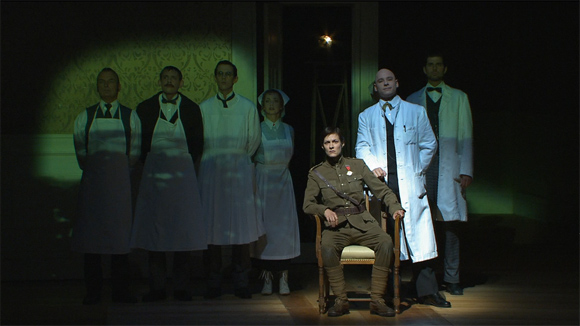
Handel’s Orlando is pretty classic opera seria stuff.  It’s based on an episode in Ariosto’s Orlando Furioso.  Orlando, a great soldier in Charlemagne’s army has lost his ardour for military glory because he has fallen desperately in love with the pagan princess Angelica, who is in turn in love with another man, Medoro. Orlando cannot accept this and he is driven to madness, prevented from causing absolute carnage only by the magician Zoroastro (who eventually restores his sanity).  There’s also a shepherdess, Dorinda, who is also in love with Medoro, but comes to accept her lot.  It’s all a bit daft and screams for a strong production concept.  In his 2008 Zürich production Jens-Daniel Herzog finds one.  He relocates the action to a military psychiatric hospital during, or just after, WW1.  Orlando is suffering from battle fatigue or PTSD and Zoroastro is a psychiatrist.  Angelica is still a princess but Dorinda has become a nurse.  It all works rather well.

Continue reading

Chill out dude

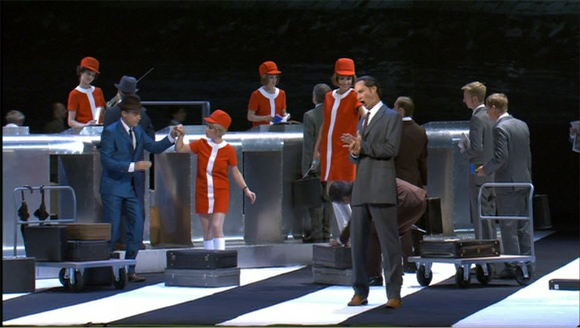
The problem with reviewing Doris Dörrie’s 2002 Berlin production of Così fan tutte is that pretty much everything that can be said about it already has been.  It’s like trying to write about Willy Decker’s “red dress” Traviata.  So I’ll try and be brief and to the point.  On the surface the idea is a bit outlandish.  Mozart and da Ponte’s satire about sexual fidelity is updated to the 1970s though to me, who grew up in the 70s, it seems much more like the 60s.  That said, it works.  It’s lively, funny, musically top notch and the presentation on DVD is very decent.

Continue reading

Almost ideal Idomeneo

The 2006 Salzburg production of Idomeneo seems to me to be just about ideal.  The production is clean and consistently interesting without ever getting too far away from the core story and the pretty much unbeatable cast is backed up by the period sensibilities of Roger Norrington and the Salzburg Camerata and Bachchor.  The only fly in the ointment is the utterly heinous video direction.

Continue reading

Boulevard Solitude

My DVD of Hans Werner Henze’s Boulevard Solitude arrived the day before his death at the weekend and so went straight to the top of the reviewing pile.   It’s an intriguing piece.  It’s based on the same Abbé Prevost novel as all the other versions of Manon but updated to the period of composition (1952) and told from the viewpoint of des Grieux rather than Manon.  In this version des Grieux picks Manon up at a railway station while she is on her way to finishing school in Lausanne.  They run away to Paris but des Grieux is broke and Manon’s brother pimps her to a rich old man, Lilaque.  The brother robs the old man’s house which gets them both kicked out.  Manon has a brief fling with des Grieux before her brother pimps her out again; this time to Lilaque’s son.  By this time des Grieux has a pretty serious cocaine problem.  The cocaine, naturally, is supplied by Lescaut.  Lescaut is in the process of stealing a painting from Lilaque fils when Lilaque père shows up.  Lescaut hands Manon a gun and she kills the old man.  In the last scene we are back at the railway station where a disconsolate des Grieux waits for one last glance at Manon as she is taken to prison.

Continue reading

Rosenkavalier on the brink

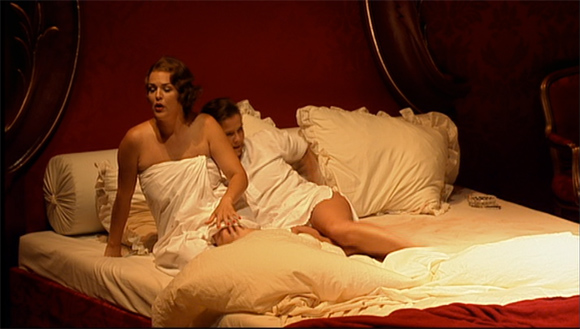
Robert Carsen’s 2004 production of Der Rosenkavalier at the Salzburg Festival was apparently enormously controversial at the time.  In many ways that says more about the iconic status of the piece in Salzburg tradition than about Carsen’s production.  There are a few controversial elements.  He has updated the period to 1914 and the third act is set in a brothel with a fair amount of nudity.  Beyond that, the production is pretty faithful to the libretto and has, I think characteristic Carsen touches like long lines of tables and chairs and a certain geometric elegance.  He seems to be using the sides of the stage to comment on the action which tends to be fixed centre stage.  I say seems because the video direction (by Brian Large) is utterly perverse and makes it extraordinarily difficult to see what Carsen is doing, let alone decode it.  We see the whole stage, maybe, for three seconds in the whole piece.  Otherwise 99% of what we get is either close up and even closer up or apparently shot from the restricted view seats high up and close to the side of the stage.  The other 1% is just plain nuts and includes a section of the Sophie/Octavian duet in Act 2 where, on stage, Octavian is maybe twenty feet to Sophie’s right but on camera he’s standing right up close on her left hand side.  I could go on but I won’t.  Suffice it to say the video direction comes close to wrecking an otherwise excellent DVD.

Continue reading

Rigoletto in Zürich

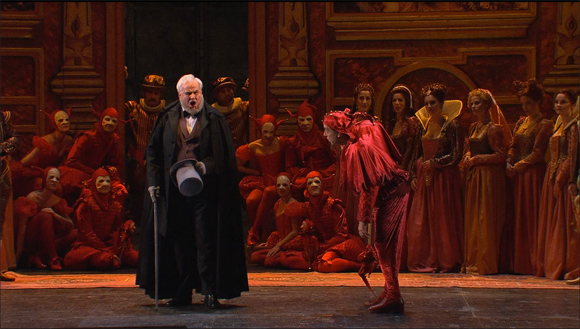
This is another of those Arthaus Blu-ray disks that’s sold at a silly cheap price as a carrier for two hours of trailers from the Arthaus catalogue.  That said, it’s very high quality indeed.  GIlbert Deflo’s production is, in the end, quite conventional though with careful and effective Personenregie.  He does trick us a bit at the start.  The scene opens with what is, apparently, a rather louche 16th century court entertainment/orgy.  There are bare breasted women and dancers of both sexes dressed as Satanic imps.  Everyone is in period costume including Rigoletto with jester hat, bells etc.  The scene is, perhaps, what we expect.  The “ladies” are very receptive to the duke’s advances.  The men are resentful but not actively so.  Then in comes Monterone in mid 19th century dress to denounce the proceedings and we, perhaps slowly, realise that this is a costume party.  From there on there’s nothing very tricksy.  The story gets told effectively and straightforwardly.  We have been pulled, effortlessly, from the time of the libretto to the time of first performance and the parallels are drawn.

Continue reading

The dream is over but the night not yet

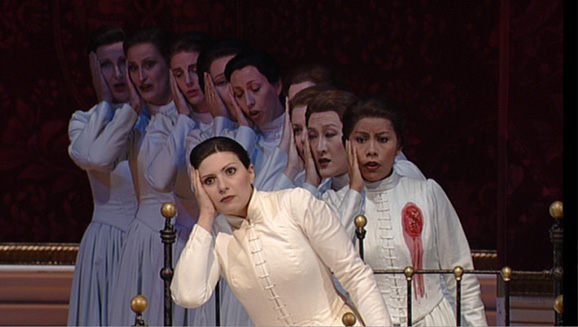
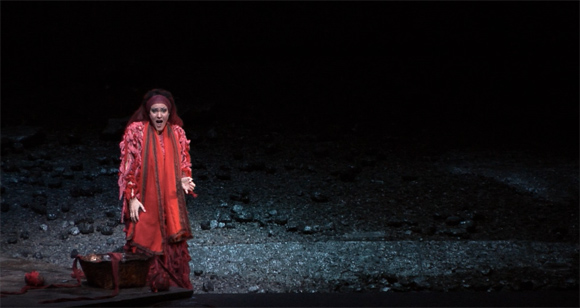
So closes Aribert Reimann’s 2010 opera Medea.  It’s a two hour piece in four “pictures” that premiered at the Wiener Staatsoper in 2010 and the Blu-ray/DVD recording is taken from that initial run.  Actually there’s a good deal more nightmare than dream in this version as, I suppose, there is in just about any version of the Medea story.  This one draws on Franz Grillparzer’s version for the libretto and is entirely concerned with events after Jason and Medea reach Corinth.  It’s unusually sympathetic to Medea herself with Jason and Kreon very much the villains.

Continue reading

A journey through space and time?

Tan Dun’s Marco Polo is hugely ambitious. He uses Marco Polo’s legendary journey as a metaphor for Space and Time.  He fuses a range of Western musical styles with Chinese, Tibetan and Indian instruments and vocal styles.  Although most of the work is sung in English there are sections in Italian and Chinese and other bits in a sort of random polyglot.  The cast includes a range of real, allegorical and psychological figures.  Marco and Polo are in fact two characters; one representing action and the external and the other the psychological and internal.  Kublai Khan, Dante, Shakespeare, Sheherazada and Mahler put in appearances and much of the narrative is carried by a Chinese opera singer playing the part of Rustichello; “the questioner”.  To be honest, despite having read the booklet, watched Reiner Moritz’s “Making of” documentary and studied the chart below, most of the time I had no idea what was actually happening.  It’s really all too abstract and involved to really work as music drama.

Continue reading