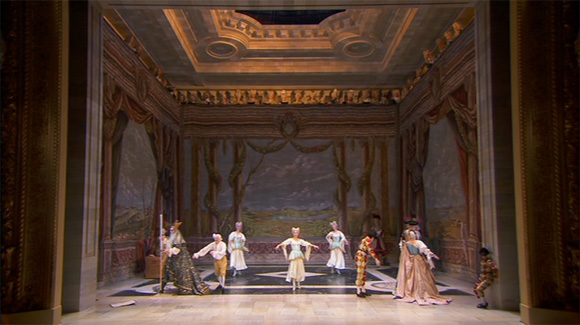
Hans Werner Henze conceived of L’Upupa und der Triumph der Sohnesliebe as his farewell to the stage although, as it turned out, it wasn’t. It’s a combination of Arabian Nights type themes crossed with elements from German folklore not unlike Die Zauberflöte, which is an obvious infuence. So obvious, in fact, that in the scene where Kasim rescues his beloved she is given a line straight out of Schikaneder. For the 2003 world premiere in the Kleinesfestspielhaus in Salzburg, director Dieter Dorn and designer Jürgen Rose chose a simple stage concept. The action is encircled by an arch, at the apex of which is a tower room. The old man, the ruler of the principality, inhabits the room. The action mostly takes place in brightly coloured scenes under the arch.
Category Archives: DVD review
There were rats
I guess Lohengrin is one of those operas that’s so loaded up with symbols it just begs directors to deconstruct it. Well that’s what Hans Neuenfels’ Bayreuth production, recorded in 2011, does and then some. There is so much going on in this production that I think it would take many viewings to really get inside it. The bit most critics have fastened on is the costuming of the chorus as rats or, on occasion, half rat, half human. It’s visually interesting and since there are also ‘handlers’ in Hazmat suits it’s clear that some sort of experiment is being alluded to. Add in bonus rat videos at key points and there’s a lot to think about. One thing this does do is solve the Teutonic war song problem. A chorus of rather timid looking rats singing with martial ardour is a good deal less Nurembergesque than a similar chorus in armour or military uniforms. Rats aside the story is really told in a quite straightforward and linear way while providing all sorts of moments that one might want to interrogate further,
Staging Messiah
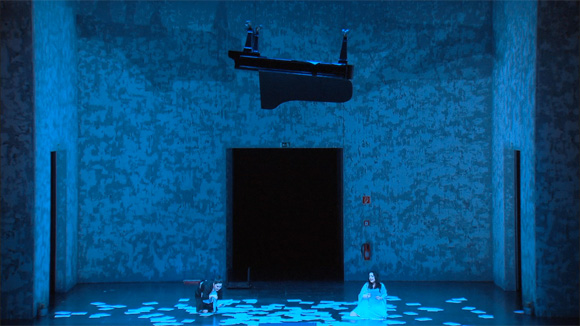
It’s a rare and valuable experience when a performance makes one reconsider a perhaps overly familiar work. That’s the effect that Claus Guth’s 2009 staging of Handel’s Messiah had on me. I don’t think that there is any piece I’m more familiar with than Messiah. I feel like I’ve known it all my life. I’ve sung it. I own a vocal score (rare indeed for me!). I couldn’t begin to count how many times I’ve heard it. And yet here it came up entirely fresh and had me thinking about it in completely new ways.
Do not expect the form before the ideal
That headline is pretty typical of the English translation of the libretto of Schoenberg’s Aron und Moses. “Holy is genital power” is another gem. The whole thing is basically an extended debate about the nature of God with Moses arguing for an extreme degree of abstraction and Aron championing a more populist version that “the people” can relate to. There are ideas in there that could probably be staged quite spectacularly, such as the Golden Calf scenes and a spot of human sacrifice. There’s even a fairly decent opportunity for an orgy. In their 1975 film Daniele Huillet and Jean-Marie Straub reject any opportunity for visual excess or even representation almost as rigidly as Moses himself.
Can’t get no Atisfaction
Despite also featuring William Christie, Les Arts Florissants and François Roussillon, the 2004 Châtelet production of Rameau’s Les Paladins could hardly be more different from the recording of Lully’s Atys that I reviewed yesterday. The work is based on Orlando Furioso and is an utterly anarchic parody of pretty much everything that Rameau had previously written. It was considered shocking in its day. The production by José Montalvo with choreographic help from Dominique Hervieu is completely mad and tremendous fun.
L’opéra du roi
Lully’s Atys was, apparently, Louis XIV’s favourite opera. It’s not hard to see why. Within the rigid conventions of its time and place it really is rather fine. The plot is classical and convoluted. After an allegorical prologue celebrating Louis’ successful winter campaign in the Low Countries we get the story proper. The hero Atys loves the nymph Sangaride, daughter of the god of the river Sangar, who returns his affection She is betrothed to Celenus, king of the Phrygians. The goddess Cybèle fancies Atys and makes him her high priest. Atys uses his position to nix the wedding which upsets both Cybèle and Celenus. Cybèle blinds Atys who kills himself but is immortalised by being turned into a tree by Cybèle. All of this takes over three hours with lots of ballets and other set pieces. The music is French 17th century court music so it’s a bit unvaried but much of it is very fine indeed.
Full of sound and Furies
When I first encountered Richard Strauss’ Elektra as a teenager I found the music almost unbearably harsh. The more I listen to it the more erroneous that judgement seems. It has its “tough” moments to be sure. How could an opera about Elektra not? But it is also full of lush romanticism and there are some really quite lovely passages. In the 2010 Salzburg Festival recording Daniele Gatti explores both sides of the music in a rather thrilling reading of the score aided and abetted by the Wiener Philharmoniker and a pretty much ideal cast.
Gerry Finley’s Don Giovanni
Jonathan Kent’s 2010 Glyndebourne production of Don Giovanni has a great cast and high ambitions but, ultimately, doesn’t really come off, largely because the relationships between the characters too often fall short of anything interesting. The concept, as explained in the two short bonus segments, is that Don Giovanni is set in a society in transition and that the title character is a sort of harbinger of the new mores. The “society in transition” chosen by Kent is a sort of hybrid of Fellini’s La Dolce Vita and the last years of Franco’s regime in Spain. He might have done better to just pick one as the Fellini elements get pretty much reduced to the costumes and the Franco elements really don’t go anywhere.
We’ll meet again in a better world
Richard Strauss’ last opera Die Liebe der Danae has a pretty chequered production history. It was scheduled to premiere at the 1944 Salzburg Festival but that was scuppered when all theatres were closed following the July bomb plot. A special exception was made for Die Liebe der Danae in that a single, public dress rehearsal was allowed at the conclusion of which Strauss is said to have bid farewell to the Wiener Philharmoniker with the words quoted in the title. It then remained unperformed until the 1952 festival where it got its true premier followed by productions over the next two years in most major European houses. After that it pretty much dropped out of the repertoire with occasional performances in Germany but apparently the production recorded at the Deutsche Oper Berlin in 2011 is only the sixteenth production all told. It’s a bit hard to see why it has been so neglected. The music is perfectly good Strauss though maybe it lacks a headline aria of the “Es gibt ein Reich” variety. Maybe the subject matter was just too frivolous for the immediately post-war world; it’s described as “A Joyful Mythology in Three Acts”. In any event, I was happy to discover it.
It’s the only Iphigénie in town
Claus Guth’s 2001 Zürich production of Gluck’s Iphigénie en Tauride is, rather surprisingly, the only video recording of the work currently available. Fortunately it’s a very decent production much preferable to the Met’s over-stuffed overly literal version but not, I think, to be preferred over Robert Carsen’s stark and elegant version seen in Toronto, Washington and elsewhere. The Zürich performance, led by William Christie, is very good but it’s rather let down by the video direction and the production for DVD.