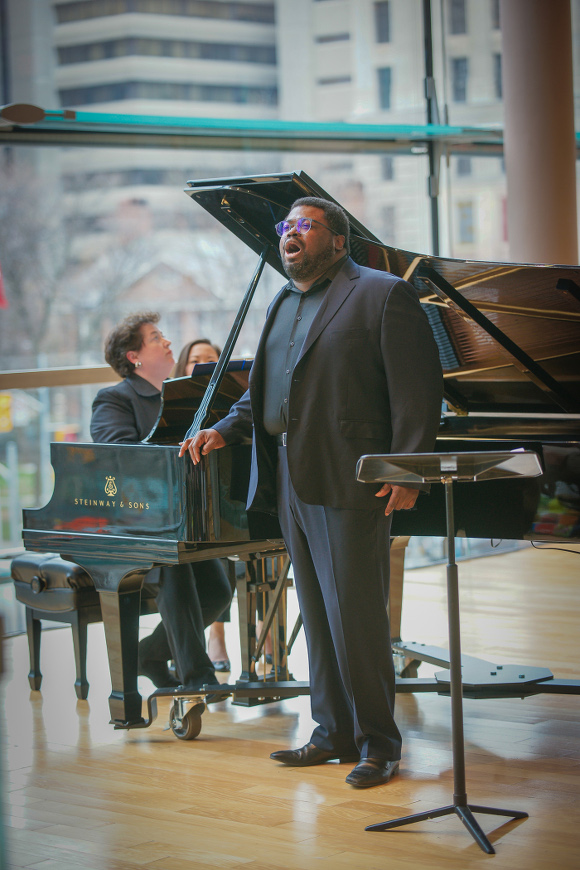
To 918 Bathurst last night to hear the Happenstancers’ latest offering Hypersuite. The concept was to take movements from Bach suites and partitas for solo instrument and combine them into sets with (mostly) contemporary music of like form. The one exception was some Telemann but we’ll come to that.
So the first set consisted of cellist Sarah Gans playing Ana Sokolovic’s vez before a brief segue brought in Katya Poplanskaya on violin for the adagio from Bach’s Violin Sonata BWV 1005. It’s really interesting as, although the Sokolovic piece uses a fair amount of extended technique there’s a definite sense that they belong to the same soundworld. Both are spare and spiky and eschew anything that might conventionally be called melody.
 The second set had a lot in common with it. Brad Cherwin on clarinet played Augusta R. Thomas’ d(i)agon(als) followed by the sarabande from Bach’s Partita BWV 1013 (usually played on flute). This segued into Telemann’s fantasie 8 played on English horn by Aleh Remezau. Completely different from the first set; more melodic and dance like, these three pieces also had much in common.
The second half kicked off with The allemande from BWV 1013 on clarinet, followed by Sokolovic’s cinq danze, II on violin and the gigue from from BWV 1008 on cello. Here there is more contrast with the Sokolovic exploring a more complex sound world though still with clear affinities to the Bach. This was followed by Elliott Carter’s a 6 letter letter on English horn. It’s a quite long and complex piece which clearly places serious physical demands on the player. Continue reading
 There’s no shortage of pandemic inspired music out there but I figured I wanted something that more closely evoked the sheer madness of life in Ontario right now. So, I turned to a 1969 piece by my fellow Manc Peter Maxwell Davies. It’s his Eight Songs for a Mad King inspired by that nutty old Hanoverian George III. The genesis of the piece is quite complex. It involves a music box, once owned by the king but by 1968 in the possession of the historian Steven Runciman. Once used by the king in an attempt to teach bullfinches to sing, it provides the inspiration for the eight “tunes” that make up the Eight Songs. The libretto is largely drawn from the king’s own words and other contemporary sources.
 This just in: