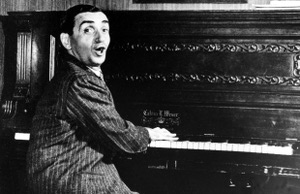
Yesterday the Talisker Players ventured into new territory for them with a program of Irving Berlin songs entitled Puttin’ on the Ritz. I’m no expert on Broadway in general or Tin Pan Alley in particular but, I suppose like most people, I’ve been exposed to a lot of this music through TV and films. The Talisker presentation was interesting and unusual in that they employed a string quartet and two classically trained singers rather than a dance band or a pianist and voices from a different tradition.
Tag Archives: jones
Chéreau Ring – Götterdämmerung
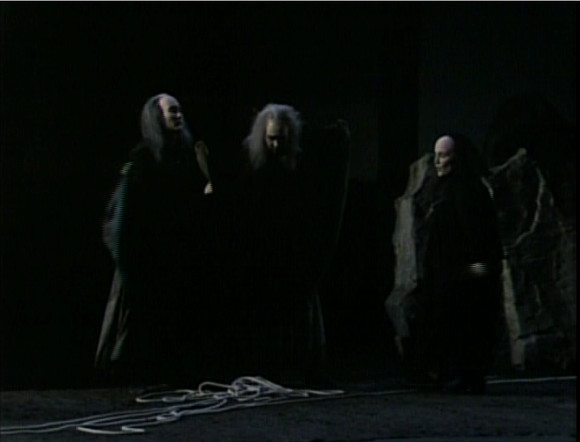
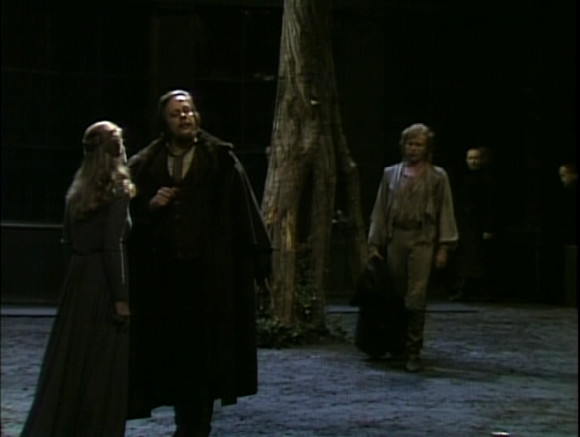
And so, at last to Götterdämmerung. The scene with the Norns is dark, very dark. There’s a rope and not much goes on (at least that is visible) but the singing is good. The “dawn” scene comes off more effectively here than the final scene of Siegfried but it’s still not great. I think the problem is a combination of Manfred Jung’s dry, rather nasal tone and Boulez rather fast tempu. It seems rushed rather than ecstatic and the Rhine Journey doesn’t thrill. I was concerned at this point that I was being unfair to a renowned production so I put on the same scene from Kupfer/Barenboim. It’s much better. Siegfried Jerusalem sounds truly heroic, Anne Evans richer tone blends better than Gwyneth Jones’ (though this could be an artefact of the recording) and, crucially, Barenboim gives the singers room to sing before markedly speeding up for the orchestral music. At least there is no naff attempt to depict a literal Grane in Chéreau’s version. At the conclusion of this scene Brian Large pulls off the first of his artsy effects. During the Rhine music he holds a close up of Brünnhilde for a rather long time before pulling out to a full stage shot which he then shrinks until there is just a tiny square of picture in the middle of a black screen which, when he slowly expands it, has transformed to the Gibichung hall. He does the same thing a couple more times. It seems odd to introduce that kind of thing at such a late stage in the cycle.
Chéreau Ring – Siegfried
Chéreau’s Siegfried is even less obviously “industrial” than his Die Walküre. There’s a forge of course but there rather has to be. Other than that we get workshop, forest and lair pretty much as one might imagine until, of course, we end up back at the ruin where Brünnhilde waits. Brian Large injects lots of smoke at every opportunity.
Chéreau Ring – Die Walküre
The second instalment of Patrice Chéreau’s 1980 Bayreuth Ring cycle is set, like Das Rheingold, in a sort of industrial bourgeois late 19th century. One would almost say steampunk if that were not an anachronism. Actually the “industrial” side is much less evident than in the earlier work. There’s a sort of astrolabe/pendulum thing in Valhalla but that’s about it. Setting aside, the story telling is very straightforward; so much so that it takes a real effort of the imagination to get into a mindset where this production could ever have been considered controversial. It’s quite literal; Brünnhilde has a helmet and breast and back plates (worn over a rather severe grey dress), Wotan has a spear, Siegmund has a sword. There’s not an assault rifle or light sabre to be seen. It is though dramatically effective.
Charming Vixen from the Glenn Gould School
This year’s opera offering from the Glenn Gould School at the Royal Conservatory is Janáček’s Cunning Little Vixen. It’s a pretty good choice for a student production with a wide variety of roles and it’s a great vehicle for showing off the excellent Royal Conservatory Orchestra. The school has chosen to present the work in English translation which probably makes sense given the difficulties of training a whole new cast in Czech even though it somewhat undermines the composer’s extremely tight linkage of text and music.
Il Trittico
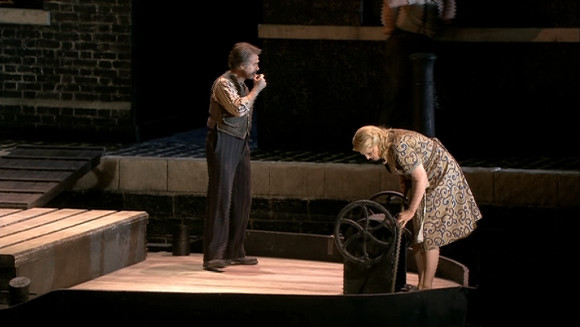
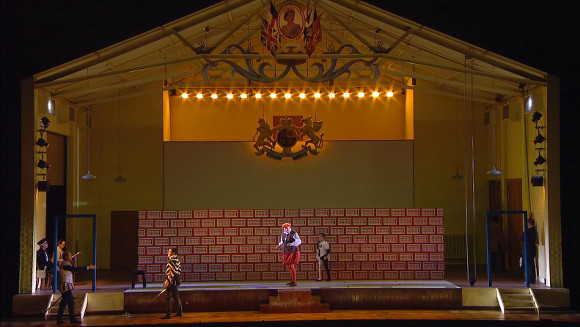
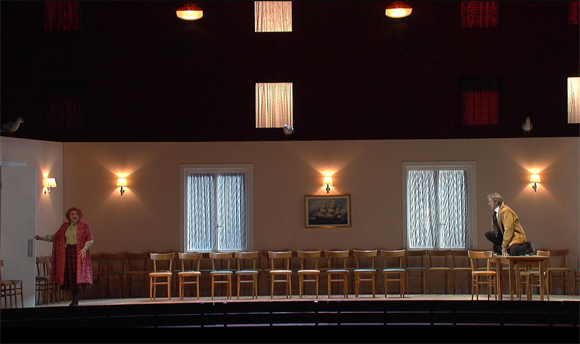
Puccini’s Il Trittico is a collection of three one act operas designed to be performed on a single evening. They rarely are. Perhaps this is because performing all three makes for a rather long evening (and for a huge cast) or maybe it’s because two of the three aren’t all that great. In any event, while most opera goers will likely have seen the comedy Gianni Schicchi, most will likely not have seen the two tragedies that precede it; Il Tabarro and Suor Angelica. However, all three works were performed as a triple bill at the Royal Opera House in 2011. The show was broadcast by the BBC and is available on Blu-ray and DVD. All three pieces were directed by Richard Jones and Anthony Pappano conducted.
Let trumpets blow
A new recording of Britten’s Gloriana is to be welcomed, even when it’s less than perfect. It’s an unusual work for Britten. It’s very grand. The orchestra is large and the music doesn’t seem to be as transparent and detailed as much of his work. This is especially true in Act 1 where I almost wondered whether Britten was sending up “grand opera”. It’s also a grand opera sort of plot. The libretto is based on Lytton Strachey’s Elizabeth and Essex and deals with the late life romance between the queen and the young Robert Devereux, earl of Essex and deputy in Ireland. It has some fine moments; notably the lute songs in Act 2 and the choral dances in Act 2. Act 3 is also dramatically quite effective; dealing with Essex’ abortive rebellion and execution. Curiously, in the final scene, Britten resorts to a lot of spoken dialogue, as he does briefly with Balstrode’s admonition in Peter Grimes. It’s almost as if he has no musical vocabulary for the highest emotional states; a sort of anti-Puccini.
Grimes on Blu-ray
There is, finally, a recording of Britten’s Peter Grimes on Blu-ray. It’s a Richard Jones production with a largely British cast, recorded at La Scala in 2012. The sound and picture quality are first rate. Unfortunately the production and performances aren’t so much.
Richard Jones has chosen to set the piece in the 1980s and to portray the inhabitants of the Borough as a sort of inbred hive mind fuelled by prejudice, alcohol and drugs. Actually it’s not a bad concept but it comes off as exaggerated with cast and chorus repeatedly making more or less coordinated middle aged disco moves. He also portrays the nieces as the sort of permanently stoned bubble heads one wants to avoid on the last train home. There are some neat touches. The Moot Hall, The Boar and Grimes’ hut are all formed by box like spaces that are tilted and rotated to good effect. The lighting is effective too. Unusually for a modern production Jones doesn’t provide any staging for the interludes, leaving the theatre dark with the curtain down. Overall, it’s a production I’d want to take a second look at but I suspect it’s just painted too broadly to be really effective.
Smart and sexy Don Giovanni
Last night saw the first of two performances of Don Giovanni by the students of the Glenn Gould School at Koerner Hall. Koerner Hall isn’t the easiest venue to do fully staged opera since it is basically a concert hall with very limited lighting and stage facilities. Ashlie Corcoran and Camellia Coo pulled off perhaps the most inventive staging I have seen there by using a giant staircase to link the part of the gallery that wraps around the stage to the stage itself. Within this basic configuration they deployed a few bits and pieces of furniture, mostly couches. It made a very serviceable unit set for the various scenes. The production was set in the 1960s and seemed to revolve around the basic idea of Don Giovanni as a “chick magnet”. All the usual suspects are clearly attracted to him. There’s no hint of coercion in the opening scene with Donna Anna and Zerlina is a very willing seductee. The idea is reinforced in “Deh vieni” when, as Don Giovanni is serenading Donna Elvira’s maid, five or six women make their way to the staircase and down to the man himself.
Four decades of Peter Grimes
Having now had a chance to watch and review all seven currently available (as of June 2025 only the Oke and Graham-Hall performances seem to be available) video recordings of Peter Grimes I thought I might do a summary of the strengths and weaknesses of each. All of them have some merit and I doubt that there would be consensus on a “winner”. Anyway, here goes…
BBC film 1969
Grimes – Peter Pears
Conductor – Benjamin Britten
Director – Joan Cross & Brian Large
This is an essential historical document with both composer and the creator of the role involved. The production is straightforward and naturalistic. The sound and video quality is surprisingly good for the period. It does, though, leave one with the feeling that there is more to the role of Grimes than Pears finds.
Royal Opera House 1981
Grimes – Jon Vickers
Conductor – Colin Davis
Director – Elijah Moshinsky
Also a historical landmark being the first major production where Grimes wasn’t sung by Peter Pears. It has the excellent Heather Harper as Ellen Orford. The production is quite dull and very dimly lit. Vickers’ Grimes is controversial. In places he sounds fantastic and in others sorely taxed. His acting is oddly stilted. Norman Bailey fails to convince as Balstrode. Sound and picture quality are OK.
English National Opera 1994
Grimes – Philip Langridge
Conductor – David Atherton
Director – Tim Albery
This is the production with most sense of the sea as a character brought out through innovative use of video projection. Langridge’s Grimes is intense, convincing and beautifully sung. Alan Opie is a very strong Balstrode. Unfortunately the orchestra and chorus aren’t up to rival versions and all aspects of the DVD; video direction, sound quality and picture quality are rather poor. This recording was rebroadcast on June 1st 2025 by the BBC with dramatically better sound. See my thoughts here.
Opernhaus Zürich 2005
Grimes – Christopher Ventris
Conductor – Franz Welser-Möst
Director – David Pountney
This is a very fine and thought provoking production with any number of magical moments. Ventris is a first class Grimes combining power and sensitivity and the supporting performances all have merit, save perhaps for Alfred Muff’s sub-par Balstrode. The orchestra and chorus are quite superb. The performance gets a thoroughly sympathetic treatment on DVD with good video directing backed up by quite excellent sound and picture quality.
Metropolitan Opera 2008
Grimes – Anthony Dean Griffey
Conductor – Donald Runnicles
Director – John Doyle
This is a rather dull and dark production given a very eccentric treatment by the video director. Dean Griffey is a lyrical and sympathetic Grimes well backed up by the supporting cast, especially Anthony Michaels-Moore as Balstrode and Teddy Tahu-Rhodes as Ned Keene. The orchestra and chorus are excellent and Runnicles is fairly convincing though the first act drags a bit. The sound and picture quality is excellent.
La Scala, 2012
Grimes: John Graham-Hall
Conductor: Robin Ticciati
Director: Richard Jones
Richard Jones’ production, updated to the 1980s, is quirky. John Graham-Hall is quite lyrical as Grimes but slips into pseudo speech a lot. Susan Gritton fails to convince as Ellen Orford. The supporting cast, the orchestra and the conducting are first rate but the chorus is decidedly sub-par. The Blu-ray sound and picture outclasses all previous versions but, overall, this recording fails to convince.
Peter Grimes on Aldeburgh Beach, 2013
Grimes: Allan Oke
Conductor: Steuart Bedford
Director: Tim Albery/Margaret Williams
This film is a record of the unique production staged on Aldeburgh beach by Tim Albery and filmed by Margaret Williams. It’s highly atmospheric and features a brilliant performance by Alan Oke but conditions were not ideal for the singers and musically this cannot match the best available recordings from the theatre.