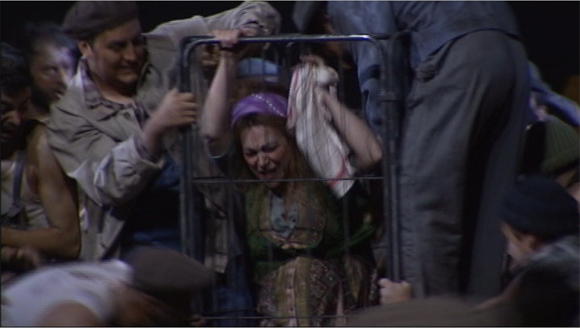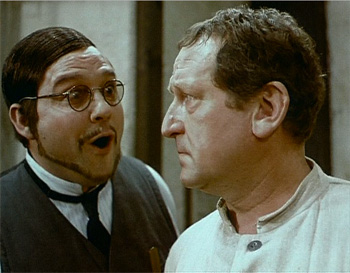
In 1970 Rolf Liebermann took the assembled forces of the Hamburg State Opera down to a castle in South Germany and made a film of Berg’s Wozzeck. The production is pretty literal. It’s set in Austria in the late 19th century and everything plays out very literally per the libretto but it’s far from being a routine or dull reading. A combination of brilliant conducting, slightly over the top acting, pointing up the Expressionist elements in the music and really good cinematography make this a very tense, creepy and claustrophobic experience. It’s simultaneously rather repellent and hard to watch and deeply engaging. Continue reading
Yet another Big COC podcast
The latest episode of the Big COC Podcast is up on iTunes. This one features Gianmarco Segato of the COC plus three bloggers; myself, Lydia Perovic of Definitely the Opera and Leslie Barcza of barczablog. We talked about Henze and European modernism segging into the differences between modern opera in Europe and America. And that led to a discussion of Adès’ The Tempest, American conservatism, the Met and it’s audience, parties at Christopher Alden’s place and much more. Then it was on to Lydia’s new novel, Incidental Music(go buy it). There was also an interview with Nina Draganić about the free concerts in the Richard Bradshaw Amphitheatre. When we came back it was for a discussion about the difference about men and women, action and feeling in opera and, ultimately, why the soprano always gets a raw deal! I really enjoyed recording this one. It really felt like a conversation between good friends (which it was) and it’s not been edited down too much. I think there may have been a segment on the Opera Atelier Der Freischütz that got chopped.
A gentler Lady Macbeth?
Stein Winge’s 2002 production of Shostakovich’s Lady Macbeth of the Mtsensk District at Barcelona’s Liceu is fairly straightforward in a minimalist sort of way. The first scene establishes the tone for sets. There’s a bed and a window and that’s about it. The succeeding eight scenes are equally stark. There’s an unusual, and disturbingly creepy, sexual tension between Katerina and Boris Ismailov; played here less boorishly than usual by Anatoli Kotcherga. The three “difficult” scenes; the rape of Aksinya, the seduction and the death of Katerina are all handled pretty well. It’s all less “in your face” than Martin Kušej’s Amsterdam production but it’s effective. There’s also an element of “black slapstick”, especially in the scenes involving the police, that seems to fit the music rather well.
Continue reading
Fairest Isle
Toronto Masque Theatre’s latest effort is a Purcell show called Fairest Isle. It’s semi-staged performance of excerpts from Purcell works, mainly the four stage works; Dido and Aeneas, The Fairy Queen, The Indian Queen and King Arthur (Wot! No Diocletian you cry) interspersed with readings from the plays and a narrative about Purcell’s life performed by actors Derek Boyes and Arlene Mazerolle. The staging involves frequent short dance pieces, in a recognisably period style (heels, long skirts, arms never above the shoulder) by Marie-Nathalie Lacoursière. The six singers, costumed throughout in dark suits or dresses, mostly sang from music stands though some pieces were blocked. There was an eight piece ensemble; two violins (Larry Beckwith/Kathleen Kajioka), viola (Karen Moffat), two oboes (John Abberger/Gillian Howard), cello (Margaret Gay), lute/guitar (Lucas Harris) and keyboards (Christopher Bagan) directed by Beckwith. Continue reading
Against the Grain Theatre’s season announcement
The following just in from arguably Toronto’s most exciting opera company; Against the Grain Theatre. So a party, György Kurtág’s Kafka Fragments and Leoš Janáček’s The Diary of One Who Disappeared (with the brilliant Jacquie Woodley) and Figaro’s Wedding; a Toronto centred reworking of the Mozart classic with an orchestra for the first time. Following on from successes like their Tranzac based La Bohème and a brillian The Turn of the Screw, this looks very exciting.
Full details, links for tickets etc, below the fold.
Waking up the senses
Furthering my quest to see more live opera I’m grateful to fellow COC podcaster Leslie of barczablog for drawing my attention to the following production that had hitherto escaped my notice.
Canadian directors, Aria Umezawa and Erik Thor combine their skills to help create Opera Five’s Winter production at the popular Gallery 345 venue. Alongside the senses of hearing and sight, the company is presenting a 3-course tasting menu thematically tied to each opera with food being prepared by local restaurants. The show features a cast of ten Toronto-based singers and the operas, Hin und Zurück (Hindemith), Aleko (Rachmaninov) and Talk Opera (Granger) a new American opera making its premiere in Canada. Milton Granger, the opera’s composer will be in attendance throughout the run. Musical direction is provided by Maika’i Nash and Kimberly Bartczak.
The show is at Gallery 345 (345 Sorauren Ave) on December 4th-6th at 7:30PM.
Tickets are $25/$30 and can be purchased online at operafive.brownpapertickets.com or at the door.
Food and opera! Sounds just my kind of thing.
COC Ensemble Studio competition
The Canadian Opera Company has announced the ten finalists for the annual Ensemble Studio competition which this year takes place in the Richard Bradshaw Amphitheatre at 6.30pm on November 29th. The event is both a singing competition and the final audition for candidates to join the Ensemble Studio next season. Since the Ensemble Studio is probably the best gig in Canada for a young opera singer it’s very competitive and the competition is a great opportunity to take a look at Canada’s best young singers. It’s a ticketed event and it’s almost sold out so if you plan on going get a ticket now.
The finalists are bass-baritone Gordon Bintner (Regina, Sask.); mezzo-soprano Charlotte Burrage (Woodstock, Ont.); soprano Aviva Fortunata (Calgary, Alta.); baritone Clarence Frazer (Toronto, Ont.); tenor Andrew Haji (London, Ont.); mezzo-soprano Danielle MacMillan (Toronto, Ont.); bass Nathan Keoughan (Charlottetown, P.E.I.); tenor Michael Marino (London, Ont.); soprano Lara Secord-Haid (Winnipeg, Man.) and soprano Kelsey Vicary (Niagara Falls, Ont.).
I’ve seen MacMillan a couple of times singing in student productions at the Royal Conservatory and I think I’ve seen Haji perform but the others are unknown to me. It should be an interesting night.
Orlando in Craiglockhart
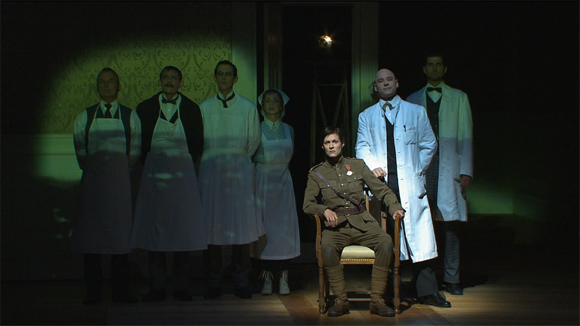
Handel’s Orlando is pretty classic opera seria stuff. It’s based on an episode in Ariosto’s Orlando Furioso. Orlando, a great soldier in Charlemagne’s army has lost his ardour for military glory because he has fallen desperately in love with the pagan princess Angelica, who is in turn in love with another man, Medoro. Orlando cannot accept this and he is driven to madness, prevented from causing absolute carnage only by the magician Zoroastro (who eventually restores his sanity). There’s also a shepherdess, Dorinda, who is also in love with Medoro, but comes to accept her lot. It’s all a bit daft and screams for a strong production concept. In his 2008 Zürich production Jens-Daniel Herzog finds one. He relocates the action to a military psychiatric hospital during, or just after, WW1. Orlando is suffering from battle fatigue or PTSD and Zoroastro is a psychiatrist. Angelica is still a princess but Dorinda has become a nurse. It all works rather well.
Watching DVDs the Handel way
There’s been a bit of jokey banter in comments on posts about various Historically Informed Productions about Historically Informed Audiences. The serious point being that we don’t watch opera in the same way the audience did in Handel’s day and, of course, we don’t perceive it in the same way. There’s nothing one can do about the perception but it did occur to me that the way I watch DVDs is, in some ways, more like Handel’s audience than the way I watch/listen when I am at a live performance. This struck me yesterday as I was watching a rather good production from Zürich of Handel’s Orlando. I’ll be writing more about that later. Continue reading
War in opera
As November 11th comes around for the 94th time since the guns were, very temporarily, silenced I thought it might be interesting to look at how war has been seen by librettists and composers over the years. Very early on we get a very gritty take on the subject in Monteverdi’s extremely compact Il combattimento di Tancredi e Clorinda but not so long after the path for the next three centuries is set with Purcell’s broadly comic King Arthur. As far as I can see from Purcell to 1945, with very minor exceptions, the message is largely “war is fun”. War is an excuse for a big parade (Aida; unless Tim Albery is directing!), an excuse for a drinking song (Faust), just plain comedic (La Fille du Regiment), a plot device (Cosí fan tutte) or a background event (Tosca, various versions of the Armida story). The only opera, pre 1945, that I can think of that deals with the horror of war is Les Troyens, and that of course takes place in a distant, mythical, past.