Against the Grain Theatre’s season announcement

The following just in from arguably Toronto’s most exciting opera company; Against the Grain Theatre.  So a party, György Kurtág’s Kafka Fragments and Leoš Janáček’s The Diary of One Who Disappeared (with the brilliant Jacquie Woodley) and Figaro’s Wedding; a Toronto centred reworking of the Mozart classic with an orchestra for the first time.  Following on from successes like their Tranzac based La Bohème and a brillian The Turn of the Screw, this looks very exciting.

Full details, links for tickets etc, below the fold.

Continue reading

Waking up the senses

Furthering my quest to see more live opera I’m grateful to fellow COC podcaster Leslie of barczablog for drawing my attention to the following production that had hitherto escaped my notice.

Canadian directors, Aria Umezawa and Erik Thor combine their skills to help create Opera Five’s Winter production at the popular Gallery 345 venue. Alongside the senses of hearing and sight, the company is presenting a 3-course tasting menu thematically tied to each opera with food being prepared by local restaurants. The show features a cast of ten Toronto-based singers and the operas, Hin und Zurück (Hindemith), Aleko (Rachmaninov) and Talk Opera (Granger) a new American opera making its premiere in Canada. Milton Granger, the opera’s composer will be in attendance throughout the run. Musical direction is provided by Maika’i Nash and Kimberly Bartczak.

The show is at Gallery 345 (345 Sorauren Ave) on December 4th-6th at 7:30PM.

Tickets are $25/$30 and can be purchased online at operafive.brownpapertickets.com or at the door.

Food and opera!  Sounds just my kind of thing.

COC Ensemble Studio competition

The Canadian Opera Company has announced the ten finalists for the annual Ensemble Studio competition which this year takes place in the Richard Bradshaw Amphitheatre at 6.30pm on November 29th. The event is both a singing competition and the final audition for candidates to join the Ensemble Studio next season. Since the Ensemble Studio is probably the best gig in Canada for a young opera singer it’s very competitive and the competition is a great opportunity to take a look at Canada’s best young singers. It’s a ticketed event and it’s almost sold out so if you plan on going get a ticket now.

The finalists are bass-baritone Gordon Bintner (Regina, Sask.); mezzo-soprano Charlotte Burrage (Woodstock, Ont.); soprano Aviva Fortunata (Calgary, Alta.); baritone Clarence Frazer (Toronto, Ont.); tenor Andrew Haji (London, Ont.); mezzo-soprano Danielle MacMillan (Toronto, Ont.); bass Nathan Keoughan (Charlottetown, P.E.I.); tenor Michael Marino (London, Ont.); soprano Lara Secord-Haid (Winnipeg, Man.) and soprano Kelsey Vicary (Niagara Falls, Ont.).

I’ve seen MacMillan a couple of times singing in student productions at the Royal Conservatory and I think I’ve seen Haji perform but the others are unknown to me. It should be an interesting night.

Orlando in Craiglockhart

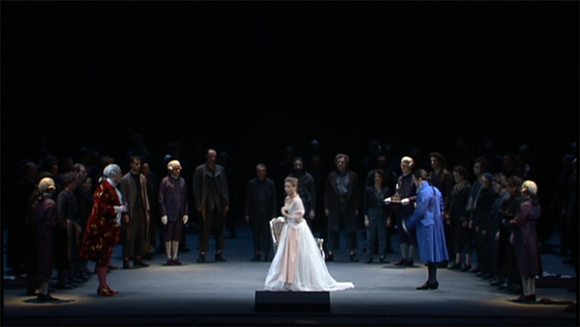
Handel’s Orlando is pretty classic opera seria stuff.  It’s based on an episode in Ariosto’s Orlando Furioso.  Orlando, a great soldier in Charlemagne’s army has lost his ardour for military glory because he has fallen desperately in love with the pagan princess Angelica, who is in turn in love with another man, Medoro. Orlando cannot accept this and he is driven to madness, prevented from causing absolute carnage only by the magician Zoroastro (who eventually restores his sanity).  There’s also a shepherdess, Dorinda, who is also in love with Medoro, but comes to accept her lot.  It’s all a bit daft and screams for a strong production concept.  In his 2008 Zürich production Jens-Daniel Herzog finds one.  He relocates the action to a military psychiatric hospital during, or just after, WW1.  Orlando is suffering from battle fatigue or PTSD and Zoroastro is a psychiatrist.  Angelica is still a princess but Dorinda has become a nurse.  It all works rather well.

Continue reading

Watching DVDs the Handel way

There’s been a bit of jokey banter in comments on posts about various Historically Informed Productions about Historically Informed Audiences.  The serious point being that we don’t watch opera in the same way the audience did in Handel’s day and, of course, we don’t perceive it in the same way.  There’s nothing one can do about the perception but it did occur to me that the way I watch DVDs is, in some ways, more like Handel’s audience than the way I watch/listen when I am at a live performance.  This struck me yesterday as I was watching a rather good production from Zürich of Handel’s Orlando.  I’ll be writing more about that later.  Continue reading

War in opera

As November 11th comes around for the 94th time since the guns were, very temporarily, silenced I thought it might be interesting to look at how war has been seen by librettists and composers over the years. Very early on we get a very gritty take on the subject in Monteverdi’s extremely compact Il combattimento di Tancredi e Clorinda but not so long after the path for the next three centuries is set with Purcell’s broadly comic King Arthur.  As far as I can see from Purcell to 1945, with very minor exceptions, the message is largely “war is fun”.  War is an excuse for a big parade (Aida; unless Tim Albery is directing!), an excuse for a drinking song (Faust), just plain comedic (La Fille du Regiment), a plot device (Cosí fan tutte) or a background event (Tosca, various versions of the Armida story).  The only opera, pre 1945, that I can think of that deals with the horror of war is Les Troyens, and that of course takes place in a distant, mythical, past.

Continue reading

A more enchanted island

Thomas Adès’ The Tempest has had something like eight runs since its premiere at Covent Garden in 2004.  It recently opened at the Metropolitan Opera in a new production by Robert Lepage which was broadcast as part of the Met in HD series this afternoon.  It’s an interesting work musically.  Some of the vocal writing is reminiscent of Britten.  It all tends to a high tessitura for the voice type concerned and goes to extremes in that direction for the soprano part of Ariel where parts are so high that clear articulation of the words is impossible.  Writing for voice and orchestra ranges from dissonant to extremely lyrical (the act 2 duet between Miranda and Ferdinand).  Key and time signature changes are legion and many of the intervals for the singers are extreme.  It must be extremely difficult to perform but it’s rather lovely to listen to.

Continue reading

Upcoming Toronto gigs


(l – r) Laura Albino and Adam Luther in the Canadian Opera Company’s Xstrata Ensemble Studio School Tour production of The Brothers Grimm, 2009.
Photo Credit: Photo: Anand Maharaj © 2009

Since my last post on upcoming Toronto opera and opera related events a few extra things have come up.  November 16th is turning into a pretty crowded evening.  I’m going to Toronto Masque Theatre’s Purcell fest, Fairest Isle, which is also on on the 17th.  Also on that night is the Glenn Gould School’s fall performance; a double bill of Ned Rorem’s Three Sisters Who Are Not Sisters and François-Joseph Vézina’s Le Lauréat.  Finally, you can also catch Opera by Request performing Tchaikovsky’s Eugene Onegin (also on the 25th) or catch them on the 17th when they are doing Bizet’s Les Pecheurs de Perles.

Later in the month there is the final audition for the COC’s Ensemble Studio.  This is always a great opportunity to see the best of the next generation of Canadian singers as they compete for a place in Canada’s premier young artists program.  There are still a few $15 standing room tickets available from the COC box office or website.

Into December when the COC Studio Ensemble are presenting three performances of Dean Burry’s The Brothers Grimm on December 7th and 8th.  The performance on the 7th will be the 500th for this work making it much the most performed classical work by a Canadian composer.  Finally, on December 15th there’s a holiday party/fundraiser for the awesome Against the Grain Theatre Company.  Folks who can stage an opera at the Tranzac ought to know how to party.

Cheap enough for beggars

Last night I went to see Essential Opera’s cheap and cheerful production of Brecht and Weill’s The Threepenny Opera.  It was a semi staged production in the relatively small Heliconian Hall.  Semi-staged in this case meant sung in costume from music stands with very basic blocking.  Accompaniment was by Cathy Nosaty on piano and accordion which actually suited the music pretty well.

The singing was good, sometimes very good.  Probably the stand out was Laura McAlpine’s Jenny.  Of all the singers on display she was the one who seemed most immersed in the sound world of the piece and could vary style and technique appropriately.  Erin Bardua’s Lucy Brown was really quite idiomatic too.  The others were more consistently operatic which sounded a bit odd in places but worked surprisingly well in, for example David Roth and Heather Jewson’s rather refined refined and bourgeois Peachums.  Obviously this approach also worked for the character who are usually sung operatically; Macheath, Brown and Polly for example.  The ensembles were all also very effective.

Continue reading

Chill out dude

The problem with reviewing Doris Dörrie’s 2002 Berlin production of Così fan tutte is that pretty much everything that can be said about it already has been.  It’s like trying to write about Willy Decker’s “red dress” Traviata.  So I’ll try and be brief and to the point.  On the surface the idea is a bit outlandish.  Mozart and da Ponte’s satire about sexual fidelity is updated to the 1970s though to me, who grew up in the 70s, it seems much more like the 60s.  That said, it works.  It’s lively, funny, musically top notch and the presentation on DVD is very decent.

Continue reading