Almost ideal Idomeneo

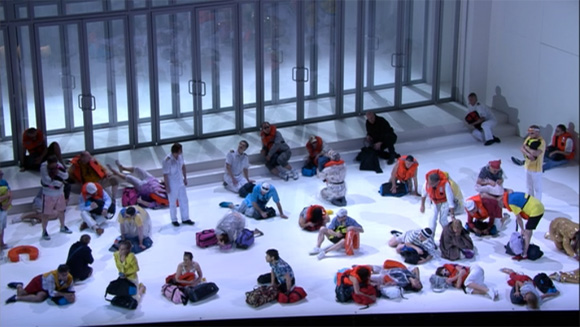
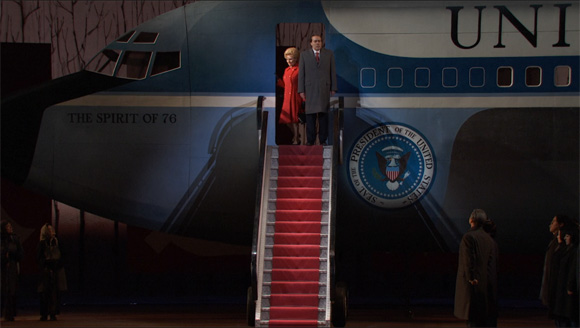
The 2006 Salzburg production of Idomeneo seems to me to be just about ideal.  The production is clean and consistently interesting without ever getting too far away from the core story and the pretty much unbeatable cast is backed up by the period sensibilities of Roger Norrington and the Salzburg Camerata and Bachchor.  The only fly in the ointment is the utterly heinous video direction.

Continue reading

Time is a funny thing

A series of blog posts discussing time, perceptions of time and historically informed performance (HIP) plus seeing Opera Atelier’s Der Freischütz got me thinking along some curiously convergent lines and arriving at the conclusion that HIP isn’t and can’t be what it is often purported to be; a fairly faithful attempt to reproduce a work as it would have been seen by its first viewers or “as the composer intended” or something like that.  Not, of course, that even if it was, we would see and hear it as the original audience did but that perhaps is a topic for another day.

Continue reading

Boulevard Solitude

My DVD of Hans Werner Henze’s Boulevard Solitude arrived the day before his death at the weekend and so went straight to the top of the reviewing pile.   It’s an intriguing piece.  It’s based on the same Abbé Prevost novel as all the other versions of Manon but updated to the period of composition (1952) and told from the viewpoint of des Grieux rather than Manon.  In this version des Grieux picks Manon up at a railway station while she is on her way to finishing school in Lausanne.  They run away to Paris but des Grieux is broke and Manon’s brother pimps her to a rich old man, Lilaque.  The brother robs the old man’s house which gets them both kicked out.  Manon has a brief fling with des Grieux before her brother pimps her out again; this time to Lilaque’s son.  By this time des Grieux has a pretty serious cocaine problem.  The cocaine, naturally, is supplied by Lescaut.  Lescaut is in the process of stealing a painting from Lilaque fils when Lilaque père shows up.  Lescaut hands Manon a gun and she kills the old man.  In the last scene we are back at the railway station where a disconsolate des Grieux waits for one last glance at Manon as she is taken to prison.

Continue reading

Forge a magic bullet and your lifestyle will improve

There’s a lot to like in Opera Atelier’s current production of Weber’s Der Freischütz but also some things that are just plain puzzling.  I enjoyed it but certain aesthetic choices made no sense at all to me.

Let’s start with the good stuff.  The OA template was relaxed quite a bit, particularly in the dance department.  Allowing the women to dance in point shoes allowed for a degree of choreographic flexibility that was most welcome to me.  This, from a dance point of view, was the best OA production I have seen.  The singing, though stylistically inconsistent, was also uniformly excellent.  Meghan Lindsay’s Agathe was superb.  She had much the most dramatic voice on display and, to me, was the truest to the real sensibility of the piece.  Carla Huhtanen, as Aanchen, was also excellent though in such a different way that wondered whether they were in the same production.  Solid singing from the men too especially Krešimir Špicer as Max who was very stylish, if not especially heroic.  The design and lighting elements were also not too constrained by baroque considerations and worked pretty well.

Meghan Lindsay and Krešimir Špicer in Opera Atelier’s production of Der Freischütz (Bruce Zinger photo).

Continue reading

Rosenkavalier on the brink

Robert Carsen’s 2004 production of Der Rosenkavalier at the Salzburg Festival was apparently enormously controversial at the time.  In many ways that says more about the iconic status of the piece in Salzburg tradition than about Carsen’s production.  There are a few controversial elements.  He has updated the period to 1914 and the third act is set in a brothel with a fair amount of nudity.  Beyond that, the production is pretty faithful to the libretto and has, I think characteristic Carsen touches like long lines of tables and chairs and a certain geometric elegance.  He seems to be using the sides of the stage to comment on the action which tends to be fixed centre stage.  I say seems because the video direction (by Brian Large) is utterly perverse and makes it extraordinarily difficult to see what Carsen is doing, let alone decode it.  We see the whole stage, maybe, for three seconds in the whole piece.  Otherwise 99% of what we get is either close up and even closer up or apparently shot from the restricted view seats high up and close to the side of the stage.  The other 1% is just plain nuts and includes a section of the Sophie/Octavian duet in Act 2 where, on stage, Octavian is maybe twenty feet to Sophie’s right but on camera he’s standing right up close on her left hand side.  I could go on but I won’t.  Suffice it to say the video direction comes close to wrecking an otherwise excellent DVD.

Continue reading

Ein sonderbar Ding

Coincidence and irony just ran into each other at high velocity.  Last night my DVD of Boulevard Solitude arrived which, among other things, sent my mind back to the long, hot summer of 1976 when, between IRA bomb scares and hitch hiking around Germany I saw the Covent Garden premiere of We Come to the River; a work which deeply confused my teenage self and put something of a damper on my infatuation with European Modernism.  So, I’m a bit ambivalent about Henze’s music but nonetheless much saddened by the news of his death for truly he was one of the giants of Modernism.  By way of irony the news arrived while I was listening to Adrienne Pieczonka singing “Die Zeit; die ist ein sonderbar Ding”.  So very, very true.

There’s a thoughtful obituary over at The Boulezian.

The COC Annual Report 2011/12

The Canadian Opera Company’s Annual report is out. You can find it here.  It not unreasonably lauds the COC’s considerable artistic achievements over the last year as well as its extensive and commendable outreach activities.  It also contains, albeit in no great detail, the financials.  Now, as a former management consultant, I know that’s the one bit of an Annual Report that’s hard to spin though most CFOs will try.  Being the analyst that I am I ran a few numbers and the results were a bit disturbing.  It was obvious that the financial position had deteriorated though the extent only revealed itself when I looked back to 2009/10 as a comparator.  Here are a few statistics comparing 2011/12 with 2009/10.

  • Capacity (i.e. seats to be sold): up 7% (this is approximate and calculated from ticket sales and reported capacity figures)
  • Seats sold: down 8%
  • Average price per seat sold: down 10%  (From $97.97 to $87.86; which seems quite low really)
  • Leading to a drop in ticket revenue of 18%

Continue reading

Rigoletto in Zürich

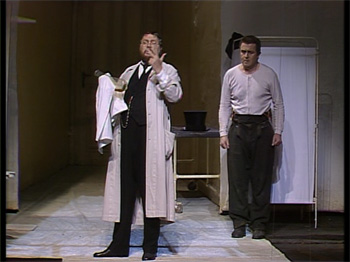
This is another of those Arthaus Blu-ray disks that’s sold at a silly cheap price as a carrier for two hours of trailers from the Arthaus catalogue.  That said, it’s very high quality indeed.  GIlbert Deflo’s production is, in the end, quite conventional though with careful and effective Personenregie.  He does trick us a bit at the start.  The scene opens with what is, apparently, a rather louche 16th century court entertainment/orgy.  There are bare breasted women and dancers of both sexes dressed as Satanic imps.  Everyone is in period costume including Rigoletto with jester hat, bells etc.  The scene is, perhaps, what we expect.  The “ladies” are very receptive to the duke’s advances.  The men are resentful but not actively so.  Then in comes Monterone in mid 19th century dress to denounce the proceedings and we, perhaps slowly, realise that this is a costume party.  From there on there’s nothing very tricksy.  The story gets told effectively and straightforwardly.  We have been pulled, effortlessly, from the time of the libretto to the time of first performance and the parallels are drawn.

Continue reading

Good news!

Intermezzo reports that Harrison Birtwistle’s 1991 (revised 1994) opera Gawain is to be performed at the 2014 2013 Salzburg Festival.  I saw this when originally broadcast on TV in the UK and really want to see it again.  I’m hoping that there will be a DVD release as it’s unlikely(!) that I will make it to Salzburg.  I’m half surprised that it hasn’t been performed again or spread beyond Covent Garden (same is true of The Minotaur of course).  But only half surprised.  There seems to be a real reluctance currently to produce work that is seen as less “accessible”.  There are exceptions of course.  Saariaho seems to be quite fashionable for example but overall, and especially on this side of the Atlantic, the modernist tradition seems to have been firmly rejected.

The dream is over but the night not yet

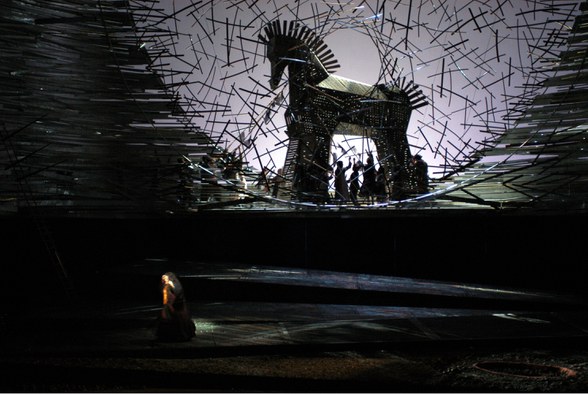
So closes Aribert Reimann’s 2010 opera Medea.  It’s a two hour piece in four “pictures” that premiered at the Wiener Staatsoper in 2010 and the Blu-ray/DVD recording is taken from that initial run.  Actually there’s a good deal more nightmare than dream in this version as, I suppose, there is in just about any version of the Medea story.  This one draws on Franz Grillparzer’s version for the libretto and is entirely concerned with events after Jason and Medea reach Corinth.  It’s unusually sympathetic to Medea herself with Jason and Kreon very much the villains.

Continue reading