A journey through space and time?

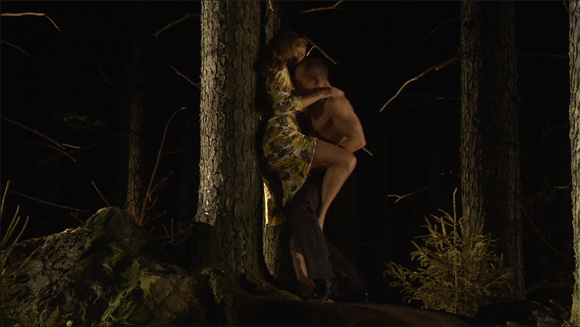
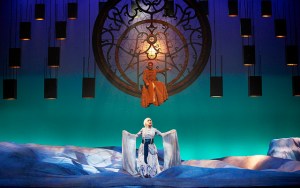
Tan Dun’s Marco Polo is hugely ambitious. He uses Marco Polo’s legendary journey as a metaphor for Space and Time.  He fuses a range of Western musical styles with Chinese, Tibetan and Indian instruments and vocal styles.  Although most of the work is sung in English there are sections in Italian and Chinese and other bits in a sort of random polyglot.  The cast includes a range of real, allegorical and psychological figures.  Marco and Polo are in fact two characters; one representing action and the external and the other the psychological and internal.  Kublai Khan, Dante, Shakespeare, Sheherazada and Mahler put in appearances and much of the narrative is carried by a Chinese opera singer playing the part of Rustichello; “the questioner”.  To be honest, despite having read the booklet, watched Reiner Moritz’s “Making of” documentary and studied the chart below, most of the time I had no idea what was actually happening.  It’s really all too abstract and involved to really work as music drama.

Continue reading

Traditional Traviata

The 2007 recording of Verdi’s La Traviata from Milan’s Teattro alla Scala is extremely traditional but very satisfying.  Liliana Cavani’s production is set in the mid 19th century with entirely conventional sets and costumes (with the obligatory cleavage) and nothing in the direction that adds up to an original concept or idea.  Act 1 is set in a glitzy ballroom.  Act 2 scene 1 takes us to a slightly odd sort of country house bedsit with billiard table  In Act 2 scene 2 we are back with the glitz with actual gypsies and bare chested matadors. Act 3 is set in a suitably dark invalid’s bedroom.  Angela Gheorghiu’s Violetta goes from ballgown to nightdress to ballgown to nightdress while maintaining Ange levels of, you guessed it, cleavage.  The guys are all in evening dress or operetta dress uniforms.  It’s all pretty and doesn’t distract from the music.
Continue reading

Another Big COC Podcast

A couple of weeks ago we recorded another Big COC Podcast.  It’s now available on the COC website and from iTunes.  This time the panel was myself, Wayne Gooding from Opera Canada magazine and Gianmarco Segato and Gianna Wichelow from the COC.

Topics covered included Robert Everett-Green’s Globe and Mail article on Il Trovatore and the persecution of the Roma, upcoming opera productions across Canada (mostly Verdi!), an interview with Marilyn Gronsdal on her Montreal remounting of Christopher Alden’s production of Der Fliegende Holländer; seen at the COC in 2010, and that hardy perennial, HD cinema transmissions of opera with especial emphasis on the Met.

Heading into winter

The leaves have turned and the Canadian Opera Company Season is underway so winter can’t be far away.  I’ve now seen both the COC fall productions so I need to find alternative fare between now and February when things kick off again.  So far I’ve found two live shows of interest in town.  At the end of October Opera Atelier is putting on Weber’s Der Freischütz.  This is a departure for OA who have previously (bar once) not put on anything later than Mozart and that in a rather idiosyncratic style.  I think it’s an interesting move and I hope it stimulates the creative juices at OA and sparks some of the innovation that made OA such an exciting company ten or twenty years ago.  If it turns into an exercise in persuading us that 19th century Romanticism is really just an extension of the Baroque I shall probably be feeling like the guy in the picture.  The other live show is Essential Opera’s The Threepenny Opera being presented in concert at Heliconian Hall on November 7th.  Essential Opera I suppose is a semi-pro outfit operating on very small budgets and The Threepenny Opera seems like a good fit.  I felt that last year’s attempt at something grander was rather a case of biting off more than they could chew.  Continue reading

L’Elisir di Steakhouse

Today was the first MetHD broadcast of the season and we got Bartlett Sher’s new production of Donizetti’s L’Elisir d’Amore.  It’s what I would call a “steakhouse production”.  It’s like a meal in a top end steakhouse.  Your steak is a fine piece of meat, they don’t mess it up and ditto your baked potato.  And it’s all served in luxurious surroundings with attentive service.  It’s a terrific steak dinner but it costs the same as the tasting menu at a place with two Michelin stars and it’s still just a steak dinner.

So, a brilliant cast; Netrebko, Polenzani, Kwiecien and Maestri, singing and acting up a storm in a production that was pretty much devoid of ideas beyond a few odd costuming choices.  Since when did Italian peasant girls get to dress like they are attending a ball in a Jane Austen novel?  Still the girl singing Nanetta was cute and had the best dress.  Gary Halvorson’s video direction was about par for the course in terms of virtually incessant close-ups.  Not a bad way to spend a Saturday afternoon but ultimately forgettable.

Die Fledermaus redux

Mireille Asselin as Adele – Photo: Michael Cooper

I was back at the Four Seasons Centre last night for another look at the new Die Fledermaus; this time with Mireille Asselin as Adele.  There were a number of things about the production that I noticed more on a second look.  The most notable was the lighting (by Paul Palazzo).  It’s superb.  It’s atmospheric without falling into the trap of being so dark one can’t see anything.  Obviously too I saw the kind of prefiguring that goes on throughout the production differently knowing where things were going to go.  It’s clever and insightful without being too intrusive.  I also noticed one or two bits of comic business that either passed over me on opening night or have been added since.  Was the Fidelio joke there on opening night?  My overall verdict hasn’t changed.  It’s a funny, sexy production that can be enjoyed on many levels and one of the best things I’ve seen in ages.

So how was Mireille?  She was very good and very different from Ambur Braid.  Mireille is pretty much your classic soubrette; what I guess we are now calling an -ina voice.  It’s not a particularly big voice but she’s accurate and musical.  She’s also a very decent actress.  One feels that she’d be an ideal Adele in a perfectly conventional Fledermaus.  For this rather spikey, edgy version though I’d go with Ambur.  Her bigger, almost abrasive, voice and her more flamboyant acting (considerably helped by her rather striking appearance) really fit this production.  I’m glad I got a chance to see both of them.

Full review of the opening night with Ambur Braid as Adele

In the news

The good news this week is that Canadian Opera Company have extended the contract of Music Director Johannes Debus through 2017. This follows the announcement of a contract extension for General Director Alexander Neef. So, not only does COC get to keep a very good conductor who is well liked by the orchestra but it keeps the Neef/Debus team together for at least another five years. Neef and Debus seem to work together extremely well so this bodes well for a continuation of the combination of varied repertoire, interesting productions and starry casts that we have seen recently at the Four Seasons Centre.  Continue reading

Beyond Good and Evil

Rameau’s Zoroastre is a tragédie lyrique in five acts.  It’s basically a story of love, power and revenge coupled with a metaphysical struggle between Good and Evil.  It has a seriously convoluted plot involving demons, incantations, good and evil spirits, a magical talisman book and human sacrifice.  Watching the illustrated synopsis on the disk is strongly recommended!  Being the baroque French beast that it is this work also has lots of ballets.  Pierre Audi’s production was staged and filmed at the court theatre at Drottningholm and is a sort of almost, but not quite, HIP concept, somewhat akin to Robert Carsen’s production of Les Boréades.

Continue reading

Fifty shades of grey

Verdi’s Il Trovatore notoriously has an episodic and highly improbable plot.  It’s also famously difficult to cast.  Creating a compelling production and staffing it with capable singers therefore presents a formidable double challenge.  The current Canadian Opera Company production gets it half right.  The problem is Charles Roubaud’s much travelled production.  There’s not an idea in it.  It’s not surprising that the director’s programme notes run to three short paragraphs.  Roubaud sets each scene in a sort of grey box of towering walls.  Unfortunately each grey box is just different enough that that the curtain comes down at the end of each scene and the stage crew spend what seems like an interminable amount of time setting up the next grey box.  We just aren’t used anymore to sitting quietly through interminable scene changes.  We expect slicker stagecraft and in a modern opera house there’s really no excuse for this 19th century approach.  Within in each grey box the grey clad cast come and go and in between mostly stand around.  Blocking is perfunctory, acting superfluous and old fashioned “park and bark” the order of the day.  It’s the sort of production that might have passed muster thirty years ago but really doesn’t cut it in 2012.
Continue reading