Chuck’s back

crEarlier this week I fired up iTunes in search of the latest Melvin Bragg “In Our Time” episode and noticed that two podcasts were downloading.  The other one turned out to be a new episode of Charles Reid’s “This Opera Life”.  Now, Charles’ podcast had been on hiatus for months and I really missed it so I was delighted at this turn of events.  I didn’t get a chance to listen to it until I was heading to the market at stupid o’clock this morning.  Anyway, to cut to the chase, after an explanation of the hiatus, Charles goes on to say nice things about this blog and the Big COC Podcast.  Which is awfully kind of him.  Charles’ podcasts are mostly interviews with the ordinary working stiffs of the opera world.  Occasionally he hooks a “big name” but mostly not and it’s all the more interesting because of it.  I think his archive now has 59 episodes, curiously numbered two to sixty!  The latest features director Jonathon Loy.  I recommend it highly.

You can find Charles Reid’s podcasts at http://thisoperalife.charles-reid.com/ or on iTunes.

And in more competition news…

simone_sThe lovely Simone Osborne has been announced as the winner of the first Maureen Forrester Award Tour.  So Simone will be appearing with Anne Larlee in forty recitals across the country which will feature, among other things, a new work by composer Brian Current, sponsored by the Canadian Art Song Project.  I guess recital tours have the advantage of there being no scenery to come crashing down on one’s head!

Maybe Gatsby should get himself a frequent flyer card and a really comfortable carrier.

Second annual COC Ensemble Studio competition

winnersLast night I was in a very full Richard Bradshaw Amphitheatre for the second annual COC Studio Ensemble competition.  Ten singers, selected down from 146 in auditions across Canada and in New York were competing for cash prizes and an opportunity to join the COC Ensemble Studio.  COC General Director Alexander Neef chaired the panel of judges which included soprano and teacher Wendy Nielsen as well as assorted COC brass.  Chorus Master Sandra Horst MC’d in her own inimitable fashion.  The format was typical of such events.  Each singer offered five arias.  They got to sing one of their choice and then the judges requested a second from the remaining four.  Piano accompaniment alternated between the equally excellent Rachel Andrist and Steven Philcox.

Continue reading

Incidental Music

Incidental Music is the title of a new novel by fellow blogger and podcaster Lydia Perovic of Definitely the Opera.  The blurb and the launch promise a book that ranges from Budapest in 1956 to contemporary Toronto with opera and somewhat tortuous relationships along the way.  I haven’t yet had a chance to read past the first 15 pages yet but those first few pages are totally Lydia and that is a very good thing.  I’ll post a proper review when I have finished reading it.

Continue reading

We’ll meet again in a better world

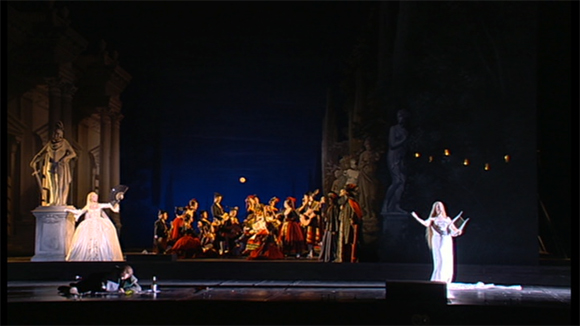
Richard Strauss’ last opera Die Liebe der Danae has a pretty chequered production history.  It was scheduled to premiere at the 1944 Salzburg Festival but that was scuppered when all theatres were closed following the July bomb plot.  A special exception was made for Die Liebe der Danae in that a single, public dress rehearsal was allowed at the conclusion of which Strauss is said to have bid farewell to the Wiener Philharmoniker with the words quoted in the title.  It then remained unperformed until the 1952 festival where it got its true premier followed by productions over the next two years in most major European houses.  After that it pretty much dropped out of the repertoire with occasional performances in Germany but apparently the production recorded at the Deutsche Oper Berlin in 2011 is only the sixteenth production all told.  It’s a bit hard to see why it has been so neglected.  The music is perfectly good Strauss though maybe it lacks a headline aria of the “Es gibt ein Reich” variety.  Maybe the subject matter was just too frivolous for the immediately post-war world; it’s described as “A Joyful Mythology in Three Acts”.  In any event, I was happy to discover it.

Continue reading

It’s the only Iphigénie in town

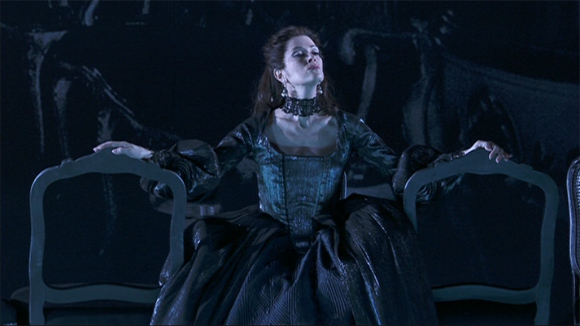
Claus Guth’s 2001 Zürich production of Gluck’s Iphigénie en Tauride is, rather surprisingly, the only video recording of the work currently available.  Fortunately it’s a very decent production much preferable to the Met’s over-stuffed overly literal version but not, I think, to be preferred over Robert Carsen’s stark and elegant version seen in Toronto, Washington and elsewhere.  The Zürich performance, led by William Christie, is very good but it’s rather let down by the video direction and the production for DVD.

Continue reading

Creepy and claustrophobic Wozzeck

In 1970 Rolf Liebermann took the assembled forces of the Hamburg State Opera down to a castle in South Germany and made a film of Berg’s Wozzeck.  The production is pretty literal.  It’s set in Austria in the late 19th century and everything plays out very literally per the libretto but it’s far from being a routine or dull reading.  A combination of brilliant conducting, slightly over the top acting, pointing up the Expressionist elements in the music and really good cinematography make this a very tense, creepy and claustrophobic experience.  It’s simultaneously rather repellent and hard to watch and deeply engaging.  Continue reading

Yet another Big COC podcast

The latest episode of the Big COC Podcast is up on iTunes. This one features Gianmarco Segato of the COC plus three bloggers; myself, Lydia Perovic of Definitely the Opera and Leslie Barcza of barczablog.  We talked about Henze and European modernism segging into the differences between modern opera in Europe and America.  And that led to a discussion of Adès’ The Tempest, American conservatism, the Met and it’s audience, parties at Christopher Alden’s place and much more.  Then it was on to Lydia’s new novel, Incidental Music(go buy it).  There was also an interview with Nina Draganić about the free concerts in the Richard Bradshaw Amphitheatre.  When we came back it was for a discussion about the difference about men and women, action and feeling in opera and, ultimately, why the soprano always gets a raw deal!  I really enjoyed recording this one.  It really felt like a conversation between good friends (which it was) and it’s not been edited down too much.  I think there may have been a segment on the Opera Atelier Der Freischütz that got chopped.

A gentler Lady Macbeth?

Stein Winge’s 2002 production of Shostakovich’s Lady Macbeth of the Mtsensk District at Barcelona’s Liceu is fairly straightforward in a minimalist sort of way.  The first scene establishes the tone for sets.  There’s a bed and a window and that’s about it.  The succeeding eight scenes are equally stark.  There’s an unusual, and disturbingly creepy, sexual tension between Katerina and Boris Ismailov; played here less boorishly than usual by Anatoli Kotcherga.  The three “difficult” scenes; the rape of Aksinya, the seduction and the death of Katerina are all handled pretty well.  It’s all less “in your face” than Martin Kušej’s Amsterdam production but it’s effective.  There’s also an element of “black slapstick”, especially in the scenes involving the police, that seems to fit the music rather well. Continue reading

Fairest Isle

Toronto Masque Theatre’s latest effort is a Purcell show called Fairest Isle.  It’s semi-staged performance of excerpts from Purcell works, mainly the four stage works; Dido and Aeneas, The Fairy Queen, The Indian Queen and King Arthur (Wot! No Diocletian you cry) interspersed with readings from the plays and a narrative about Purcell’s life performed by actors Derek Boyes and Arlene Mazerolle.  The staging involves frequent short dance pieces, in a recognisably period style (heels, long skirts, arms never above the shoulder) by Marie-Nathalie Lacoursière.  The six singers, costumed throughout in dark suits or dresses, mostly sang from music stands though some pieces were blocked.  There was an eight piece ensemble; two violins (Larry Beckwith/Kathleen Kajioka), viola (Karen Moffat), two oboes (John Abberger/Gillian Howard), cello (Margaret Gay), lute/guitar (Lucas Harris) and keyboards (Christopher Bagan) directed by Beckwith.  Continue reading