Another announcement – Ukrainian artsongs

stephaniaSunday, November 2nd at 3:00 p.m. in Koerner Hall,  bass-baritone Pavlo Hunka launches the world premiere of Galicians I: The Art Songs, the latest recording in the Ukrainian Art Song Project (UASP). Hunka will be joined in performance by renowned Canadian opera singers Russell Braun, Krisztina Szabó, and Monica Whicher. They will be accompanied by pianist Albert Krywolt and featured artist, violinist Marie Bérard.  The concert will feature the world premiere performance of selected art songs by four of Ukraine’s Galician composers.

Continue reading →

The one we’ve all been waiting for

unclejohnSo Toronto’s hottest indie opera company, Against the Grain Theatre, has finally announced a 14/15 season.  Not entirely unexpectedly they are bringing #UncleJohn; a transladaptation (©Lydia Perovic) of Mozart’s Don Giovanni to Toronto after it’s successful appearance in Banff this summer.  With a new English libretto by Joel Ivany, #UncleJohn will be staged at The Black Box Theatre at 1087 Queen St. West’s vintage rock venue, The Great Hall. .

Continue reading →

Don Tom

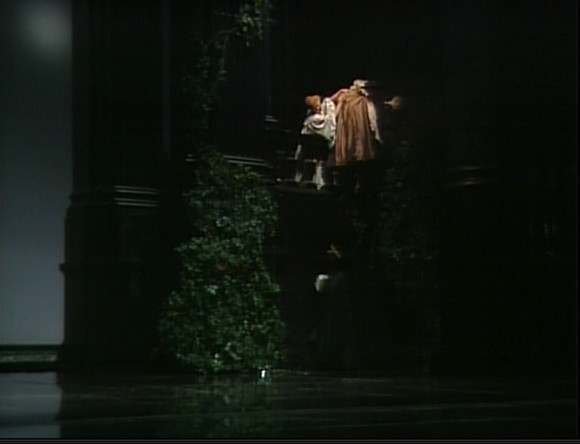
There are over 40 video recordings of Don Giovanni in the catalogue, dating back to 1954, and Thomas Allen sings the title role in quite a few of them.  This one was recorded at La Scala in 1987 and features a very strong cast in a careful, traditional staging.  It’s also pretty decent technical quality for the era.  The director was Giorgio Strehler in a comparatively rare opera outing.  His sets and costumes are of some vague aristocratic past with liveried footmen, big hats and twirling capes.  It’s quite handsome but not in any way revelatory.  Nor is any aspect of the production really.  We are clearly in an aristocratic milieu.  Tom Allen’s Don Giovanni is arrogant and proud with plenty of swagger.  There’s no hint of ambiguity about  Edita Gruberova’s Donna Anna or Ann Murray’s Donna Elvira and Francisco Araiza is a properly dutiful chump of a Don Ottavio.  It’s all quite serious with comic relief only in the most obvious places.  Having said that, there are some very effective scenes; especially the ending which has a an interesting lighting plot and manages not to be anti-climactic.

1.balcony Continue reading →

The Perfect American

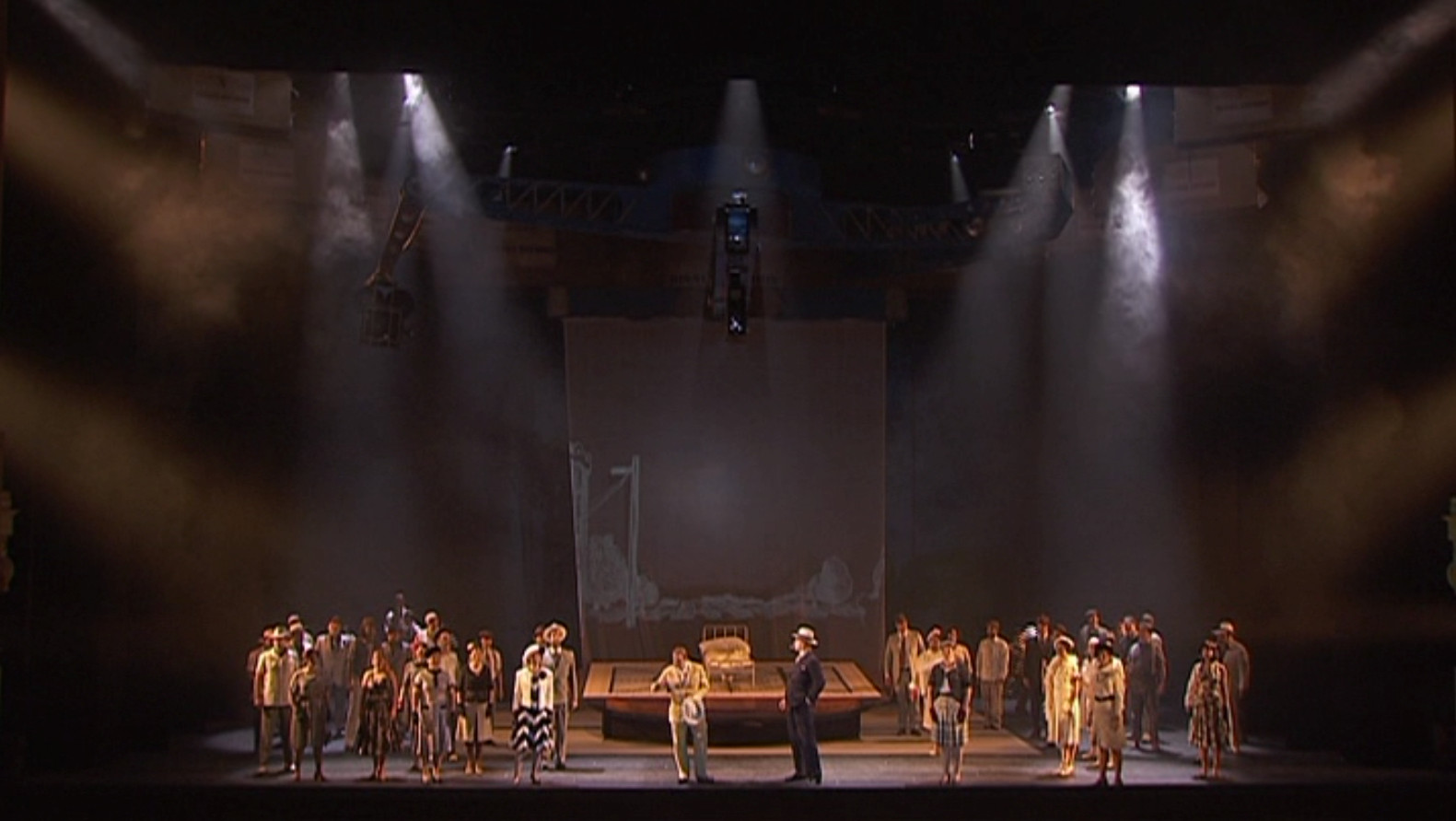
The Perfect American is the ironic title of Philip Glass’ latest opera which premiered in Madrid last year.  It’s about Walt Disney and set at the end of his life looking back at his life and forward to his death.  It’s a not very flattering portrait.  It depicts Disney as blinkered, racist, virulently anti-Communist and, in fact, only comfortable with a sort of Leave it to Beaver America; though passionate about that.

1.marcelline Continue reading →

Are you my mother?

Donizetti’s Lucrezia Borgia is based on one short episode in the storied life of the famous female pharmacist.  In it she twice poisons her son; once at the insistence of her husband, the second time by accident.  The second time her son refuses the antidote preferring to die with his equally poisoned buddies but learns in his dying breath that Lucrezia is indeed his mother.  It’s pretty unusual for a bel canto opera in that the leading female role (a) has agency, (b) doesn’t go mad and (c) doesn’t die.

1.mumson Continue reading →

Moving into October

October is the month things usually really get going again in Toronto and this year is no exception.  The calendar for the first third of the month is very busy.  Highlights include three free concerts in the Richard Bradshaw Amphitheatre, the opening of two productions at the Canadian Opera Company and Nuit Blanche events at the Canadian Music Centre and the UoT Music Department.

fall101308_6 Continue reading →

With tender pity swells

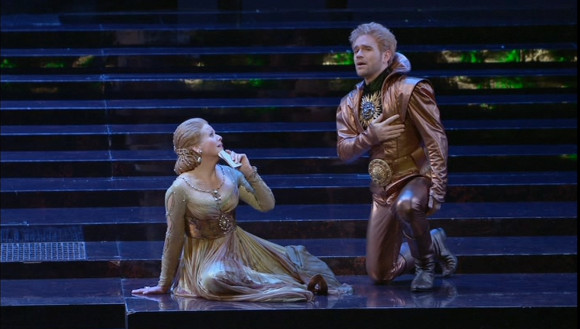
Here’s another fine example of how well Handel’s oratorios can work when staged.  It’s a recording of Hercules made at Paris’ Palais Garnier in 2004.  The staging is by Luc Bondy and William Christie and Les Arts Florissants are joined by a youngish cast of extremely good singers.  It’s compelling stuff.  I think what, for me, makes the oratorios much more interesting than most of Handel’s opera seria is structural.  The operas tend to alternate recit and da capo aria with maybe a duet or chorus to close an act but they are pretty predictable.  In the oratorios Handel makes much more use of ensembles and the chorus and, for me, that’s vastly preferable.

1. Lichas_Dejanira Continue reading →

Here we go again

Yesterday lunchtime saw the first free lunchtime concert of the season in the Richard Bradshaw Amphitheatre.  Following tradition, it was presented by the members of the Ensemble Studio.  Or, to be more accurate, by six of the nine as an unprecedented three singers had fallen victim to the virus that is apparently sweeping the Toronto opera world (HighCbola?).

Credit: (l-r) Jennifer Szeto, Andrew Haji, Karine Boucher, Charlotte Burrage, Clarence Frazer, Jean-Philippe Fortier-Lazure, Iain MacNeil. Photo: Karen Reeves

Credit: (l-r) Jennifer Szeto, Andrew Haji, Karine Boucher, Charlotte Burrage, Clarence Frazer, Jean-Philippe Fortier-Lazure, Iain MacNeil. Photo: Karen Reeves

Continue reading →

Roots

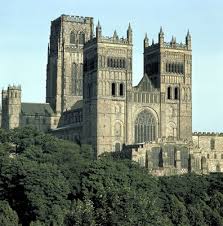
durhamcathedralI was talking to Leslie Barcza of barczablog at a concert yesterday.  He asked me what I was most looking forward to in the upcoming season and I was a bit stumped for an answer because there’s lots of good stuff in Toronto this season but nothing that really sets my pulse racing.  Finally I answered with the TSO’s Dream of Gerontius, which, it turns out, is not exactly high on Lesley’s bucket list.  This led to a brief discussion about how origins affect our reactions; that is until the actual concert interrupted our talk.

Continue reading →

Historic Ariadne

Opera videos of performances before 1980 are quite rare and are mostly films.  Recordings of live performances are extremely uncommon and often quite interesting.  A couple have just been rereleased on DVD.  The one reviewed here is an Ariadne auf Naxos from the 1965 Salzburg Festival (the other is a recording, in German, of Don Giovanni with Fischer-Dieskau – watch this space).  It’s an old ORF TV broadcast with a grainy 4:3 black and white picture and less than stellar mono sound but it does provide an idea of what audiences saw and heard fifty years ago.

1.haushofmeister Continue reading →