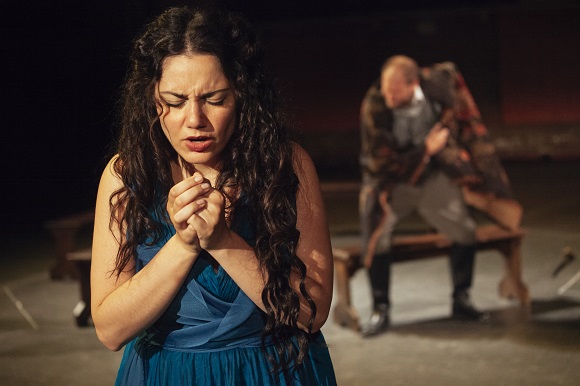
It’s World Pride Week in Toronto and as far as I know Tamar Iveri isn’t in town. What is, is the Toronto premier of When the Sun Comes Out by Leslie Uyeda and Rachel Rose presented by Queer Innovative Theatre; a group of LGBTTIQQ2SA (WTF BBQ!) performers. Unsurprisingly the piece treats of same sex relationships. It’s a love triangle with a twist. Solana (Teiya Kasahara) is a foot loose wandering lesbian who has fallen in love with a married woman, Lilah (Stephanie Yelovich) who, unfortunately, lives in a dystopia where same sex relationships are a capital offence. Their relationship, and their lives, are threatened by Lilah’s jealous husband Javan (Keith Lam). But he too has a secret in his past. They also have a daughter who neither will give up making simple resolution of the relationship issues impossible.
Summer Opera Lyric Theatre 2014
Summer Opera Lyric Theatre is a summer study and performance programme for young artists directed by Guillermo Silva Marin. This season they will present (in English) three fully staged works with piano accompaniment. The offerings are Mozart’s The Magic Flute (August 1st, 3 rd(mat), 6th (mat) and 9th), Puccini’s Madame Butterfly (August 2nd (mat), 5th, 7th and 9th (mat)) and Barber’s Vanessa (August 2, 6th, 8th and 10th (mat). All performances are at the Robert Gill Theatre, University of Toronto, 214 College St. (entrance on St. George). Single tickets are $28, students and seniors are $22. For tickets, call 416-366-7723 (Mondays to Fridays 12 to 6 pm).
Where gay hussars are found
OK I’m not going to pretend that Johann Strauss’ Der Zigeunerbaron is profound or anything but it is kind of fun, especially when given the no holds barred Mörbisch Seefestspiele treatment. It’s a tale of mistaken identity and romance with some silly humour thrown in and lots of gypsies (complete with obligatory anvil chorus) and a hidden treasure. Heinz Marecek’s 2000 production is old fashioned spectacular with scads of dancers, galloping hussars and rather outlandish costumes all set on the large Mörbisch island stage and complete with a noisy and spectacular firework display at the start of Act 3. There are bonus pigs.
Never mind the murder; that’s a detail
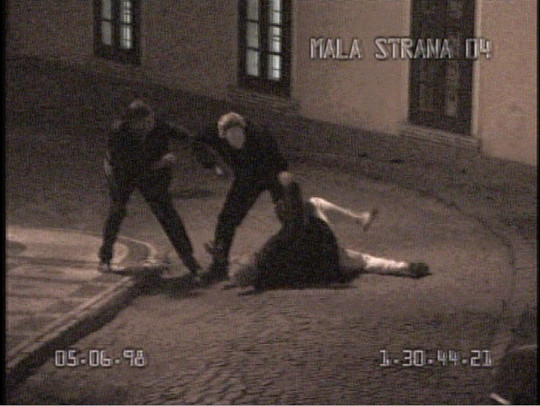
The Real Don Giovanni is an extremely quirky 1998 docu-drama starring Sir Thomas Allen. It’s set during a work when he is singing the Don at the Stavovské divadlo; site of the opera’s 1787 premier. He’s also investigating his theory that Don Giovanni was based on Giacomo Casanova who was, indeed, he claims, much involved in the creation of the opera. He pursues his research in various archives, including Duchkov Castle, ladies’ bedrooms and through an interesting encounter with two tarts in a graveyard..
The Tanenbaum Garden
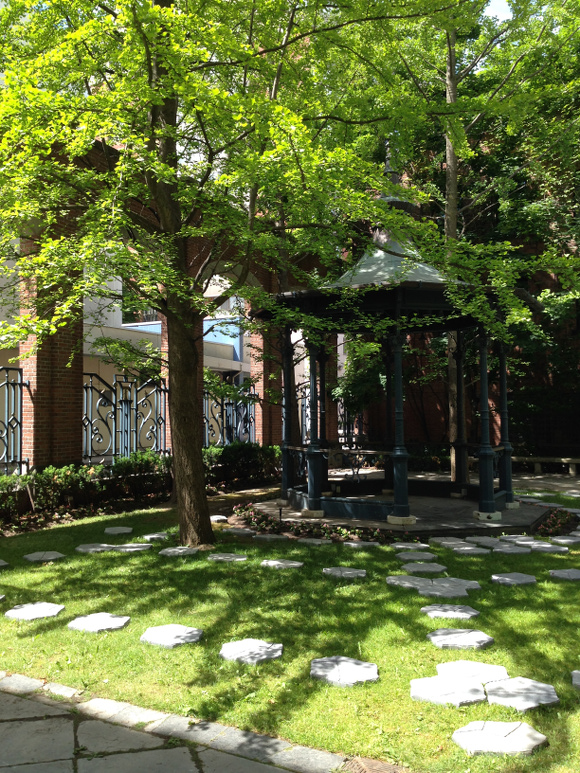
So, I stopped by the Tanenbaum Garden around noon today to get some shots of the Pelléas et Mélisande set. Obviously it looks a bit different with the sun high in the sky than in the evening but I think you’ll get the idea.
Pelléas et Mélisande in the Tanenbaum Courtyard Garden
Hidden away up an alleyway behind the COC’s ioffice and rehearsal complex is a very beautiful garden. I say hidden because I lived less than 200m away for 10 years before I discovered it. Last night it made a rather magical setting for Against the Grain Theatre’s new production of Debussy’s Pelléas et Mélisande. The piece is set in a gloomy castle and surrounding forest in Brittany. The high, ivy covered walls and ironwork of the performance space, enhanced by Camelia Koo’s fractured flagstones forming patterns on the grass, evoked the essentially sunless world of Maeterlinck’s poem. Costuming in the style of the period’s composition meshed nicely with the aesthetic of the roughly contemporary space.
Girard’s Parsifal on Blu-ray
François Girard’s production of Parsifal at the Metropolitan Opera was much written about at the time of the HD broadcast in March 2013. My review of that broadcast is here.I don’t think my opinion has changed very much. It’s a powerful and intensely beautiful production and there are some wonderful performances, especially that of René Pape. I’m not going to rehash the previous review but there were a few things I noticed second time around. In Act 1, for instance, the gendering of the scene is mirrored in other ways to emphasize the polarity. The knights are in white, the women in black. The men are in orderly circles, the women are just a crowd. Also the final scene is almost overwhelmingly intense. Kaufmann sings quite beautifully with fine diction, gravitas and simply gorgeous high notes. Pape caps off a performance of great pathpos and humanity with the gentle gesture with which he closes Kundry’s eyes in death. It’s compelling stuff.
Just for fun 10/n
Photograph by: Greg Pender, The Starphoenix
It’s Operaramblings’ favourite “crazy lady” Ambur Braid currently singing The Queen of the Night in Saskatoon (of all places). The full review from The Starphoenix is here.
Shelter
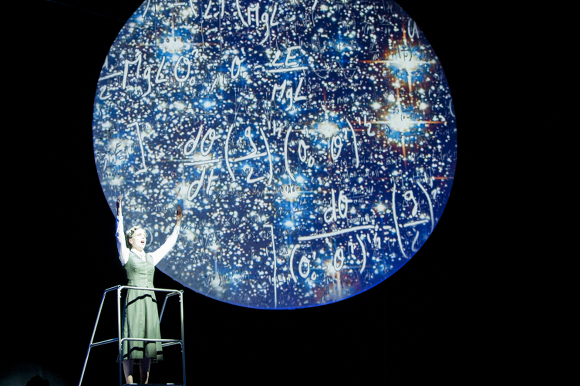
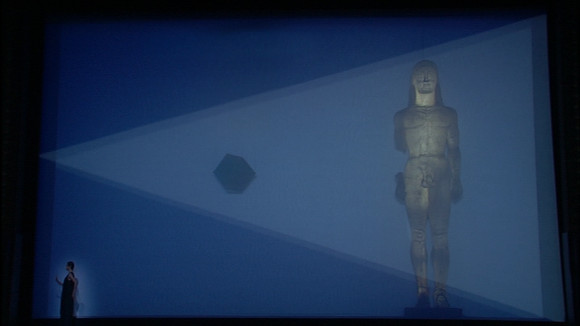
Shelter; music by Juliet Palmer, libretto by Julie Salverson, has been ten years in the making. It premiered in Edmonton a couple of years ago, finally, got its Toronto premiere at the Berkeley Street Theatre last night under the auspices of Tapestry. It’s a complex and eclectic piece dealing with what it is to be human in a nuclear age. There are two parallel plots which intersect in a way that makes dramatic sense but violate conventional notions of synchronicity. This is, after all, a piece rooted in post Einsteinian physics. The first concerns Austrian Jewish physicist Lise Meintner, one of the discoverers of nuclear fission. She has been forced into exile by the Anschluss and is seen here refusing to work on the Manhattan project. The second plot concerns a highly stereotypical 1950s American couple Thomas and Claire who meet at a social, marry and quickly produce a child; Hope. Their “American Dream” is shattered when it turns out that the baby glows! Fast forward 21 years and Hope is demanding her freedom in a world from which she has thus far been sheltered. Reenter Meintner, engaged by Thomas to be Hope’s tutor, and still obsessing about the Manhattan project. The final twist comes with the arrival of the Pilot, in WW2 Army Air Corps uniform, who uses a Geiger counter to find his prey. He fails to convince Meintner to change her mind but does persuade Hope to fulfill her destiny as He pilots the Enola Gay to 31,000 feet and a clear sky. It’s weird, disturbing and powerful.
Gluck à l’outrance
Gluck’s Alceste is not as well known as Orfeo ed Eurydice or the Iphigénie operas but in some ways it’s an even better example of what Gluck meant by “reform”. It’s simple, restrained and elegant. The plot has some similarities with Orfeo. The good king of Thessaly, Admète, is doomed to die unless someone else volunteers in his place. Naturally enough, this being opera, his wife Alceste volunteers. There is much dignified lamenting. She descends to Hades. Husband and wife reproach each other for their selfishness in being the one to die. Hercules shows up and, in gratitude for earlier hospitality, saves the day. There is (dignified) rejoicing. It;s an easy score to listen to with plenty of good tunes but no blockbuster, memorable, numbers.