
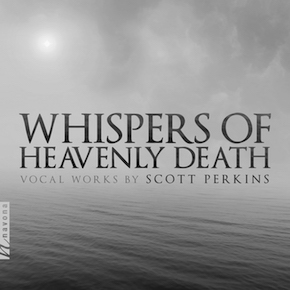
 Whispers of Heavenly Death is a new CD of song settings by Scott Perkins. It’s a generously filled disk with nine works amounting to some 33 tracks. First up are five Walt Whitman poems from the eponymous collection. The settings are sparse but quite varied with legato vocal lines handled nicely by the dark toned mezzo Julia Mintzner. Accompaniment, as on the rest of the disk, is by Eric Trudel.
Six settings from the Holy Sonnets of John Donne follow sung by soprano Jamie Jordan. The music here is spikier and set much higher. It suits Jordan’s light, bright soprano. My favourite tracks are next; four settings of riddles from the Exeter codex sung by baritone Dashon Burton. They are very varied. Ic eom ƿunderlicu ƿiht is jerky and set very high for baritone with arpeggio accompaniment. Moððe ƿord fræt is very rhythmic while Ic ᵹefræᵹn for hæleþum is in a very beautiful, liturgical, vein sounding more medieval than the rest. Ƿrætlic honᵹað gets perhaps the only blues setting an Old English text has ever got! The very short Ƿundor ƿearð on ƿeᵹe is just plain weird. Plenty here for any Old English geek.

 The 6th in the annual series of fundraisers for St. Mike’s ICU in memory of Elizabeth Krehm took place at Christ Church, Deer Park last night. Once again Evan Mitchell had assembled a fine orchestra of volunteers and Elizabeth’s sister, Rachel, sang. The orchestra book ended the program with the overture from Hänsel und Gretel and Brahm’s 4th Symphony; the latter a very red blooded account indeed with the brass and woodwinds getting a workout. The main interest though was the premier of Come Closer: Songs on Texts by Elizabeth Krehm. The texts are drawn from selections of Elizabeth’s writing, from Grade 2 to near the end of her short life, selected by Rachel. The music is by Ryan Trew. They are really quite evocative texts, showing a surprising emotional depth. The settings are apt; steering a middle ground between artsy and schmaltzy, and Rachel sang with real feeling. It was a loving and lovely act of remembrance.
 I was fortunate, back in November 2016, to be at the Aga Khan Museum when Miriam Khalil gave an
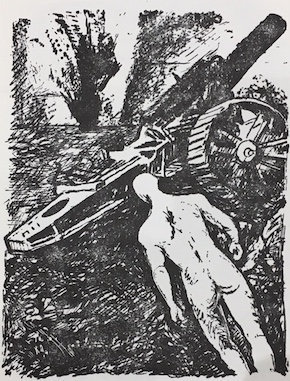 Last night’s TSO performance of Britten’s War Requiem was a bit of a mixed bag. There were things to like but, overall, I was not greatly moved; which I expect to be by this work, and it seemed like a very long evening for one work of modest length.
 I haven’t heard a lot of music by Andrew Staniland but what I’ve heard I’ve liked so I was pleased to get my paws on a recent recording of songs by him; Go by Contraries. There are three pieces on the disk. The first, and longest piece; Earthquakes and Islands, is a setting of eight poems by Toronto poet Robin Richardson. It’s the work that reminds me most of Dark Star Requiem. Words and music are both quite quirky. My Voice, In My Mouth, for example. is a meditation in an oncologist’s waiting room about the consequences of getting close to a lion. The music is full of variation; tonally, rhythmically, harmonically and dynamically. It’s quite surprising the range of sounds Staniland can conjure up from a piano and two singers. It always appears to be rooted in the text though and even long voiceless passages come back logically to words.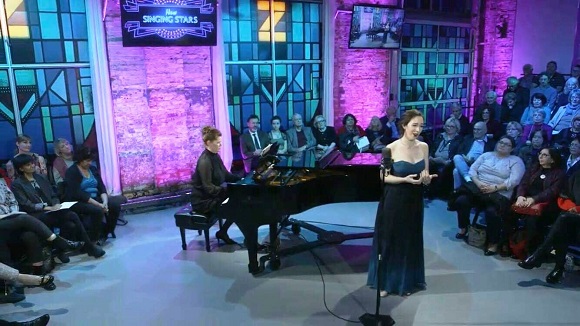
 The Art Song Foundation of Canada has launched a new free on-line magazine called, somewhat unsurprisingly, Art Song Canada. The first issue has three articles including a very interesting one by Gerald Finley. You can sign up for it and see the first issue
 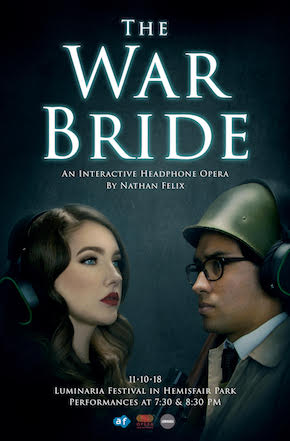 I’m not going to get to see this (obv!) but I am intrigued as it’s a concept I’ve not come across before. Next Saturday (November 10th) Mexican-American composer, Nathan Felix, will use headphones to present his new opera titled, The War Bride, at Luminaria Contemporary Arts Festival in San Antonio Texas. There will be two performances starting at 7:30pm and 8:30pm in Hemisfair Park. Felix is known for his guerilla style approach in presenting classical music in unconventional spaces and The War Brideis given no exception, with a performance outside along the riverwalk at Hemisfair Park.
