Tiefland

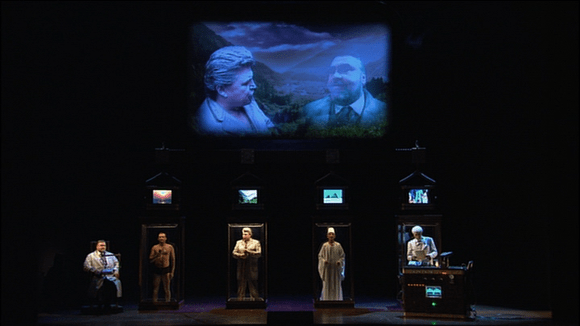
Eugen d’Albert is largely forgotten as a composer but his seventh (of twenty) opera, Tiefland, is still performed occasionally in German speaking countries.  It’s an odd work.  The plot is melodramatic with a cloying degree of sentimentality; sort of Mascagni meets Gounod, while the music is like pastoral Wagner (think the way the woodwinds are used in Tristan) with touches of Carmen and, just occasionally, hints of Sullivan (one of d’Albert’s teachers).  For a 1903 work it feels curiously retro.

tiefland1

Continue reading

The Merchant of Venice

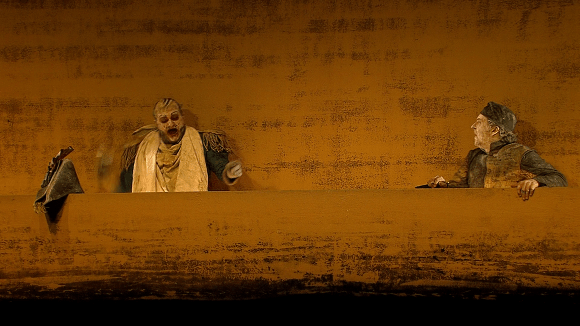
André Tchaikowsky’s The Merchant of Venice was written in the years leading up to his premature death in 1982 but, despite interest from ENO in the 1980s, it did not get a full performance until David Pountney decided to stage it at the the 2013 Bregenz Festival with Keith Warner directing.  It’s hard to explain the neglect though Pountney ascribes it some degree as the fate of the emigré  (the composer being a Polish Jew domiciled in the UK).  The Merchant of Venice is a really solid piece.  It’s got all the elements; a strong story, a really interesting but not overly intimidating score and really good writing for voice (it really is singable).  It’s the right length at around two and a half hours and it doesn’t call for unreasonable orchestral or vocal forces.  John O’Brien’s libretto even manages to overcome some of the objections to staging Shakespeare’s play.  While one might consider the Shakespeare piece to be antisemitic, O’Brien’s libretto is much more clearly about anti-semitism.  There’s also a clear homoerotic element in the Antonio – Bassanio relationship and perhaps too in Portia – Nerissa.

mov1

Continue reading

Rusalka à la Freud

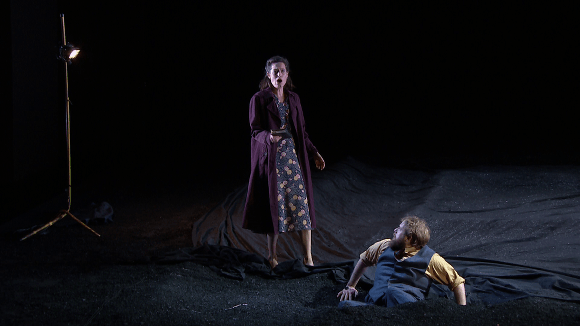
Stefan Herheim’s 2012 production of Dvořák’s Rusalka for Brussels’ La Monnaie Theatre is predictably ambitious and complex.  He takes an explicitly Freudian (by way of Lacan) view of the piece(*).  The female characters are representations of male views of the female and, sometimes it seems, vice versa.  It’s seen most clearly in Act 2 and I found unpacking Act 1 much easier after seeing it so I’m going to start there.  We open not with bucolic, if coarse, peasants preparing for a wedding feast.  We are on a street in a scruffy part of, I guess, Brussels.  The gamekeeper and kitchen boy are replaced by a priest and a policeman.  The traditional dismembered game animals become a female chorus, many of them nuns, with exaggerated secondary sexual characteristics.  There is, essentially, an orgy.  Clearly the human world that Rusalka cannot enter is about sex in its most physical aspects not meaty Central European banquet platters!  Rusalka and the Foreign Princess are dressed and wigged identically.  They are quite freely interchanged.  Lines that are canonically addressed to one are addressed to the other and so forth.  It’s pretty clear that each represents, albeit imperfectly, the Prince’s ideal woman.  Rusalka is the unattainable feminine ideal; flawed in that she cannot engage in fully satisfying sexual activity.  The foreign Princess is sexually satisfying but falls short precisely by not being unattainable.  Some less clear male duality is suggested by the appearance of the Vodnik dressed as the Prince.  It just gets weirder from there with the ballet of nuns, prostitutes, fish, squid and heaven knows what else spilling over into the auditorium while the Prince and Foreign Princess watch from a box and Rusalka and the Vodnik get caught up in the action.  At the conclusion of the act it’s Rusalka not the Princess that he begs for help.

rusalka1

Continue reading

What’s black and white and red all over?

The 2010 Oslo recording of Monteverdi’s L’incoronazione di Poppea is one of the strangest opera videos I have ever seen.  Besides having an almost complete set of the characteristics that critics pejoratively assign to Regietheatre it also has a very unusual video treatment that goes well beyond quirky camera angles and overly intrusive close-ups.  So the box is being entirely accurate when it states “Based on a performance directed by Ole Anders Tandberg.  Adapted and filmed by Anja Stabell and Stein-Roger Bull”.

poppea1

Continue reading

All the Mozart

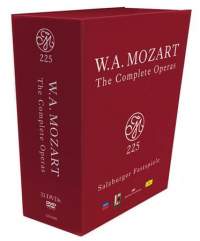
dg0743902Deutsche Grammophon have re-released the Mozart M22 recordings in a new edition.  It contains all the operas, singspiels and other bits and pieces mostly recorded at Salzburg in 2006.  The whole thing comes to 33 DVDs recorded in HD and with 5.1 surround sound.  It’s also incredibly cheap.  Amazon.ca has it listed at C$139.99 including shipping.  Full details are available on the Presto Classical site which is likely a good source for UK buyers but others might want to watch the postage charges on this one!  The set includes some fine productions including Kušej’s Don Giovanni and La clemenza di Tito and Guth’s Le nozze di Figaro.  It’s also still currently the only way of getting hold of Herheim’s notorious Die Entführung aus dem Serail which has been out of the catalogue for ages and still isn’t available separately.  The only drawbacks I can see are that many collectors will already have many of these discs and it’s only available on DVD rather than Blu-ray (but most of these recordings never did make it to Blu-ray).  It would make a great Christmas present for someone starting an opera DVD collection.

Saul og David

Carl Nielsen’s operas don’t get performed much outside his native Denmark so it’s no surprise that the only video recording of his 1902 opera Saul og David was recorded in Copenhagen.  The libretto is a fairly straightforward telling of the familiar story of Saul, David, Goliath, Samuel and so on.  The music is very much of its time.  It’s bold and lyrical; perhaps reminiscent of Strauss in a conventional mood or, perhaps, Elgar.  There are some really good choruses and David and Michal get a gorgeous duet in Act 3.

1-ox

Continue reading

Wozzeck as puppet theatre

Wozzeck is a tricky piece for a director.  There seem to be two possible approaches.  One can find a character for Wozzeck himself that resonates with contemporary audiences and treat the piece more or less realistically.  That’s the approach taken by both Bieito and Tcherniakov.  Alternatively one can run with the overtly expressionist aspects of the piece and present it in a more abstract way as Peter Mussbach did.  Andreas Homoki’s 2015 Zürich production takes the second route.  The piece is presented as if the characters are puppets in a puppet theatre in a sort of ultra-grim version of Punch and Judy.  It’s visually quite arresting and there are some very well composed scenes.  To give just one example, immediately after Wozzeck has decapitated Marie the chorus appear as nightmarish Maries while Wozzeck sits nursing the severed head.  That said, the concept does pall and maybe hasn’t really got the legs, absent any other real directorial ideas, to carry the piece for two hours.

1-wozzcap

Continue reading

Words (almost) fail me

If I had been languishing in obscurity for 250 years like Joseph Bodin de Boismortier I think I’d rather stay that way than be rescued by Hervé Niquet and the French “comedy” duo Dino and Shirley (Corinne and Gilles Benizio).  To be fair their take on Boismortier’s 1743 ballet-comédie Don Quichotte chez la duchesse isn’t nearly as bad as their previous brutal murder of Purcell’s King Arthur but it’s really weird and patchy.  It’s rather hard to describe in fact.  It’s a sort of mash up of farce, commedia, slapstick and pastiche in which bits of baroque opera occasionally break out.  It’s also staged as meta theatre with the stage interacting with the pit and Niquet himself ending up in the action.

1-couple

Continue reading

The Romans, being wanton, worship chastity

Continuing my struggle with Britten’s The Rape of Lucretia I got hold of the Blu-ray recording of Fiona Shaw’s 2015 Glyndebourne production.  I’m beginning, I think, to see my way to understanding the problems inherent in the libretto and some of the strategies that can be used to overcome them.  The more minor problem is Junius and the odd scene early in Act 2 where he seems to be inciting the Romans to revolt while acting as a general in Tarquinius’ army while, also, apparently, been in some sense complicit in the rape.  So we have a two faced power hungry schemer who is oblivious to the consequences of his mischief making; whether rape or rabble rousing (a sort of Roman Boris Johnson).  Most productions ignore this aspect of things and probably rightly.

0-chorus

Continue reading

Rationing the rapture

Katharina Wagner’s take on Tristan und Isolde recorded at Bayreuth in 2015 is hard to unpack.  There are some hints in a short essay in the booklet accompanying the disk and a few more in the interview with conductor Christian Thielemann included as an extra but it still leaves the viewer with a lot to do.  It’s essentially unromantic and quite abstract.  A lot of stuff that happens in a traditional interpretation just doesn’t happen but there’s not really anything much to replace it.  What’s left is the story of two people who fall in love in a situation where that is bound to end badly and where, despite the best efforts of pretty much everyone else, it does.  It’s actually quite nihilistic.  Tristan, and maybe Isolde, seek a kind of transcendence in love/death but there is none.  At the end Isolde doesn’t die but something in her does.  It had me thinking of Bergman’s The Seventh Seal (but then so much in life does).

1.gantry

Continue reading