Kaufmann’s Cav and Pag

Jonas Kaufmann made a double role debut as Turiddu and Canio in the classic verismo double bill of Mascagni’s Cavalleria Rusticana and Leoncavallo’s Pagliacci at the Salzburg Easter Festival in 2015,  The productions were directed by Philipp Stölzl and Christian Thielemann conducted with the Staatskapelle Dresden in the pit.

1.church

Continue reading

Bechtolf Round Two – Don Giovanni

Sven-Eric Bechtolf’s second Mozart/daPonte for Salzburg was Don Giovanni which premiered in 2014.  There are some similarities with his Così fan tutte.  He uses a symmetrical unit set again and shows a fondness for creating symmetrical tableaux vivants but there the similarities pretty much end.  I could find a consistent, believable set of humans in Così but not so much in Don Giovanni.  The problem is really the man himself.  Bechtolf, in his notes, seems to be arguing that Don Giovanni can make no sense in an age of pervasive accessibility and exposure to all things sexual.  Da Ponte’s Don requires a climate of sexual repression for his essence; to Bechtolf a kind of Dionysian force (he cites Kierkegaard), to make any sense as a human.  I think I get that but then, I think, the challenge becomes to create a Don Giovanni who does make sense to a 21st century audience as, in their different ways, do Guth and Tcherniakov.  Bechtolf seems to treat the character not so much as a human rather than as a kind of energy focus who exists by igniting aspects of the other characters; whether that’s lust or jealousy or hatred.  He caps off this idea at the end by having Don Giovanni reappear during the final ensemble as a kind of mischievous presence still chasing anything in a skirt, even if it’s, perhaps, from another world.  It’s an idea that I could not really buy into.

1.stab

Continue reading

Newbury’s Norma on DVD

Kevin Newbury’s production of Bellini’s Norma made it to Toronto via San Francisco, Barcelona and Chicago with Sondra Radvanovsky singing the title role (at least some of the time) in all four cities.  It was recorded for DVD and Blu-ray at the Liceu in Barcelona in 2015.  Watching the DVD didn’t change my opinion of the production.  Here’s what I said about it on opening night in Toronto:

Kevin Newbury’s production is perhaps best described as serviceable.  I have seen various rather desperate efforts made to draw deep meaning from it but I really don’t think there is any.  That said, it looks pretty decent and is efficient.  The single set allows seamless transitions between scenes which is a huge plus.  So, what does it look like?  It’s basically a sort of cross between a barn and a temple with a back wall that can raised or moved out of the way to expose the druids’ sacred forest.  There’s also a sort of two level cart thing which characters ascend when they have something especially important to sing.  Costumes were said to have been inspired by Game of Thrones; animal skins, leather, tattoos (which actually don’t really read except up very close), flowing robes.  Norma herself appears to be styled, somewhat oddly, on a Klingon drag queen. The lighting is effective and there are some effective pyrotechnics at the end.  All in all a pretty good frame for the story and the singing.

There did seem to be far fewer pyrotechnics in the Barcelona staging though (either that or the video direction pretty much ignores them).
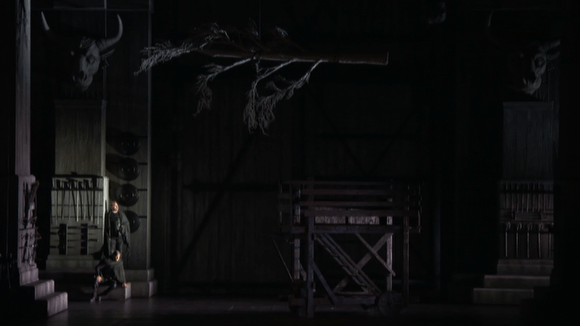
1-stage

Continue reading

Shattering Parsifal

Dmitri Tcherniakov’s 2015 production of Wagner’s Parsifal recorded at the Staatsoper in Berlin in 2015 left me emotionally drained as I don’t think I’ve ever been after watching a recording.  I can only imagine what it must have been like to experience this live.  The combination of the production, exceptional singing and acting and Daniel Barenboim’s conducting is quite exceptional.  It’s not going to be easy to unpack it all coherently but here goes…

1-ritual

Continue reading

Turandot with the Berio completion

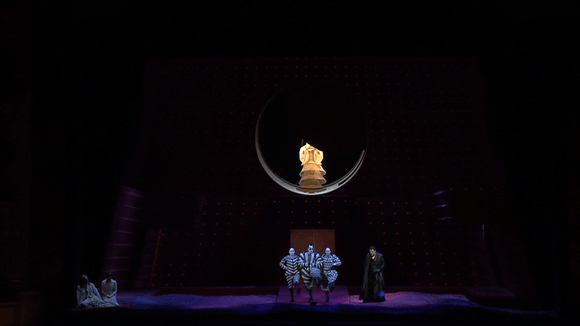
La Scala and Riccardo Chailly have embarked on a project to record all the Puccini operas.  The first one, recorded in 2015, is Turandot with a new completion of the third act by Berio rather than the usual Alfano version.  The director was Nikolaus Lehnhoff with Nina Stemme as Turandot and Aleksandrs Antonenko as Calaf.

1-ppp

Continue reading

A new Salzburg da Ponte cycle – Così fan tutte

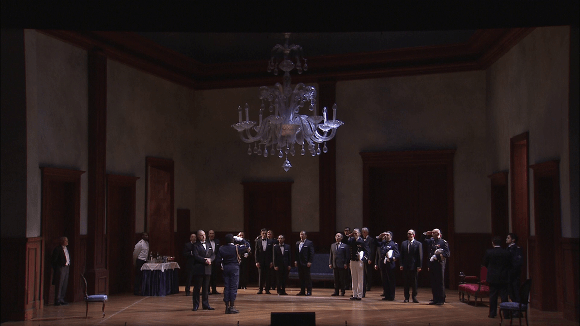
Every few years the Salzburg Festival replaces the productions of the three Mozart/da Ponte collaborations with new productions.  At least in recent years they have entrusted all three to the same director but the “refresh” happens in different years and not always in the same order.  I reviewed Claus Guth’s offerings here (Le nozze di Figaro, 2006; Don Giovanni, 2008; Così fan tutte, 2009) and noted the way that certain linking elements developed over the course of the “cycle”.  I was interested to see whether the same thing held for the newest iteration by Sven-Eric Bechtolf.  All three have now been released on Blu-ray (though due to availability issues I have the Così on DVD) so I thought I should watch them in the order they appeared at the festival and see what transpires.  So here we go with Così fan tutte recorded in 2013 in the Haus für Mozart.

1-guys

Continue reading

Moors and Christians

Schubert could write great melodies and he had a real affinity for the voice so one might expect him to have been successful when he turned his hand to opera.  He wasn’t with Fierrabras which wasn’t performed until decades after his death and has been revived seldom since, most recently at Salzburg in 2014 where it was recorded. It’s easy to see why.  The libretto is awful and even if the music were really amazing, which it isn’t but more of that later, I doubt it would have made much impact.

1-knickets

Continue reading

La fuga in maschera

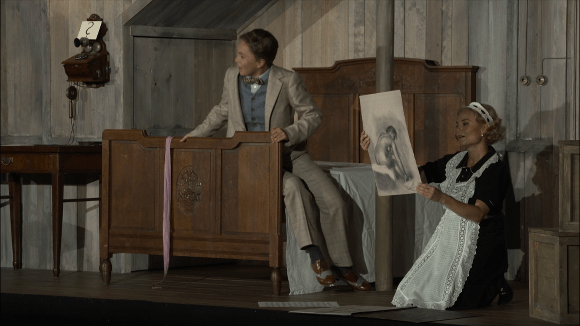
I find it interesting the way some opera composers become canonical to the point where their most unsuccessful (often deservedly so) works still get produced while others, equally famous in their day, disappear pretty much entirely.  One of the latter group is Gaspare Spontini who had a long career stretching from the the late 18th into the middle of the 19th centuries during which he was active in Italy, Paris, Vienna and Germany.  There was a revival of his La Vestale at La Scala with Visconti directing and Callas in the title role but otherwise the 20th century pretty much ignored him.  So obscure had he become that the Wikipedia entry for his operas describes his La fuga in maschera as “genre unknown”.  Perhaps that’s not so surprising as the work was last performed in 1800 and the score was thought to be lost until it turned up in an English bookshop in 2007.  Subsequently it was performed in 2012 at the Teatro GB Pergolesi in Jesi as part of the Festival Pergolesi Spontini.

1-portrait

Continue reading

Historic Der Freischütz

In the late 1960s and early 1970s the Hamburg State Opera cooperated with Polyphon and NDR to make a series of thirteen films for television of assorted operas.  They are all available as a boxed set called Cult Operas of the 1970s but one or two of them are also available separately.  One such is a 1968 recording of Weber’s Der Freischütz.  It was directed for film/TV by Rolf Liebermann and recorded in the studio using the HSO’s stage production.  I think the action is lip synched to a pre-recorded soundtrack (normal practice at the time) but I’m not sure.

1-men

Continue reading

Cav and Pag

Mascagni’s Cavalleria Rusticana and Leoncavallo’s Pagliacci are not only a commonly coupled pair of operas but pretty much define the genre we call verismo.  It’s a curious genre in a lot of ways.  Musically it defines a style, brought to its highest state by Puccini, that is a sort of Fukuyama-esque “end of opera” after which everything is, for a section of the opera audience, modern, inaccessible and frightening.  It’s also dramatically an attempt to get away from stories from myth and history and root the drama in “stories of everyday folk”.  Which is fine, I suppose, if one believes the only things “everyday folk” care about are female constancy and the more pagan end of Catholicism for these stories tend to be a touch unsubtle; “she done him wrong so he killed her” (and her dog and he probably crashed her truck too).  It’s actually quite ironic that Puccini, held up as the arch exponent of verismo, rarely actually goes down this path.  Il Tabarro perhaps, maybe Suor Angelica, at a stretch Tosca but in large part his material is drawn from the usual well of opera plots.  So Cav and Pag is interesting as almost pure verismo.

cav1

Continue reading