The Romans, being wanton, worship chastity

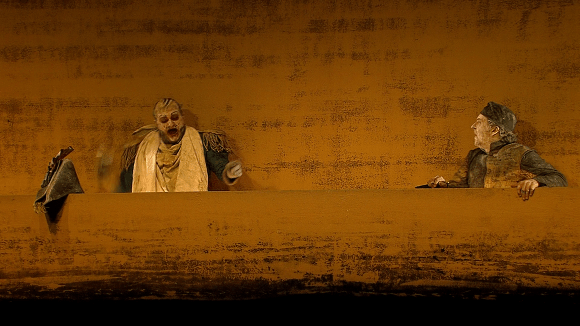
Continuing my struggle with Britten’s The Rape of Lucretia I got hold of the Blu-ray recording of Fiona Shaw’s 2015 Glyndebourne production.  I’m beginning, I think, to see my way to understanding the problems inherent in the libretto and some of the strategies that can be used to overcome them.  The more minor problem is Junius and the odd scene early in Act 2 where he seems to be inciting the Romans to revolt while acting as a general in Tarquinius’ army while, also, apparently, been in some sense complicit in the rape.  So we have a two faced power hungry schemer who is oblivious to the consequences of his mischief making; whether rape or rabble rousing (a sort of Roman Boris Johnson).  Most productions ignore this aspect of things and probably rightly.

0-chorus

Continue reading

Rationing the rapture

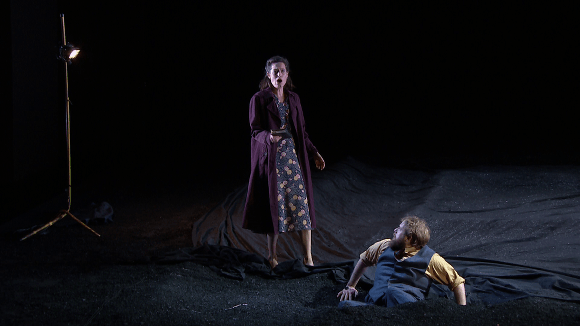
Katharina Wagner’s take on Tristan und Isolde recorded at Bayreuth in 2015 is hard to unpack.  There are some hints in a short essay in the booklet accompanying the disk and a few more in the interview with conductor Christian Thielemann included as an extra but it still leaves the viewer with a lot to do.  It’s essentially unromantic and quite abstract.  A lot of stuff that happens in a traditional interpretation just doesn’t happen but there’s not really anything much to replace it.  What’s left is the story of two people who fall in love in a situation where that is bound to end badly and where, despite the best efforts of pretty much everyone else, it does.  It’s actually quite nihilistic.  Tristan, and maybe Isolde, seek a kind of transcendence in love/death but there is none.  At the end Isolde doesn’t die but something in her does.  It had me thinking of Bergman’s The Seventh Seal (but then so much in life does).

1.gantry

Continue reading

Abstract Fidelio

Fidelio is an interesting piece.  The music is great and it has a powerful, very straightforward, plot.  There are no convoluted subplots here.  But there is a lot of spoken dialogue which slows things down.  Is it necessary?  Claus Guth doesn’t think so and in his 2015 Salzburg production he replaces the dialogue with ambient noise and also doubles up Leonora and Don Pizarro with silent actor “shadows”; the former using sign language in the manner of the narrator character in Guth’s Messiah.  It works remarkably well.  The ambient noise sections are quite disturbing and the “shadows” add some depth, especially the frantic signing in the final scene.  Perhaps worth noting that the “noise” contains a lot of very low bass and precise spatial location.  It may need a pretty good sound system to have the intended effect.

1.room

Continue reading

Alcina in Aix

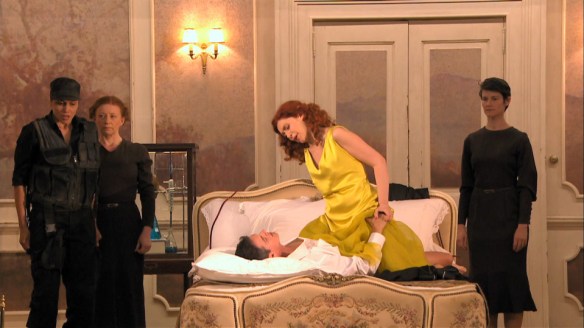
Katie Mitchell’s production of Handel ‘s Alcina recorded at Aix-en-Provence in 2015 is extremely interesting.  It’s almost complete with maybe twenty minutes of the ballet music cut.  None of the ballet is actually staged as such.  It’s also a Mitchell special multi-space set (like Written on Skin) with the lower level having Alcina/Morgana’s boudoir, drawing room or whatever at any given moment flanked by two smaller spaces which are the “personal” spaces of the two sisters.  When the ladies withdraw from the public/enchanted space they are replaced by actresses who look decades older.  Only late in the piece as Alcina’s magic fades do the two worlds get confused.  The upper level of the set is taken up with the giant machine that turns Alcina’s victims into taxidermied animals.  The overall aesthetic is upscale modern with lots of actors as very competent servants.

2.alcina

Continue reading

Ossian meets Anne of Green Gables

Rossini’s La donna del Lago is based on the Walter Scott poem, itself a deliberately romantic view of Scottish history, simplified until not much is left but the rivalry for the heroine’s hand by her three suitors and a completely unexplained war between the king of Scotland and the Clan Alpine.  Dramatically it’s thin indeed but it’s Rossini so there is crazy virtuosic music and it’s very hard to cast.  One needs two mezzos; one a mistress of Rossinian coloratura, the other more dramatic, and two tenors; both of which can do the crazy high stuff.  The supporting roles aren’t easy either.  Realistically only a major house could cast this adequately.

1.anne

Continue reading

The clutter of bodies

The latest Handel oratorio to be given the operatic treatment by Glyndebourne is Saul, which played in 2015 in a production by Australian Barrie Kosky.  It’s quite a remarkable work.  The libretto, as so often the work of Charles Jennens, takes considerable liberties with the version in Samuel and incorporates obvious nods to both King Lear and Macbeth as well as more contemporary events.  David’s Act 3 lament on the death of Saul, for instance, clearly invokes the execution of Charles I.  What emerges is a very classic tragedy.  Saul, the Lord’s anointed, is driven by jealousy and insecurity deeper and deeper into madness and degradation and, ultimately, death.  This is the basic narrative arc of the piece.

1.head

Continue reading

Brokeback Mountain

I’ve become a little wary of operas based on best selling novels and/or Hollywood films so I approached Charles Wuorinen’s Brokeback Mountain with a certain amount of skepticism.  I should not have.  It’s a Gerard Mortier commission; originally for NYCO but, following that débacle, it followed him to the Teatro Real in Madrid where it premiered in 2014.  The libretto is an adaptation by Annie Proulx of her original story.  Always a good sign.

1.sheep

Continue reading

Guillaume Tell

Rossini’s last opera, Guillaume Tell, was written for Paris and is an extremely ambitious piece of great musical sophistication.  It’s also very long.  Performed uncut, a rarity, it runs something like four hours including ballets.  It’s also hard to cast with the role of Arnold Melcthal in particular making unusual demands.  It’s a high tenor role combining the flexibility needs of a typical Rossini role with something much more heroic.  The soprano role of Mathilde has some of the same issues; signature Rossini coloratura is combined with the sort of dramatic heft one might more associate with early Wagner.

1.boat

Continue reading

Another fine Cesare

Handel’s Giulio Cesare is pretty well served in terms of video recordings.  The very fine Glyndebourne and Copenhagen versions get some serious competition from the 2012 production that inaugurated Cecilia Bartoli’s reign as director of the Salzburg Whitsun Festival.  The production is by Moshe Leiser and Patrice Caurier.  It’s set in somewhere like Iraq in an immediately post-war period.  It’s quite dark, probably darker than Negrin’s in Copenhagen and world’s away from McVicar’s almost RomCom version.  There’s a lot of violence and some pretty sleazy sex.  A lot of this centres around Tolomeo who is portrayed as beyond revolting.  There’s a scene where he rips guts out of a statue of Caesar and starts to gnaw on them and there is a fair bit in that vein.  Caesar and Cleopatra are portrayed ambiguously too.  Sure they are the “heroes” of the piece but Cleopatra’s delight in flogging off her country’s oil wealth to the Romans shows a degree of cynicism.  This is not a production for the Konzept averse but I think all the choices made have a point and the overall effect is coherent.  It’s not without humour either.  Cleopatra sings V’adore pupille in a 70s blonde wig while riding a cruise missile with Caesar watching through 3D glasses.

1.head

Continue reading

Dido as tragédie lyrique

The influence of the myth that Purcell’s Dido and Aeneas was written for a girls’ school seems to have had a long lasting influence on performance practice resulting in presentations that are very short and uncomplicated.  In reexamining the work for the Opéra de Rouen Haute-Normandie, Vincent Dumestre of Le Poème Harmonique and stage directors Cécile Roussat and Julien Lubek come to different conclusions and, accordingly, present the work quite differently.  They argue that the work was written for the court of Charles II though quite possibly never performed there owing to the death of the king and the turmoil that followed.  They further argue that existing score fragments show numerous places where dance movements should be inserted and that this indicates something akin to Lully’s tragédies lyriques, especially as Lully was much in vogue in London at the time.

1.duet

Continue reading