Le postillon de Lonjumeau

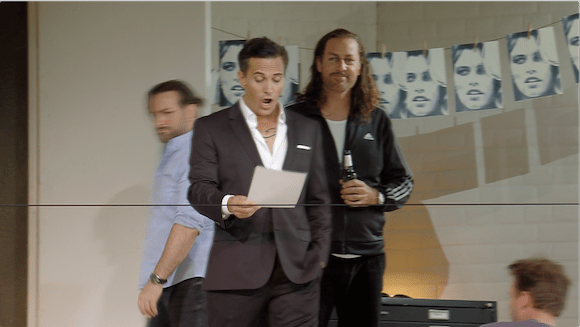
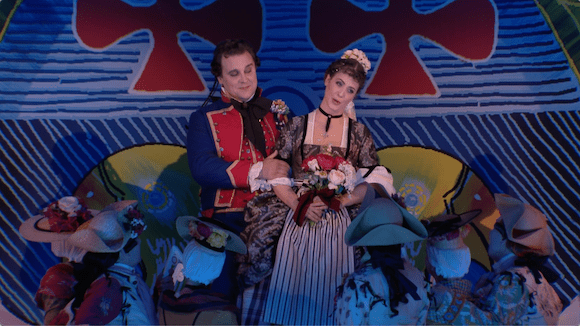
Most people probably know Adolphe Adam as the  composer of the music for the ballet Giselle but he was more than that. He was also a scholar who worked hard to study and revive the work of Rameau and other pre-Revolution composers. So, when tasked with composing a piece for the Opéra Comique he chose to combine elements that had produced previous “hits”; a vocationally based plot, a love story and so on with a Louis XV setting that allowed him to include pastiche Baroque. The result was Le postillon de Lonjumeau; a work that had much success across Europe during the mid 19th century (Wagner conducted it in Riga) but which had long disappeared from the repertory when the Opéra Comique revived it in 2019. Denise Wendel-Poray reviewed it in the Summer 2019 issue of Opera Canada and it has now been released on DVD and Blu-ray.
1.marriage

Continue reading

Spare and compelling Tristan

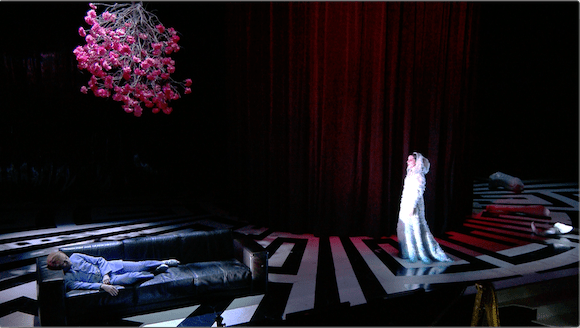
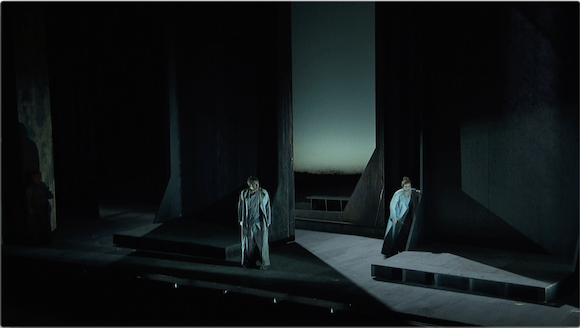
I’m rarely disappointed by a Pierre Audi production and his Tristan und Isolde for Teatro dell’opera di Roma, recorded in 2016, was far from that.  It’s a bit of a slow burn but then so, really, is the work itself.  It’s starkly simple.  The sets contain few elements and no fuss.  Costuming is almost drab but the direction of the singers is compelling and it builds to a brilliant staging of the Liebestod with Isolde silhouetted, motionless in a kind of frame and absolutely nothing happening which, paradoxically, is riveting.

1.ship

Continue reading

Grim, dark Hoffmann

One of the interesting things about Offenbach’s Tales of Hoffmann is that there is no definitive edition so creative teams have a lot of flexibility in how they cut and combine material.  Director Tobias Kratzer and conductor Carlo Rizzi created a really interesting take for their production at Dutch National Opera in 2018.  It’s a very modern, very dark interpretation that while it keeps Offenbach’s music (though not interpolations like Scintille diamante) and the words are all from (some version of) the libretto the storyline varies a lot from what we are used to while keeping intact the central psychological fact that Hoffmann is incapable of relating to real women.

1.party

Continue reading

La morte d’Orfeo

Stefano Landi’s La morte d’Orfeo of 1619 is interesting for several reasons.  It’s one of relatively few operas from this early in the history of the art form that we have enough information on to perform.  It was also written in and for Rome so it reflects the clerical influences of that environment rather than the more secular Venice of Monteverdi.  It’s also an unusual take on the Orfeo legend.  It takes off from where Monteverdi and many others leave off.  Euridice is dead, for good this time, and the opera deals with the balance of Orfeo’s life.  Briefly, he is heartbroken and renounces Pleasure; including wine and women.  He compounds this by not inviting Bacco to a birthday celebration attended by most of the other gods.  Bacco and his female followers are not pleased.  Orfeo is torn to pieces by the Maenads.  Orfeo is quite OK with this because now he will be united with Euridice but Charon refuses to take him; a demi-god, across the Styx.  Mercury fetches Euridice from the Elysian Fields but she has drunk from Lethe and doesn’t recognise him.  She’s quite clear that she wants nothing to do with this so-called Orfeo.  Giove makes it up to Orfeo (who also drinks the water of Lethe and forgets Euridice) by making him into a constellation and all the gods rejoice.  (for consistency’s sake I’ve used the Italianised versions of the Roman versions of the various Greek characters in the same way as the libretto).

1.orfeoeuridice

Continue reading

Fernand Cortez

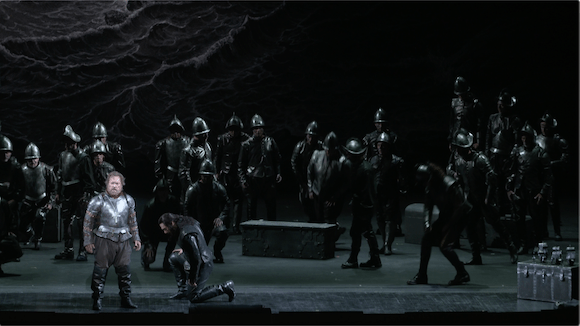
For probably the first time in almost 200 years the 1809 original version of Gaspare Spontini’s Fernand Cortez ou la conquête de Mexique got a theatrical run last October.  It was at the Teatro del Maggio Musicale Fiorentino in a new edition by Paolo Petazzi where it was recorded for video release.  There’s tons to unpack here because few people will be familiar with the work and if they are it will likely be in the very different 1817 version.  It’s also a far from straightforward production.

1.leadsoldiers

Continue reading

What is this anguish that each of us carries inside?

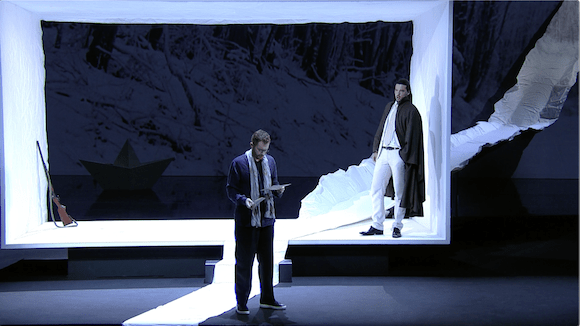
What is this anguish that each of us carries inside?  That’s the central question of Thomas Larcher’s chamber opera Das Jagdgewehr that premiered at the Bregenz Festival in 2018.  It’s based on a 1949 novel by Yasushi Inoue about a hunter, the three women in his life and the poet to whom he sends the women’s letters.  It’s a stark, intense tale of love, death, secrecy, loss and betrayal told in a prologue and eleven scenes over about an hour and a quarter.

1.letter

Continue reading

Another fifties Falstaff

Directors seem to see the 1950s as the logical time period to stage Verdi’s Falstaff though they come up with very different 1950s.  Robert Carsen set his in a rather dark world that pits the nouveau riche against a declining gentry.  Richard Jones went for a sort of Carry on film aesthetic that was entirely English.  Laurent Pelly in his production filmed at the Teatro Real in Rome in 2019, despite some overtly English elements in the set design,  gives us a distinctly continental European feel.  Indeed Falstaff, Pistola and Bardolfo might easily be hangovers from the more criminal end of the French resistance.  There’s much less of “class struggle” in Pelly’s rather straightforward production.  In fact it seems like a fairly light comedy with the darker aspects emerging only rarely.

1.gang

Continue reading

Double dwarf

The Deutsche Oper’s production of Zemlinsky’s Der Zwerg, recorded in 2019 in Berlin, is directed by Tobias Kratzer who seems to be the rising star among young German opera directors.  I can see why.  This is a thoughtful and clever production that really does have something to say without being unduly gimmicky.

1.piano

Continue reading

War and Peace

No, not the opera by Prokofiev but Robert Carsen’s rather brilliant take on Mozart’s Idomeneo recorded last year at the Teatro Real in Madrid*.  It’s a contemporary Mediterranean setting.  Crete is a completely militarised society.  Everyone is uniformed and carries weapons.  The Trojans are refugees living in a camp with all the pathetic accoutrements of refugee camp life.  Idomeneo and Elettra stand for the traditional “Make Crete Great Again” kind of nationalism while Idamante and Ilia look forward to a world where “Us” and “Them” dissolve in our common humanity.  Carsen, Neptune, this writer and, I think, listening closely to the music, Mozart side with the young lovers.

1.refugees

Continue reading

King Arthur in Berlin

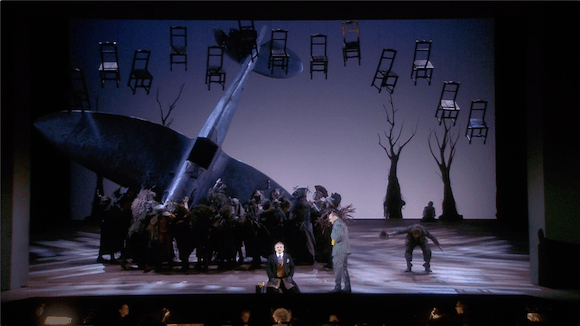
Purcell’s King Arthur contains some wonderful music but it also poses real staging issues.  How much of the play that the music supports does one include?  How to contextualise the unfamiliar version of the King Arthur story?  How to deal with the rather crude nationalism?  Sven-Eric Bechtolf and Julian Crouch come up with a very interesting approach for their 2017 production at the Staatsoper Berlin.

1.spitfire

Continue reading