Unknown's avatar

About operaramblings

Toronto based lover of opera, art song, related music and all forms of theatre.

Ariadne auf Dresden

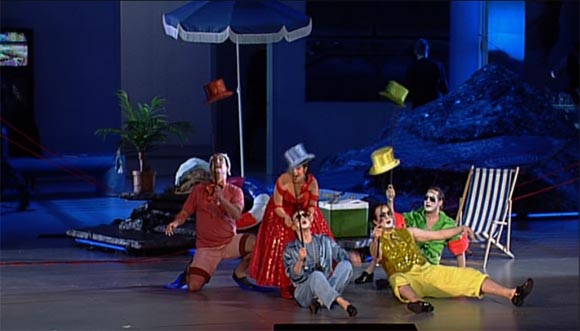
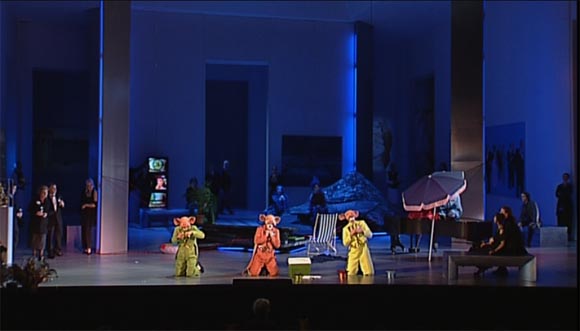
Marco Arturo Marelli’s 2000 production of Richard Strauss’ Ariadne auf Naxos is fascinating and compelling. He sets the work in the present at a very posh, arty party. Throughout there are extras playing party guests all over the place. The “opera” itself takes place in the middle of the main salon where the party is taking place. There are many interesting touches. For example, the Komponist features extensively in Act 2. Obviously smitten with Zerbinetta, he appears to accompany her on piano at the beginning of Groß mächtige Prinzessin and frequently watches from the side of the room as she is drooled over by various male party guests. Only at the end does the staging shift from the party to something that suggests some sort of reality in the relationship between Bacchus and Ariadne before dropping us right back into the party where the guests have completely ignored this piece of transcendence to go and watch the fireworks in the garden. The directorial take on Zerbinetta is interesting too. No flighty airhead here but rather a somewhat cynical and worldly young woman. It works rather well.
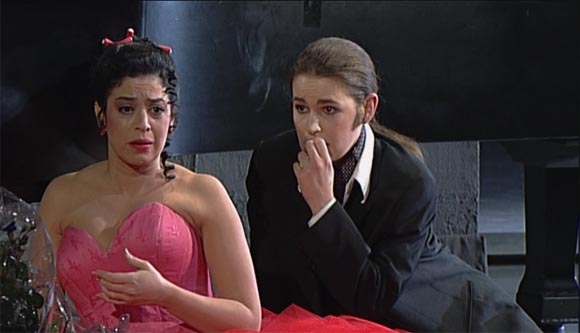
The performances are a bit mixed. The Act 1/Prologue is uniformly strong. Sophie Koch is an excellent Komponist. She sings well and acts very well indeed. Her, non singing, portrayal of the character in the second act as a gauche and geeky young man socially and emotionally out of his depth is really quite funny and touching. Friedrich-Wilhelm Junge is excellent as the Major-Domo. He has just the right touch of disdain. Moving on to the main action it’s a bit of a mixed bag. Iride Martinez’ Zerbinetta is a tour de force. She is completely consistent in her portrayal of the character to the extent of, at times, somewhat suppressing the beauty of the music in favour of dramatic verisimilitude. That’s not to say she sings badly. She sings very well but to a particular purpose. Susan Anthony’s Ariadne didn’t really convince me as much. She’s OK but “OK” isn’t a description I want to use about someone singing Es gibt ein Reich. It should make the hair stand up on the back of one’s neck and Anthony’s doesn’t. To be fair she’s not helped by the recording (see below). Jon Villars’ Bacchus is pretty good and the supporting nymphs and players are more than adequate. The players in particular have a lot of business and they handle it with considerable comic flair. Surprisingly, Sir Colin Davis’ reading of the score seems a bit bland. He doesn’t point the rhythms nearly as incisively as Levine on the Met recording or, even better, as Andrew Davies did in Toronto last year. The orchestra sounds a bit undercooked too. The recording may be a significant part of the problem here too.
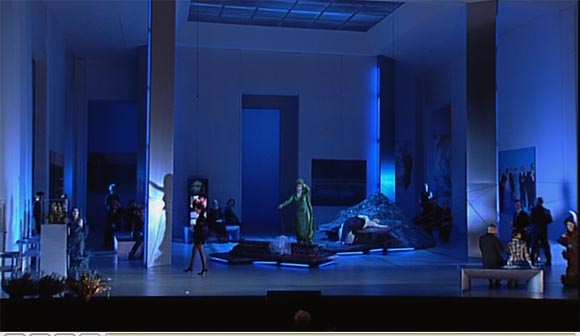
Technically this isn’t too, too bad for a budget Kultur effort. The video direction by Felix Breisach is very good. He shows us the whole stage often enough to appreciate the complexity of the director’s concept and its execution and his close ups aren’t excessively close. It’s a good balance. It’s a pity he’s not better served by the picture quality. It’s fairly good 16:9 (not 4:3 as the box and most on-line references suggest). It works pretty well on close ups but the lack of definition is a bit annoying on the longer shots.  This production would definitely have benefitted from being shot in HD. The sound is Dolby 2.0 and it’s at best OK. There’s no real sense of space and it’s a bit dry. It certainly doesn’t do Susan Anthony or the orchestra any favours. Subtitles are English only and documentation is limited to a track listing.
There aren’t a lot of versions of Ariadne on DVD. There’s a recent Guth production with Emily Magee, which is said to be quite good, an ancient film with Karl Böhm and a 1988 Met version. The Met version is musically far superior to the Dresden offering but features a deadly dull production that looks like it was first given half a century before Ariadne was written. Given that, I think this Dresden version is well worth a look.
Battle of Britten

Should there be popularity contests for operas? Is it legitimate to claim that one opera is “better” than another? Perhaps not, though opera house programming reflects the fact that the mobile vulgus has very firm views about what it will and will not part with its hard earned dollars, pounds or euros to see. In any case, today is Burns Day which seems as good a day as any to venture into the “base, common, and popular”. So herewith that most vulgar of instruments; an opinion poll:

OK, only really doing this to see if I can get polls to work.

Hunger and starvation is increasing everyday

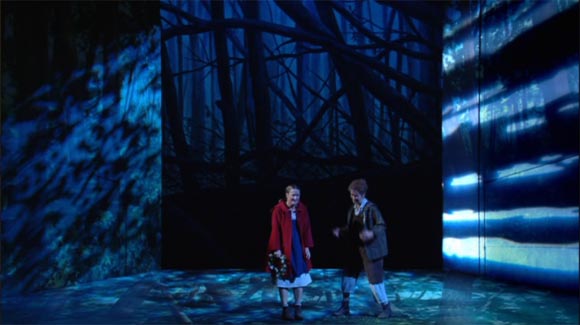
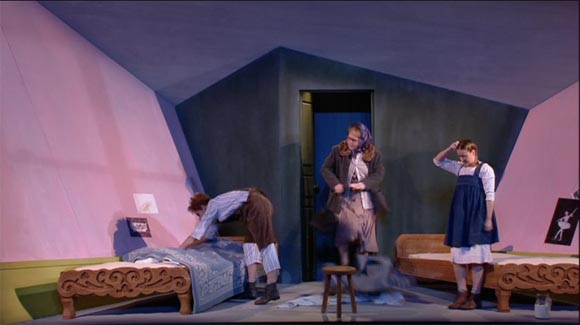
The Royal Opera House’s 2008 production of Humperdinck’s Hänsel und Gretel makes no concessions to the idea that this is a sort of operatic Nutcracker to be staged for the kiddies at Christmas. Patrice Caurier and Moshe Leiser’s production is firmly in the grim, and Grimm, tradition of central European folk tales and it’s sung in German.

For Act 1, designer Christian Fernouillet has created a claustrophobic bedroom with surfaces at odd angles in which the children (Angelika Kirschlager and Diana Damrau) play out their hunger displacement games until their angry mother (Elizabeth Connell) sends them off to forest to gather berries. The father (Thomas Allen) returns with food and this relief from hunger is played out in a scene heavy with sexual innuendo between mother and father. It’s quite creepy. Finally they realise that the children are missing and set off in search.

Act 2 starts in a classic fairy tale forest which rapidly darkens into a place of real menace. The sandman (Pumeza Matshikiza) is a strange distorted creature who puts the children to sleep. In the dream sequence the fourteen guardian angels, with animal heads, carry in a bunch of furniture, including a fireplace, to create a fireside scene of bourgeois domesticity. Two of the animal angels reveal themselves as the mother and father and give the children gifts. Inside each elaborate package is a single sandwich which is devoured with rapt concentration.

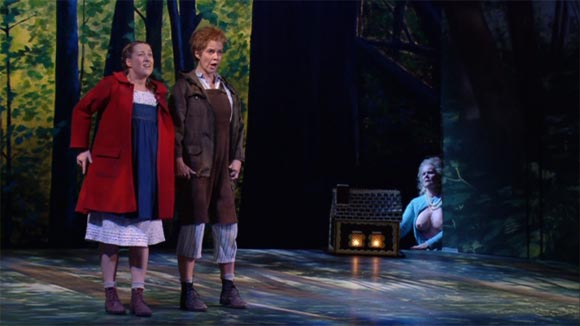
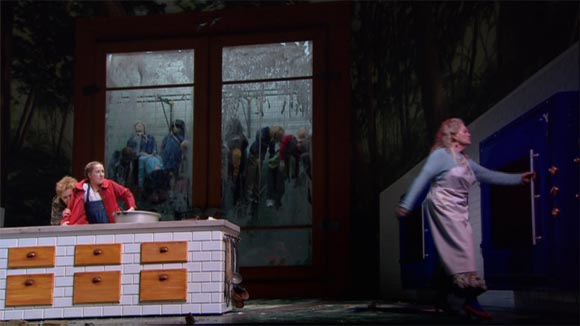
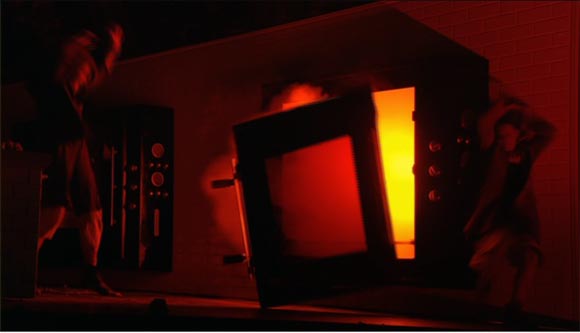
Act 3 opens with the Dew Fairy, here a pink confection played by Anita Watson, waking the children. The witch (Anja Silja), a vicious looking old woman with comedy breasts and a Zimmer frame, leaves a miniature gingerbread house for the children to explore. This transforms to the full size version with dead children hanging in a glass fronted cupboard and industrial scale ovens for the witch’s child based confectionery experiments. There is no concession whatever to comedy. The witch is scary as all hell and the scene in which she is shoved in the oven involves some serious pyrotechnics. The conventional happy ending descends into an orgy of face stuffing as the revived children fall on the cake/corpse of the witch. The production is consistent in its essential seriousness and is supported by fine acting across the board. In line with the concept nobody camps up their part. It’s all in earnest.

Musically it’s a really strong performance. Both Kirschlager and Damrau are quite excellent and work really well together. Kirschlager has quite a rich tone which blends nicely with Damrau’s cleaner sound. Thomas Allen is also really good. He’s quite chilling in the Hexenritt for example. Anja Silja’s Witch is a tour de force. She is every inch the witch/hag of nightmares without descending into cheap vocal trickery. Matshikiza sings very sweetly. Connell and Watson are quite good too but didn’t really register strongly with me. Colin Davis gets a suitably Wagnerian sound out of the orchestra and seems to balance drama and beauty very nicely. He’s well supported by the ROH orchestra, especially the brass and woodwinds, and the Tiffin Boys’ Choir and Children’s Chorus. The sheer beauty of the piece really comes out in the finale with Erlöst, befreit, für alle Zeit which manages to be gorgeous while avoiding dipping into excessive sentimentality.

The video direction of Sue Judd is good. She isn’t fixated with close ups though, since this isn’t a terribly busy production, she brings the camera in when there’s not much else to watch. There aren’t any gimmicks and it’s a good approximation to how one would watch from a decent seat which is what video directors ought to give us. The sound and picture quality are very good. It was shot in 1080i and the DVD picture is generally crisp and clear. The DTS 5.1 soundtrack is absolutely first class; vivid and with spatial depth and everything clearly located. This is also available on Blu-ray.  Audio choices there are LPCM 2.0 and 5.1. Subtitle options are English, French, German, Spanish and Italian. There’s a useful “Making of” documentary, an interview with Colin Davis plus cast and synopsis material on the disks. The package includes an unusually lavish tri-lingual leaflet.

ETA 23 May 2019: I have now had a look at the Blu-ray.  It is, as expected, even better from an AV point of view.  The LPCM 5.1 sound track is especially good with real depth and sense of spaciousness.  The stereo is not bad either but switching it to it from surround the reduction in the width and depth of the sound field is tangible.  Also note that at time of writing this recording is available as part of a three disk set called Fairytale Operas that also contains the Glyndebourne Cunning Little Vixen and Jonathan Dove’s The Adventures of Pinocchio.

I hesitate to compare this Hansel und Gretel with the roughly contemporary Metropolitan Opera version. They are very different but both worthwhile in their own way.

Être ou ne pas être

Ambroise Thomas’ Hamlet is a very grand French opera based loosely on various (loose) French adaptations of the play by Shakespeare. If one discards any notion that one is going to see Shakespeare with music and takes the piece on its own terms it’s really pretty good. In recent years it’s been doing the international opera circuit in a production by Patrice Caurier and Moshe Leiser that originated in Geneva in 1996 and was, for example, seen in the Met HD series a year or two ago. Most productions have featured Simon Keenleyside as Hamlet and Natalie Dessay as Ophélie. The available DVD version, recorded at the Liceu in Barcelona in 2003 features both of them.

Really all this opera needs to work is a baritone with exemplary French who can sing with power and lyricism for three hours and really, really act. That, I guess, is why Keenleyside owns the role. He’s superb. He probably peaks in the really quite amazing second act where he does a sort of mad scene as the “play within a play” misfires but he’s superb throughout. The second requirement is someone who can do a compelling mad scene with lots of blood and coloratura. Natalie Dessay seems to have trouble cutting her wrists but is otherwise brilliant and is rewarded with what is probably the longest applause for a single aria ever committed to DVD.

The rest of the cast is mostly very good. Alain Vernhes’ Claudius is very strong, vocally and dramatically; certainly much better than James Morris at the Met. Béatrice Uria-Monzon is occasionally a bit squally as Gertrude but acts really well, especially in the confrontation with Hamlet in Act 3. I didn’t care much for Daniil Shtoda’s Laërte. he sounded too “Italian” and not at all idiomatic. Overall though really great singing backed up by a very crisp performance from the orchestra under Bertrand de Billy. They sounded more lyrical and less bombastic than in the Met version.

The production is not especially exciting. It’s very plain with just a few moving “faux marble” walls. Most of the scenic effects are left to the lighting plot which is effective though hard to film (see below). Costumes are a sort of generic late 19th century with breastplates thrown in in odd places for some reason. It all provides an effective enough backdrop for some carefully directed and well executed acting. There’s no high concept here but the story gets told.

The video direction by Toni Bergallo is pretty good. It’s a tough ask. Often the light levels are low with a really brutal lighting focus on a single character. The Act 2 scene between Hamlet and the ghost is a great example. It’s very hard to make something like that look good on video. The cameras start to lose definition with the low light levels and then the high local contrast sort of blurs out. I found myself watching from quite close up even on a sixty inch screen! The DTS 5.1 sound track is OK but not demonstration quality. There’s not a lot of spatial depth and sometimes the singers sound as if they have been miked too close. The Dolby surround and LPCM stereo mixes aren’t any better. It’s not bad overall technically but it’s not up with the latest from a label like Opus Arte. There are subtitles in English, French, German, Italian, Castilian and Catalan. The only extra is EMI’s standard teaser reel.

Overall, this is well worth seeing. It’s a pretty good little known work, Keenleyside is exceptional and the production for DVD is pretty decent.

Disenchanted Island

The temptation to review this afternoon’s MetHD broadcast of The Enchanted Island in McGonagallesque (or perhaps more accurately, Samsesque) doggerel is strong but I think I’ve had enough of it for one day and do you really want to read stuff like:

Ten great singers get to sing trash
‘Cos Peter Gelb wants lots of cash
Jeremy Sams goes for broke
Which almost rhymes with baroque
For real baroque would too jazzy
for the New York bourgeoisie

Unfortunately that’s about as good as the libretto gets most of the time.

There are a few moments when one half suspects an opera is about to break out. The lovers’s quartet in Act 1 set to “Endless pleasure” is pretty good and Act 2 starts well with strong arias from Hermia (Liz deShong) and Sycorax (Joyce diDonato). Throughout the excellent cast sing and act with technical excellence and great commitment but the overall effect is still of the Royal Shakespeare Company doing panto with the funny bits left out.

It’s perfectly possible to do baroque in a way that is funny, engaging and accessible. The Glyndebourne production of Purcell’s The Fairy Queen and Salzburg’s hilarious and subversive production of Purcell’s King Arthur show what can be done. The Enchanted Island doesn’t cut it, being one more proof that the Met’s formula of throwing lots of money at a bad idea doesn’t work.

Camera work and sound quality were no better than usual.

If you feel the need to read a proper review Olivia Giovetti’s is very good.

Mozart’s Mitridate – ROH 1993

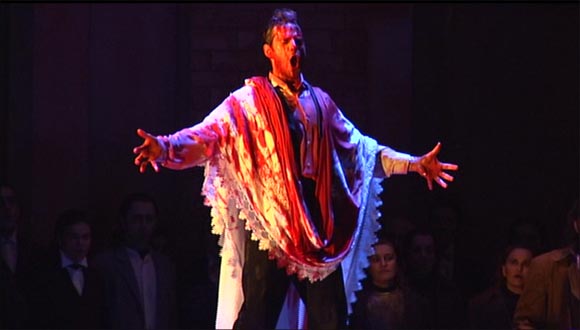
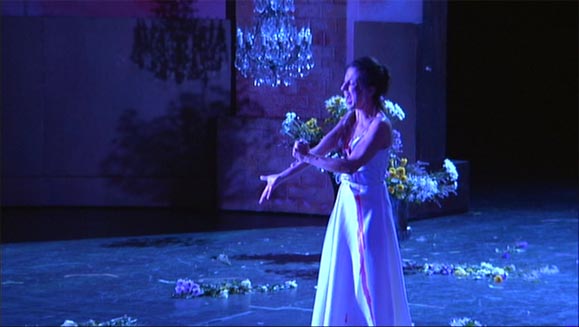
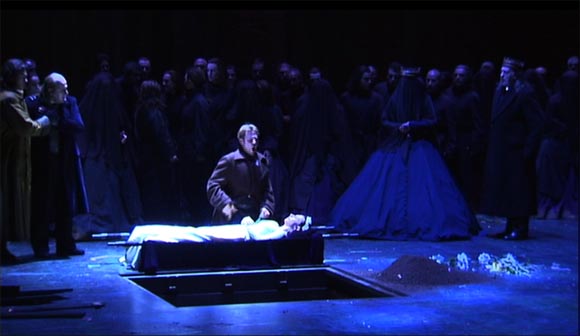
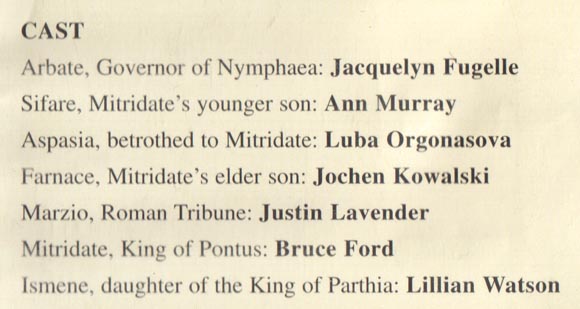
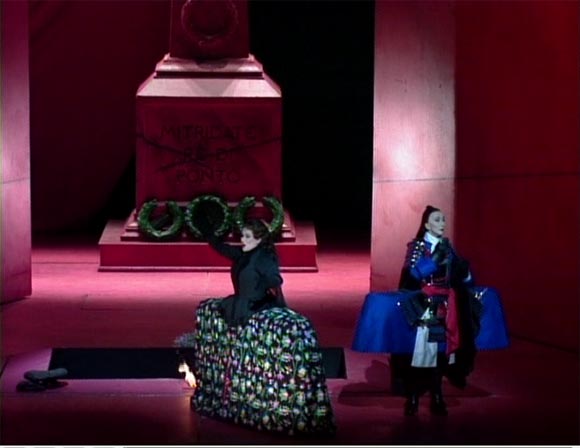
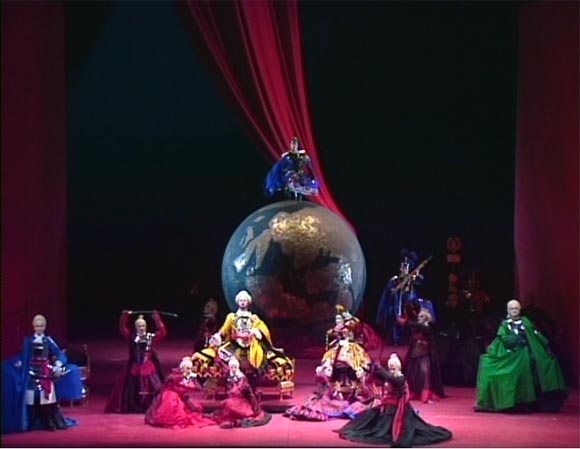
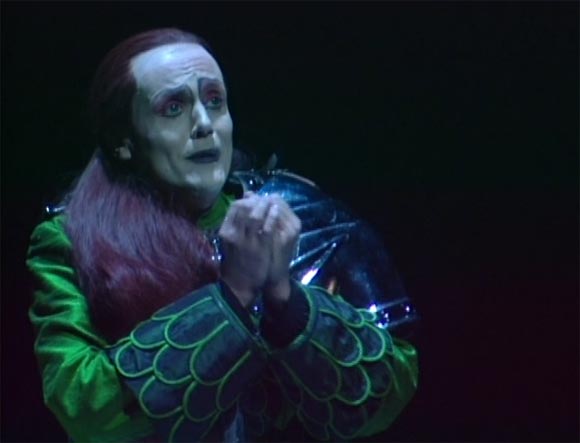
Mitridate, rè di Ponto is a three act opera seria by a fourteen year old kid called Mozart with a libretto based on Racine. Like most operas with a libretto based on Racine, and there are many, it isn’t exactly a barrel load of laughs. While it’s fair to say that the music may well be the best ever composed by a fourteen year old and it is recognisably Mozart it’s still not really quite enough to carry three hours of recitative and da capo arias about the troubled love life and familial relations of a first century BC King of Pontus and his fractious sons. In short, it gets a bit tedious. For a modern audience it’s not improved by the fact that all the male voices are high. Originally the score called for three castrati and two tenors. In the 1993 Royal Opera House production two of the three castrato roles were taken by mezzos and the third, inevitably the baddy, by a countertenor. For the record, here’s the full cast:

The director – Graham Vick, designer – Paul Brown and choreographer – Ron Howell do a pretty good job of injecting some life into the production with fairly extreme use of colour in the costume design, sets and makeup. The choreography and blocking is also quite striking at times but it still ends up being rather a wash of coloratura. The singers too do a worthy job but after a while it all starts to sound the same. Good work too from conductor, Paul Daniel, and the ROH orchestra but ultimately a bit blah.

Video director Derek Bailey does a pretty good job for the period. It’s hard to object to closing in on the singer during a da capo aria and he does pull out when there is stage wide action. He’s not helped by pretty average picture quality that lacks the definition needed to make long shots fully effective. Technically it’s a typical Kultur release of the period. The less than brilliant picture is coupled with so-so Dolby 2.0 sound, hard coded English sub-titles and minimum documentation. It’s also a bit quirky in that the overture comes on, with lead in credits, as soon as the disc is inserted. There’s no “set-up” menu.

One for the Mozart completist.

Ein Volk, Ein Opera Company, Kein Opera

Forgive the grammar, you get the idea.

So at today’s COC season launch there was an exchange that went roughly like this:

Alexander Neef: Any questions?

Bald academic dude in jacket and tie: I’d like to ask about progress on the two commissions (unannounced) to Margaret Atwood and [somebody else] and more generally when are we going to see a Canadian opera on the Four Seasons stage? makes unflattering comparisons to the SF Opera announcement yesterday.

Clique of Canadian Academic Composers: Here, here, rhubarb etc.

Alexander Neef: That’s become a ritual question so I’ll give you my ritual answer “When we have something concrete to announce we’ll announce it”.

Grumpy female: Claims that there are “many” Canadian composers who could compose something better than L’Amour du Loin (though mentions no names).

More rhubarb etc.

In principle I can see that it’s part of the remit of a national opera company to produce operas by its nationals though to what extent the Canadian Opera Company is a national company is well open to question. It only plays in Toronto. It raises just about all its funding there and it gets next to no support from either the federal government or the hockey channel which masquerades as a national public broadcaster. That said, I doubt one Canadian in a million could name a Canadian opera composer and if they could it would likely be one that no sane opera house would consider working with. So there’s a problem. No company can afford to give a seventh of its season to a guaranteed flop and no-one in Canada is going to pay for a vanity production by an unknown composer even if the libretto is written by Atwood or Ondaatje. I don’t hear solutions. I just hear over-entitled academics demanding that someone else throw away a couple of million bucks.

Rant over. Normal service will now be resumed.

Canadian Opera Company season announcement 2012/13

So this morning I was at the Four Seasons Centre for the press conference to announce the COC’s 2012/13 season.

Board President Philip Deck started off with a strong statement about continuing to improve the quality of the product on the Four Seasons Centre stage and striving for “uncompromising and inspiring” programming with a goal of becoming “one of the world’s great opera houses”. There are crucial words here. If General Director Alexander Neef is to meet these goals he will need a supportive Board. It looks like they are there with him at least for now and that’s very good to hear.

There was a very good “teaser video” with contributions from the many Canadians who will feature next season. I guess this will be available on line at some point. Then we got to the main business with Alexander presenting the line up. It’s pretty exciting so here it is in all its glory and with my commentary.  Continue reading →

Opera 101 – Tosca

Opera 101(I) at the Duke of Westminster last night was more interesting than I expected. Besides the usual host, Brent Bambury, we had the director of the current production Paul Curran, Mark Delavan, who is singing Scarpia, and Julie Makerov, one of two Toscas. Delavan and Makerov were engaging and funny if not specially revelatory though both revealed a taste for country music which is a bit disturbing. Most of the interest came from Curran. He’s an intense little Scot who tells it how he sees it. He grew up in the less salubrious parts of Glasgow (I’m reliably informed that there are salubrious bits!) and the first opera he saw was Wozzeck which he describes as the story of his life. I was struck by his emphasis on the role of the music in his directorial process. He described himself as a “musician first” and talked at some length about his role in making sure that the singers can sing to their best ability. He’s also no literalist. I asked him whether the very specific time and place setting of Tosca was constraining or liberating and he went on a bit of a rant which I loved! He listed off the historical inaccuracies with the Tosca libretto with encyclopaedic accuracy peppered with expressions like “complete bullshit” basically ending up at “so I feel I can do pretty much what I like with it”. He’s also not one for the pretties. He told a story about being criticized because Tosca’s dress in Act 2 was inelegant. His response “It’s a rape scene (F word not far away here we feel). I don’t think she’s asking ‘does my bum look big in this?'”. I liked his take on “Vissi d’arte” as a Jewish aria too. He’s alluding to it’s sense of a contractual relationship with God as opposed to Tosca’s over Catholicism (he’s from a very Catholic family). All in all good value.

We had a brief chat afterwards about Britten, ‘difficult’ operas and stuff. I want to see his Peter Grimes but, unfortunately, Santa Fe isn’t exactly next door.

In a couple or three hours it will back to COC for me for the third time in 24 hours. This time for the 2012/13 season announcement.

fn1. Opera 101 is a pub based series of fairly informal talks by members of the creative team for various COC productions.