Unknown's avatar

About operaramblings

Toronto based lover of opera, art song, related music and all forms of theatre.

The eternal enemy of righteousness

Michael Grandage’s lack lustre Don Giovanni at the Metropolitan Opera made me very curious to see his very well reviewed 2010 production of Britten’s Billy Budd for Glyndebourne. It is now available on DVD and Blu-ray so I did just that. It’s as good as the Don Giovanni wasn’t.

The set design suggests the interior of a warship of the period (1797) which gives scope for galleries around and behind the main stage area. By changing the lighting and sliding panels into place, it easily becomes anywhere desired on the ship. It’s very much an ‘interior’ setting which is appropriate as the sea is as absent in Billy Budd as it is present in Peter Grimes. Having created a working stage arrangement, Grandage focuses on the Personenregie. What’s striking about this production is how the director works the relationship between the characters and the development of the characters as individuals. Claggart is chilling. Vere lacks, in the last analysis, moral courage but his distaste for Claggart and his manifestations is palpable. Billy radiates simplicity and innocence. The lesser parts too are fully developed, not just filler. Dansker really foreshadows what is to come.

Along with this Grandage contrives some truly striking images. In the prologue “old” Vere appears almost disembodied until the ship materialises around him and the action proper starts. Towards the end of Act1 there”s a striking picture of Billy and Claggart in the centre of the picture; Billy on deck,

Claggart above him at the quarter deck rail. In the final scene the men hauling on Billy’s rope could be straight out of Rodin. Needless to say it takes considerable acting skill across the company to pull all this off. Grandage gets this from a solid cast of anglophone singers led by John Mark Ainsley as Vere, Jacques Imbrailo as Billy and Phillip Ens as Claggart. There are lots of quite important supporting roles so here’s the full cast:

Musically too, this is a treat. The real stars here are the London Philharmonic and conductor Mark Elder. The orchestral playing is taut and incisive and shows off a really good score to fine advantage. The singing is glorious too. Clearly this is a work where the needs of the drama trump pretty singing but in the places where beauty is possible we get it. In the prologue one could easily mistake Ainsley for Pears as he floats the high notes. Imbrailo has a gorgeous voice and there’s some fine singing from many others.

The technical team for this production is essentially the same as for The Fairy Queen and the results are equally good. François Roussillon lets us see the stage and only goes close up where it makes sense. This time I watched the DVD rather than the Blu-ray presentation (two DVD9 discs). It’s not quite as good as Blu-ray. The 16:9 anamorphic picture is very good but even on my less than state of the art TV it’s not quite as good as the 1080i Blu-ray. The sound difference is even more marked. The DVD sound is DTS 5.1 and is clear and well balanced but it comes up short on spatial depth compared to DTS-HD Master Audio. (There’s also LPCM stereo). There are English, French, German and Spanish subtitles, decent documentation and a few short extras on the first disc.

I recommended this unreservedly for both die hard Britten fans and those willing to explore but get the Blu-ray version if you can.

Exemplary Blu-ray transfer for Glyndebourne’s Fairy Queen

I’ve reviewed two DVDs of Purcell’s semi-opera King Arthur on this blog. One was excellent and one was terrible and between them they went a long way to showing how difficult these semi-operas are to stage well but how rewarding when they succeed.

In 2009 Jonathan Kent and William Christie combined to produce a version of The Fairy Queen for Glyndebourne. It’s quite different in style from the successful Salzburg King Arthur but it works splendidly on its own terms. The Fairy Queen combines a libretto based on A Midsummer Night’s Dream with songs, masques and dances of a largely allegorical nature. Like the play itself they range from high flown allegory with classical elements to bawdy humour. It is very English. It almost epitomises what separates the English baroque from the French. Kent and Christie tackle this with a robust English sensibility, There are some changes to the dialogue and to the order of the numbers but it all makes sense (so far as this piece can). The allegorical elements are gorgeously and wittily staged making good use of a large circular lift at centre stage that allows fully formed tableaux to rise into our sight. The bawdy elements are tackled head on with a robustly TV Mopsa (Robert Burt) in the “Dialogue of Corydon and Mopsa” and the, by now, notorious bonking bunnies in the “Dance for the Haymakers”. The audience is totally engaged and one hears plenty of that commodity, rather rare in the opera house, uninhibited laughter. The team of designer Paul Brown and lighting designer Mark Henderson make all of this look quite spectacular. The dramatic action is played out in fairly long segments and the parts are taken by actors rather than singers. The fairies are appropriately sinister with wings that look inspired by contemporary prints of fallen angels. The Rude Mechanicals are rude and not too mechanical.  The “humans” are credibly 17th century in manner though dress gets less formal as the action proceeds.  The disparate elements are integrated very well.  There’s plenty of dance and it’s choreographed by Kim Brandstrup in a style that is robustly muscular but solidly in the classical ballet tradition.

The cast of actors, singers and dancers is huge and consistently excellent.

I was particularly impressed with Sally Dexter’s Titania and Desmond Barrit’s Welsh accented Bottom among the actors.  Barrit even got to do some singing with a not too over the top version of the “Song of the Drunken Poet”.  The singing stars were the wonderful, sweet toned Lucy Crowe; her “if love’s a sweet passion” was a delight, and the robust bass-baritone Andrew Foster-Williams who, among other sings, sang a truly chilling Winter.  Singling out individual performances isn’t the point though.  This is very much an ensemble performance.  Christie directs the Orchestra of the Age of Enlightenment from the harpsichord and is as idiomatic as one could possibly hope for.

So, how well does the stage production transfer to disc?  Extremely well!  The video director is François Roussillon.  Unlike most of his peers he appears to have realised that opera lovers are not, for the most part, watching on tiny screens anymore.  He makes sure we can see what the designer and director intended.  Sure, there are close ups but never at the expense of the bigger picture.  The technical quality is of a very high order.  There are two formats available; a two DVD set and Blu-Ray.  I watched the latter but I doubt most people would see a huge difference.  It was filmed in 1080i HD and the picture is clearly better than my first generation HD TV can fully do justice to.  The sound is incredibly good.  On Blu-Ray it’s DTS-HD Master Audio (DTS 5.1 on DVD).  The quality is apparent even as Christie is walking to the pit.  The applause simply sounds as if one is in the house rather than the usual muffled fluttering noise.  The balance, clarity and spatial depth are exemplary throughout.  Both formats also have LPCM stereo.  There are English, French, German and Spanish subtitles.  There are useful extras.  The disc includes interviews with Kent and Christie which are well worth watching and the booklet includes an informative essay by Kent as well as a track listing and synopsis.

All in all this is an excellent production given an exemplary transfer to disc.  Here’s the official trailer, unfortunately in less than exemplary Youtube quality:

A girl called Maria

Maria Ewing has always been a bit of an enigma to me. It’s the range of roles I’ve heard her in; Salome, Dido, Carmen, Rosina. Soprano to mezzo and bel canto to dramatic.  In the recording under consideration here she sings Rosina in Rossini’s Il Barbiere di Siviglia. It was recorded at Glyndebourne in 1982 when she was 32. Her performance is typical Ewing. She acts really well, looks great (if her unusual looks work for you – they do for me!)  and sings really well without ever really sounding beautiful and occasionally giving one the feeling one gets watching somebody corner a little too fast on a large motorbike. I find watching her fascinating.

The production is as traditional as one could get and makes the small, old Glyndebourne stage look even smaller. Costumes too are absolutely generic 19th century comic opera. Blocking is basic. Mostly it’s very straightforward “park and bark”. All in all it’s the sort of thing you simply wouldn’t see in a modern opera house (except maybe the Met) and I’m sure it would please the investment banker’s wife in the Salzburg King Arthur. The singing and acting, Ewing aside, backs the production up.

John Rawnsley is a very broad Figaro with winks and big gestures and little mincing footsteps. He sings very well indeed but he has a voice that seems two sizes too loud for the production and tends to dominate ensembles. Max-René Cosotti is the Count. He has an old fashioned Italian tenor voice that works really well in this context. The rest of the cast is perfectly OK too and there’s a bit of a bonus in that Basilio is sung by a 33 year old newcomer called Ferrucio Furlanetto. We are a million miles away from Phillip II here! The London Philharmonic are in the pit under Sylvain Cambreling. They are balanced well back from the voices but seem OK to me. All in all, this is musically quite fine, if rather old fashioned, but dramatically it’s rather like watching superior panto for adults.

Technically this disc is about what one might expect. It’s taken from an ITV broadcast and is very much video directed for small screen. The picture is barely DVD quality 4:3 and the sound is Dolby 2.0. It isn’t particularly good either being slightly muffled and with quite unrealistic balance. Subtitles are available in English, French, German and Spanish. There are no extras and minimal documentation. All in all I think one has to treat this like a dodgy mono sound recording from the 1950s. It’s worth having if one wants a record of these singers but otherwise one is better off looking for something more recent. Certainly Dario Fo’s Amsterdam production is much more fun to watch.

Don Carlos

There aren’t too many examples of the French version of Verdi’s Don Carlos on DVD. The one reviewed here is a 1996 Luc Bondy production from the Théâtre du Châtelet in Paris. It’s billed as the original 1867 five act version but I think some of the 1883 cuts are made. There’s no useful documenation so I can’t be sure. It features a very strong cast. Robert Alagna sings the title role, Thomas Hampson is Posa, Karita Mattila (looking very young!) is Elisabeth de Valois, José van Dam is Philip, Eric Halfvarson sings the Grand Inquisitor and, rather unexpectedly, Waltraud Meier is Eboli. Anthony Pappano conducts the Orchestre de Paris.

The set designs (Gilles Aillaud) are slightly stylized but essentially literal, simple and easy on the eye. Costumes (Moidele Bickel) are a sort of historical eclectic. There are nods to the 16th century but the women’s gowns could be any period or none, the Flemish deputies wear the sort of collar the vet puts on your pet after surgery and Alagna looks like he’s stepped out of Pirates of the Caribbean. That sounds negative but it’s actually just undistracting. There’s no high concept here so the whole thing turns on the Personenregie and, of course, the music. Bondy gets pretty impressive performances out of his players, creates some interesting stage pictures in the crowd scenes and doesn’t over egg the auto da fe. It’s not fancy but it works.

Musically this is a really good performance. All of the singers (except Halfvarson) tend to the light but beautiful end of the spectrum for their voice type and it all makes for an experience that seems especially apt for the french text. The revelation for me was Mattila. I’ve seen her only in heavier roles and I really had no idea she could sing so beautifully too. She is especially ravishing in the final scene where “Toi qui sus le néant” brought the house down. The chemistry between Hampson and Alagna is excellent and their voices blend well. Halfvarson is a stentorian and truly creepy Inquisitor. Meier seems a bit mannered at times but she pulls off the big moments fairly spectacularly. Pappano gets lovely playing from the orchestra but the voices are balanced quite a long way forward so we don’t get the full effect. All in all, it’s pretty compelling to watch.

Yves André Hubert is the video director. He does a good job. There isn’t a lot going on on stage other than the interaction between the principals most of the time so close ups there are fine and he does pull back when there’s something to pull back for. Picture quality (16:9) anamorphic is OK but not HD by any means. There are two sound options. I started with the Dolby 5.1 which I found lacks clarity and depth. The Dolby 2.0 alternative, while not of the highest quality, is much better. The whole 210 minutes with two soundtracks is crammed into 7.4 GB on a single DVD9 so top quality is hardly to be expected. There are English, French, Spanish and Japanese subtitles and documentation is minimal. Extras are limited to a cast list and synopsis.

All in all this is well worth seeing.

Bieito’s Wozzeck is beautifully presented by Opus Arte

After what seems like an interminable series of reviews of DVDs that don’t do full justice to the product on stage I finally got to look at one that presented the production almost as if one had been in the theatre. It’s an Opus Arte disc of Calixto Bieito’s production of Berg’s Wozzeck staged in Barcelona in 2007. Bieito is seen by many as the epitome of Regietheater directors and many people will write off any of his productions without further ado. Not me. I found this Wozzeck by turns powerful, compelling, revolting and sometimes puzzling but never dull or disrespectful.

Continue reading

Worthwhile Peter Grimes marred by poor DVD production

Britten’s Peter Grimes is pretty well served on DVD. Peter Pears’ performance was captured in a BBC broadcast in 1969 and John Vicker’s radical interpretation was captured on video in 1981. More recently Christopher Ventris and Tony Dean Griffey have also made it onto video disc. There is also Philip Langridge in Tim Albery’s 1994 ENO production which is the focus of this review.

Discussions of interpreting Grimes tend to fall into a Pears vs. Vickers dichotomy. Vickers offers a rather brutal portrayal which is consistent with the libretto but tends to downplay the subtlety of the music while Pears is almost lyrical and dreamy. Notoriously the composer greatly preferred Pears’ version and had little good to say about Vickers. Langridge doesn’t really fit either of these models. His reading is intense, veers on madness from the beginning and is totally convincing in the “mad scene” in Act 3 Scene 2. What’s harder to reconcile with this reading is the violence that can’t be avoided. Langridge’s Peter just doesn’t come across as the sort of man who would suddenly strike a woman in the face. That said, it’s a fascinating and compelling reading. It’s also beautifully sung. Parts of the role lie cruelly high (certainly too high for Vickers) but Langridge copes with ease and beauty of tone. It’s a performance to stand alongside any of the others. He’s very well backed up by Alan Opie as Balstrode who is as good as anyone else who has taken on the role (and that’s an exalted list) Janice Cairns is a pretty good Ellen Orford. She starts a bit slow but by the second act she’s singing and acting beautifully. The rest of the cast is also pretty good. Unfortunately the orchestra (conducted by the usually excellent David Atherton) and chorus aren’t up to the standard one might hope for. They are certainly not in the same league as the Metropolitan Opera forces on the DVD recorded as part of the “Live in HD” series and they just don’t have either the punch in the gut impact in the final scene that one would like or the shimmering beauty that Runnicles finds in the Sea Interludes. Some of this may be the recording (see below) but some I think is intrinsic to the performance.

Tim Albery’s production is interesting. On one level it’s quite conventional with somewhat stylized but essentially naturalistic sets; fishing boats, nets, a tavern etc. Costumes too are in the same vein; set perhaps a few decades later than originally but not jarringly so. On another it’s less obvious. He makes use of video projections in the interludes. They are black and white and switch from grainy, almost posterized, sea scenes (including some rather odd fish) to projections of Peter and his apprentice later on. They also make an appearance during the storm scene in the pub. They look a bit clunky to me. Whether that’s deliberate or the best that 1994 technology could manage I’m not sure. The detailed stage direction, both of principals and chorus, is at times very good indeed. I suspect that it’s actually even better than the DVD allows us to see. The Act 1 scene between Balstrode and Grimes made me realize that Peter Grimes really is a tragedy. The protagonist has choices but his pride forces him towards his nemesis. I’ve never previously seen that so well brought out. The menace in the crowd scenes is palpable too. Where I’m less convinced is in Albery’s focus on the apprentice. We see visuals of him all the time and the opera closes on a projection of his corpse. He’s also portrayed as utterly terrified all the time. It’s somewhat at odds with the portrayal of Grimes and makes it quite hard to see why Ellen and Balstrode don’t smell a rat. Also, the focus on the relation between Peter and the boy downplay the role of the sea as a player in the drama. For me, the inexorability of the sea is a constant chorus element in this opera but it doesn’t come out in this production.

Now for the disappointing bit. The DVD sucks. I so wish I had seen this live! The video direction was very clearly for small screen (its from a BBC broadcast) and odd angles and super close-ups abound. One has to work quite hard to mentally reconstruct what Albery was aiming for. The sound too is poor. The only option is Dolby 2.0 and it lacks clarity. The chorus at times sounds pretty awful and I’m sure a big part of that is the recording. To cap it off there are no subtitles. That might not matter if the recording were super clean but it isn’t. The only documentation is a chapter listing. Now I was watching the North American release on the notorious Kultur label (when I hear the word “Kultur” I reach for my Browning). In Europe it was released on Euroarts and based on past experience and reviews that might well be a different story.

If the best you can do is a copy of the Kultur pressing I’d say this is definitely worth a look, if only for Langridge’s performance, but it’s by no means the best recording out there.

This recording was rebroadcast in HD by the BBC on June 1st 2025.  My revised thoughts based on that broadcast are here.

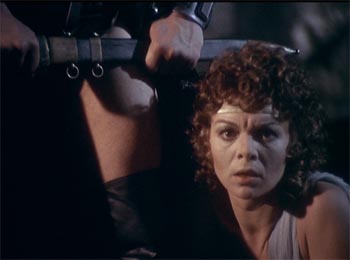
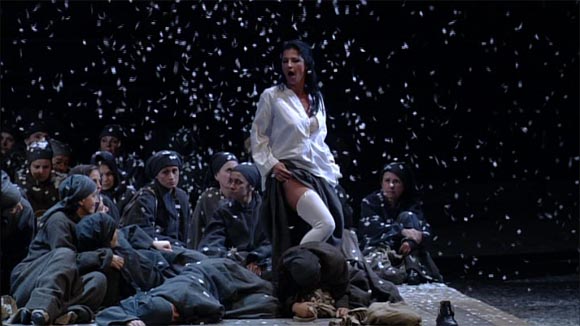
Just for fun 4/n

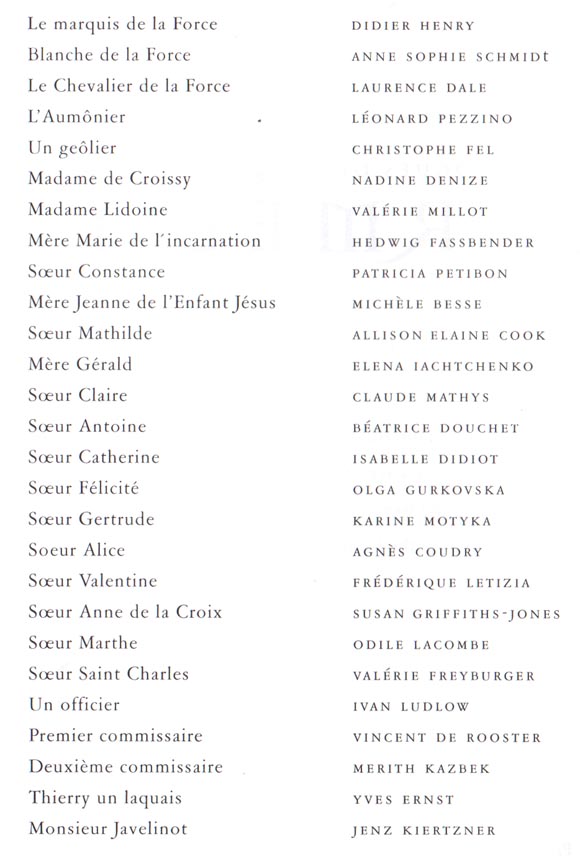
So, gentle readers, what do you think this image relates to?

ETA: Callum Blackmore correctly identified this as being from We come to the River by Hans Werner Henze. It’s a scan of one page of the Royal Opera House programme for 20th July 1976 when I, as a somewhat bemused 18 year old, saw David Atherton conduct a cast of thousands in that rather remarkable work.

Curious about young artists programmes

A lot of opera companies have young artists programmes. They seem to vary a lot and so I’m curious to know more about them and what opera goers think about them. I’m no expert but I do have quite a lot of exposure to my local YAP; the Canadian Opera Company Ensemble Studio. I know a couple of the singers. I’ve seen many of them perform both in COC sponsored ventures and otherwise. I’ve seen many graduates of the programme perform too and I’ve been enormously impressed. One of the things about the Ensemble Studio that I really like is that it provides lots of performance opportunities. I don’t really understand how one can grow in a performing art without performing. I’m not sure though that this emphasis on performance is universal with YAPs. The Met programme for instance seems to offer few performance opportunities (please disabuse if I am wrong!). Here in Toronto our young performers get frequent opportunities in the free lunchtime concert series at the Four Seasons Centre, they do an annual schools tour with works geared for kids, they do a special performance with full orchestra on the Four Seasons centre Stage of one of the COC productions that year and they, crucially, take on many of the lesser, and sometimes not so lesser, roles in the COC’s productions. For example in the two productions mounted so far this season three members of the Ensemble Studio sang in Robert Carsen’s production of Iphigenia in Tauris alongside Susan Graham, Russell Braun and Joseph Kaiser and the roles of Marullo, Countess Ceprano and two other roles in Rigoletto were sung by ES members not to mention that the Gilda in four performances was also an ES member. How does it work in your local company?

A fistful of tenors

I put Rossini’s comedies in the category of “guilty pleasures”. They are silly, trivial, lack real human emotion and are musically pretty trite but they are frothy and fun and sometimes even funny. Rossini’s tragedies on the other hand are just that, tragedies. Ermione is no exception. The plot is emotionally beyond credibility, despite being (or perhaps because of) being based on Racine without managing to descend into the unintended humour of, say, Armida. The music is more suited to a comedy and so all that’s left is visual spectacle, vocal virtuosity and a lot of opportunities for the leading lady to chew the scenery. That, ultimately, is probably what it’s about. It was written for Isabella Gilbran. Presumably she coerced Rossini into providing a vehicle for her to display her talents as a tragedienne. Otherwise the whole thing is inexplicable.

The production given at Glyndebourne in 1995 has a lot going for it. Anna Catarina Antonacci sings the title role, the majestic Diana Montague sings Andromache and Andrew Davis is in the pit. There are also four tenors, which is plenty though not quite in the Armida class. They all seem to be less than about five foot six tall which given that the bass role is sung by the lofty Gwynne Howells looks decidedly odd. Director Graham Vick sets the work in an opera house in the mid 19th century but for reasons obscure everything is tilted at odd angles. It looks like a wedding cake gone badly wrong. Blocking is all very basic, partly at least because Antonacci’s gowns have enough train to seriously inhibit movement. It’s basically park and bark with the odd swoon.

As a musical performance I can’t fault it. Antonacci, Montague, Howells, Jorge Lopez-Yanez (who plays King Pyrrhus) are all near perfect. Antonacci in particular runs through the whole arsenal of Rossinian fireworks with consummate ease. The other roles are never less than competent. Andrew Davis does his level best to breathe some life into the score but there’s really not much he can do about the jolly little tunes that keep popping out of the woodwinds at the least opportune moments.

Humphrey Burton video directs. It was originally filmed for Channel 4 and opens with the obligatory Glyndebourne sheep shots. It is very much a 1995 production for the small screen so lots and lots of close close ups. So many of these are of Antonacci’s cleavage that one wonders whether a dedicated boob cam was employed. Given the original motivation for the opera this may be a case of Historically Informed Videography. The disc package is typically basic Kultur label; 4:3 barely DVD standard picture, Dolby 2.0 sound, no extras. There are subtitles in English, French, German, Italian, Spanish and (oddly) Portuguese. The only documentation is a chapter listing.

One for the Rossini completist only.

As lovely as sin itself

Alban Berg’s Wozzeck is without doubt a work of genius but it’s also a huge downer from start to finish and that can make it pretty difficult to watch. Perhaps the true measure of the 1996 recording from Frankfurter Oper is that it manages to be so consistently visually engaging that the relentless cruelty and horror becomes much more bearable. The production is described as “recorded under studio conditions from the stage of the Frankfurter Oper”. I’m not entirely sure, beyond the absence of an audience, what that means. It looks pretty much like any other DVD filmed from a stage production but maybe some of the scene to scene transitions incorporate non-stage effects. Who knows?

Director and designer Peter Mussbach offers us a largely abstract expressionist staging. Each scene takes place in a cube at centre stage, framed in neon and populated for the most part by a few shapes in primary colours. Only at the beginning of Act 3, where Wozzeck watches Marie “betray” him with the Drum Major does it just for a moment bend towards a more naturalistic aesthetic. Costumes are similarly stark. The Hauptmann in particular wears something that looks like a red and pink chicken suit with epaulettes whereas Wozzeck is dressed in a simple white (almost) shirt and trousers. Only the drum major gets the almost realistic over the top military tailoring look. In the transitions between acts a cube filling, well, cube, apparently made of breeze block or cork or some similar textured substance, appears and spins around and does stuff before dropping back to give us a new cube set. Only right at the end are there characters or scenery outside the cube, albeit grotesquely masked children, as the camera pulls back to reveal the whole artifice of the stage machinery. It’s hard to describe but it does work rather well.


The singing and acting are very good indeed. Dale Duesing gives a horrifically convincing performance as the mentally tortured Wozzeck while remaining absolutely vocally secure and even lyrical on the odd occasion he has the chance. Kristine Ciesinski is equally affecting as Marie. Dieter Bundschuh’s Captain and Frode Olsen’s Doctor are well over the top but that’s clearly what the production calls for. The acting is as stylized as the sets. Ronald Hamilton’s Drum Major is a seething mass of testosterone (is there a more unpleasant character in all of opera?). Barry Banks, as Andres, comes close to bringing a touch of sanity to proceedings and is lovely to listen to. Sylvain Cambreling conducts and is quite satisfactory.

No video director is credited so I assume Mussbach took on that role. He uses a lot of close ups but given how stark the sets are and how little is going on apart from the main characters that seems perfectly reasonable. The only place it becomes problematic is in the last scene of act 2 where there is quite a lot going on including puppet doubles for Marie and the Drum Major and a cart load of musicians. I would like to see more of the overall picture here. Small caveats aside it all works pretty well as a film.

The DVD package is pretty basic. The picture is a decent quality 16:9 anamorphic. The only sound option is Dolby 2.0. The only subtitles are English and they are huge; at least twice the size they need to be, and quite intrusive. The only documentation is a chapter listing.