 Yesterday someone landed up here with the search string “rumor is that the met opera is going to end it’s live in hd performances”.
Has anyone heard anything to that effect?


Yesterday someone landed up here with the search string “rumor is that the met opera is going to end it’s live in hd performances”.
Has anyone heard anything to that effect?
 The competitors for the Ensemble Studio competition to be held on November 26th have been announced. They are: soprano Karine Boucher (Quebec City, QC); mezzo-soprano Emma Char (Kitchener, Ont.); mezzo-soprano Francesca Corrado (Vancouver, B.C.); tenor Jean-Philippe Fortier-Lazure (Kitchener, Ont.); bass-baritone Nathan Keoughan (Charlottetown, P.E.I.); bass-baritone Iain MacNeil (Brockville, Ont.); tenor Jean-Michel Richer (Montreal, QC); soprano Lara Secord-Haid (Winnipeg, Man.); and mezzo-soprano Rachel Wood (London, Ont.).
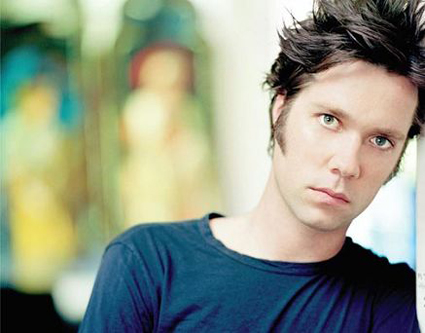
As previously announced this year’s competition will be a glitzy gala affair and apparently Rufus Wainwright will MC.
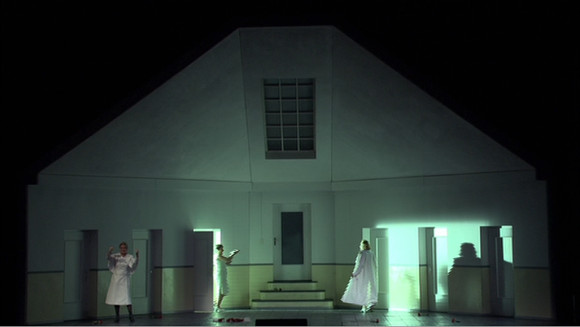
Paul Dukas’ Ariane et Barbe-bleue is a setting of a libretto by the symbolist poet and playwright Maeterlinck. It’s roughly contemporary with both Debussy’s Pelléas et Mélisande and Strauss’ Salome. It shows. It really is a product of a particular fin de siècle world view. Like Debussy’s piece, Ariane is loosely based on a folk tale. In this case it’s the gory story of Duke Bluebeard and his six wives but here it’s curiously etiolated. It’s as if Maeterlinck is reacting to the ultra-realism of, say, Zola, by retreating into a strange inner world. It’s not even the troubled inner world of Freud or Jung either. It’s colourless (and we’ll come back to that). All this is reinforced by Maeterlinck’s style of telling rather than showing. Much of what “action” there is takes place off stage and is narrated by the on stage characters. Both words and music are used to fill in the gaps.
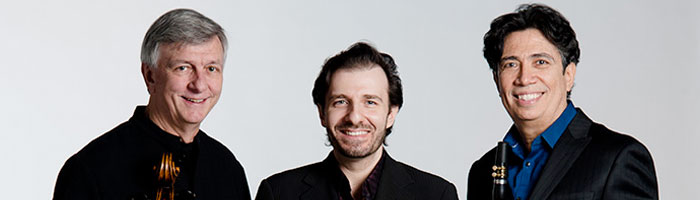
Yesterday’s Amici Ensemble concert featured four works transcribed for different combinations of instruments than the composer originally intended. First up was Berg’s Adagio for violin, clarinet and piano. This is from the Kammerkonzert originally scored for violin, piano and thirteen assorted wind instruments. Unsurprisingly it doesn’t get played often in that arrangement. It’s pretty typical second Vienna school; twelve tone but quite accessible and very pleasant to listen to. It was expertly played by Serouj Kradjian (piano), David Hetherington (cello) and Joaquin Valdepeñas (clarinet).
I received this yesterday from Rachel Krehm of Opera 5. In short the family have a arranged a performance of the Mozart requiem for Rachel’s younger sister who died last year. It’s at Grace Church on the Hill on November 17th at 8pm. Proceeds from the concert will go to the ICU at St. Mike’s. Full details under the cut.
 Wolfgang Rihm’s Dionysos is described by him as “eine Opernphantasie”. It certainly isn’t an opera in the conventional sense lacking, as it does, anything resembling a plot. It’s a staged setting of poems by Nietzsche written just before his final descent into madness (if one considers that’s not where he was from the start!). Rihm conceives this as four scenes each dealing with a different “element” in Nietzscean terms. The four are Water, a scene set on a lake; Air, a mountain scene; Intimate Space, a scene in a brothel; and Public Space, set in a town square. So, episodic and linked only by a certain kind of mood and the characters. The weight of the piece is carried by “N”, a baritone role. he interacts variously with a amle guest who doubles as Apollo and a high soprano who doubles as Ariadne. In addition there is a trio of ladies; high soprano, mezzo, contralto, who play various roles from pseudo Rhinemaidens to tarts.
So besides producing, well, opera the nice folks at Opera 5 produce videos called Opera Cheats. The best way to find them is to go to their Youtube channel. But just for fun, here’s a recent and rather brilliant one.
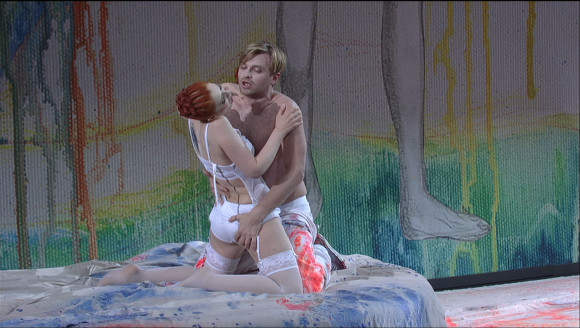
Vera Nemirova’s production of Berg’s Lulu was recorded in the Haus für Mozart at Salzburg in 2010. It’s presented in the now conventional three act version completed by Friedrich Cerha. The sets are painterly, including in Act 1 a giant painting of the title character. Lighting is used to create a very distinct palette for each scene and the detailed direction of the actors is careful and effective. I didn’t see any big ideas but then on this video recording, if there had been any, they would likely have been lost in the incessant close ups and strange camera angles. One “trick” perhaps is that much of the action in Act 3 Scene 1 takes place in the auditorium with a fair bit of confusion as the actors hand out fake cash to the punters. This is, of course, the scene where the glitterati go broke so perhaps some irony is intended.
 The line up for the annual Messiah fest is becoming clearer. Traditional heavyweights, the Toronto Symphony and Tafelmusik go head to head. The Symphony’s line up of soloists is Klara Ek, soprano; Lawrence Zazzo, countertenor (which may not please the traditionalists or the mezzo fanatics); John Tessier, tenor and John Relyea, bass-baritone. The chorus is the Toronto Mendelssohn Choir and Christopher Warren-Green conducts. Dates are the 17th, 18th, 20th, 21st and 22nd December at Roy Thomson Hall. Tafelmusik field Dame Emma Kirkby, soprano (buy now while stocks last?); Laura Pudwell, mezzo-soprano; Colin Balzer, tenor and Tyler Duncan, baritone. Ivars Taurin conducts. Performances are 18th, 19th, 20th and 21st December at Koerner Hall. On the 22nd Tafelmusik also have their traditional singalong Messiah at Massey Hall.
Continue reading
The Ontario Philharmonic and Richard Margison are doing a show of Italian opera “greatest hits”. There are two shows; December 10th at Koerner Hall and the Regent Theatre, Oshawa on December 7th. Full details.
Up in Montreal a new outfit, Stu and Jess Productions, are doing Menotti’s The Medium with a cast drawn from current McGill graduate students. That runs from November 7th to 9th in a converted church in Verdun. Full details
Last, but not least, the Glenn Gould School annual production at Koerner Hall has been announced. It’s The Cunning Little Vixen by Janáček and it plays at Koerner Hall on March 19th and 21st. I’m interested to see how they handle the dance elements. More details.