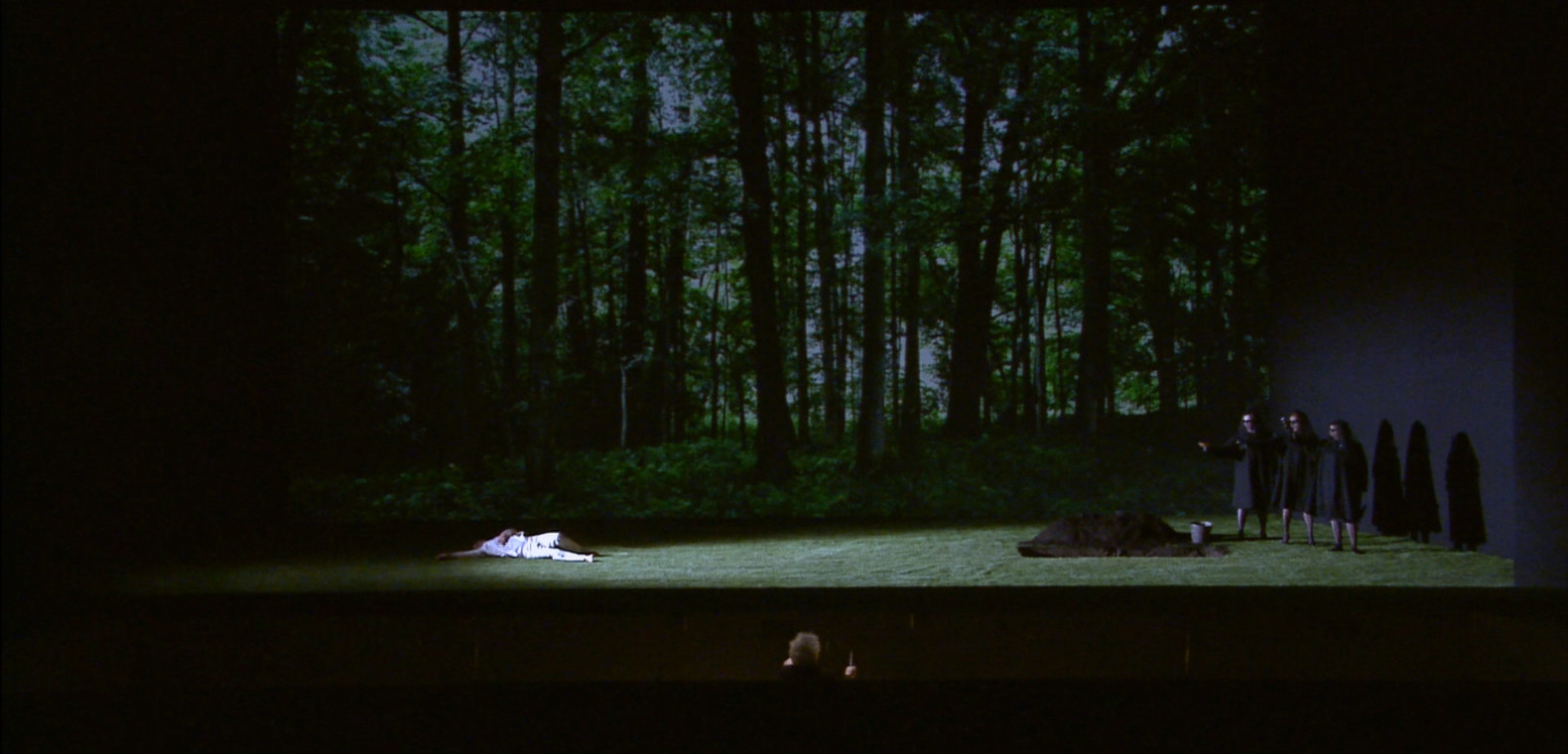
“The god-damn son of a bitch is dead”. So says one of John A. Macdonald’s henchmen on checking his watch to see that the scheduled time of Louis Riel’s execution has passed; at least in Harry Somers’ 1969 operatic version of the story. Louis Riel, on the face of it is a historic narrative about the leader of the 1869 and 1885 Métis opposition to the expansion of the Dominion of Canada. But it’s deeper than that. It’s a complex work dealing with fundamental questions of identity and belonging and of the relation between people and state. Written during a weird combination of the orgy of cultural nationalism that greeted the centenary of Confederation and Canada’s most turbulent political violence it transcends the Canadianness of its story and clear parallels could be found in many countries, including Canada, today. This is really about “culture wars” in all their complexity and horror.
Author Archives: operaramblings
Adventure story
Robert Carsen doesn’t seem disposed to treat Handel too reverentially. Although there is some of the trademark Carsen cool minimalism in his 2011 Glyndebourne production of Rinaldo (not to mention symmetrically arranged furniture) there’s also a degree of humour, as there is in his Zürich Semele. I find it very effective and, judging by the audience reaction, so did the people who saw it at Glyndebourne.
Ein Reich, ein Volk, ein König
In many ways Meyerbeer’s Les Huguenots is a typical mid 19th century French grand opéra. It takes a sweeping, epic story; in this case the St. Bartholomew’s Day Massacre, and grafts onto it the elements the paying public demanded; spectacle, ballet, showpiece arias etc. The result is unwieldy and, when applied to such grim subject matter, almost grotesque. The 1991 Deutsche Oper production by John Dew (performed in German as Die Hugenotten) takes these disparate elements and works with them; mixing laugh out loud and extremely grim to create a piece of music theatre that is truly disturbing.
Summer in the city
This year’s Toronto Summer Music Festival reported a 28% increase in attendance over the previous year with the under 35 segment up 11%. Obviously this is a good thing but I’m also interested because it tends to reinforce my view that the assumption that there’s no market for classical music in the summer months is based on a very outdated view of behaviour. Most of us don’t decamp to the cottage for the summer. The model of the non-working wife taking the children to the cottage for the summer where father joins them on the weekend is right up there with the idea that schools should close for the summer because the kids are needed on the farm.
I think there’s a real opportunity for a summer opera venture in Toronto. Maybe it’s where we could slot in our (missing) equivalent of Chicago Opera Theatre that does more obscure and/or edgier stuff than the big kids at the COC? One can hope, I guess.
Allons enfants de la Patrie
There can’t be many French Revolutionary propaganda comedies but Cherubini’s Koukourgi is one of them. Written in the crisis year of 1792 and intended for the Théatre Feydeau it never actually made it onto the stage and remained unperformed until it was staged by the Stadttheater Klagenfurt in 2010. By then the dialogues, the overture and the finale had been lost but music director Peter Marschik found a couple of bits from other Cherubini operas to fill the musical gaps and director Josef E. Köpplinger supplied rather arch German dialogue to link the musical numbers (sung in French).
Two years!
So I’ve been here for two years now. This will be the 534th post. Readership has grown from 267 hits in September 2011 to between 4000 and 7000 per month in 2013 (there’s more traffic outside of the summer months). It’s been a blast.
Thanks to everyone who has helped along the way including all the great people at Canadian Opera Company, Against the Grain Theatre and Opera Five among others. And special thanks to fellow opera bloggers The Earworm, Regie or not Regie, Opera Obsession, Definitely the Opera and Third Floor Republic and to many, many others for helping create a real sense of community.
Born to the anvil, not the hammer
Manuel de Falla’s La Vida Breve is often credited with being the first true Spanish opera. It’s certainly one of very few works in that language one might encounter in an opera house. It’s hard to see why it’s not performed more often. It’s a dramatic story about the tragic love affair of a gtpsy girl and a wealthy young man and the music is a blend of verismo and flamenco. The orchestration is quite exciting and the Spanish influenced vocal lines are very easy on the ear. It really ought to have a rather wide appeal.
Season announcements
Announcements for the upcoming season in Toronto are starting to come in. Voicebox: Opera in Concert have announced a thee show season at the St. Lawrence Centre for the arts. The season opens on Sunday, November 24, 2013 at 2:30 PM with Benjamin Britten’s Gloriana. This isn’t a work one gets to see very often so even a piano accompanied concert version is very welcome. Musical Director and Pianist will be Peter Tiefenbach. Soprano Betty Waynne Allison will sing Elizabeth I with tenor Adam Luther as Essex. The cast also includes Jennifer Sullivan, Jesse Clark and Mark Petracchi.
Starry Tosca
Puccini’s Tosca doesn’t seem to lend itself to Regie type treatments. Even quite adventurous directors seem to mostly stick to the very specific time and place of the libretto (even though, as Paul Curran pointed out to me, the plot makes no sense in the Rome of 1800). In the 2012 Royal Opera House recording Jonathan Kent certainly takes very few liberties with the piece; the church is a church, the palace a palace and the castle a castle. There are a few deft design touches. Both Cavaradossi and Tosca wear very bright colours indicative of the new dyes that became available at the period (actually I think this is a slight anachronism – must check with the fashion lemur) whereas Scarpia is more conservatively attired. Generally though it’s pretty straightforward.
What makes a piece of classical music famous?
A friend posted the following question on Facebook:
“What is the most famous piece of classical music?”
Most of the answers seemed to be an attempt to find a piece of classical music (for some value of “classical”) that was well known as itself. That surprised and puzzled me a bit but it did cause me to ask the question:
“What makes a piece of classical music famous?”