

 2020 started with news of yet another anti-semitic atrocity in the United States. My musical 2020 started with a new recording of that finest of all musical acts of resistance to anti-semitism, Shostakovich’s Symphony no. 13 in B-Flat minor “Babi Yar”. It’s a setting of poems by Yevgeny Yevtushenko for orchestra, bass soloist and men’s chorus and it’s powerful stuff. It’s often performed at consistently high energy and volume and seething with anger. Riccardo Muti treats it rather differently. The recording, featuring bass Alexey Tikhomirov, the Chicago Symphony and the men of their chorus, doesn’t lack drama or intensity but it’s also often intensely lyrical. When require, Tikhomirov and the chorus produce some gorgeously beautiful, even delicate, singing and the orchestra do the same. There’s not much of the blaring brass one associates with the Leningrad recordings of the Shostakovich symphonies. Instead there’s some wonderful playing, especially by the low brass. The motif in the fourth movement, curiously reminiscent of the Fafner scene in Siegfried, features a sort of duet between tuba(?) and timpani to great effect. This is very fine music making.
The recording, on the CSO’s Resound label, is exemplary. The textures are crystal clear and the overall ambience feels like a proper symphony hall. This is the memorial for Babi Yar.
 So what do you get when you mash up contemporary classical music, experimental electronic music, staging, art installations and other stuff? That’s what FAWN’s Convergence Theory concerts are about. There’s one at Victory Social Club on January 25th. Details are
  The second half of January kicks off with the COC’s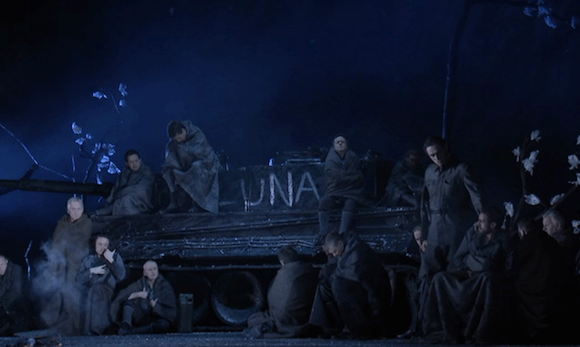

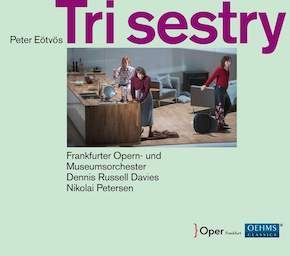 Peter Eötvös’ 1998 opera Tri sestry is based on the Chekhov play and was recorded live at Oper Frankfurt in 2018. It takes fragments of the original Russian play and recombines them in a non-linear way to create a prologue and three “Sequences” from the points of view of Irina, Andrei and Mascha repectively. The recombination is complex enough for the accompanying booklet to contain a table mapping Chekhov’s scene order to Eötvös’. There’s no libretto in the CD package so even flipping between the (fairly detailed) synopsis and the track listing it’s hard to figure out who is singing or about what. No doubt this was much clearer when watching the stage production.
 operaramblings