Hands on Figaro

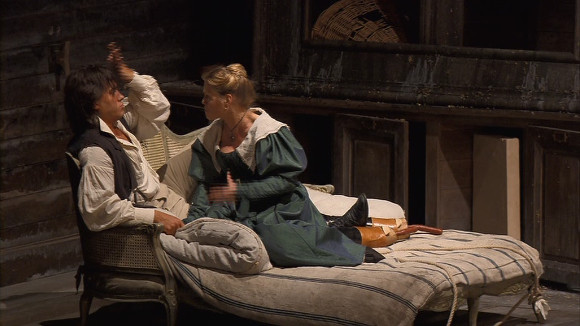
In the booklet accompanying David McVicar’s production of Le nozze di Figaro, recorded at the Royal Opera house in 2006, there’s an essay by the director in which he raises all kinds of questions about the rise of the bourgeoisie, the nature of revolution and romantic conceptions of love.  He even appears to draw a parallel between Joseph II and Tony Blair. Then he declines to explain how he has embodied all these ideas on the stage and challenges us to “Watch, listen, participate”.  Well I did and I’m none the wiser.  What I see here is an essentially traditional approach; transferred cosmetically to 1830s France but so what?  It’s darker than some Figaro’s but not nearly as dark as, say, Guth.  Curiously, the main “extra” on the disks “Stage directions encoded in the music” tees this up much more clearly than the essay.

1.figarosusanna Continue reading

ROH cinema screenings return to Bloor Hotdocs

15830210743_c7a53486abRoyal Opera House cinema screenings are back at the Bloor Cinema and it seems that the full season will be available.  ENO are you watching or is your sense of Ontario gepography akin to your business acumen?

First up, tomorrow, at noon they’re screening Giordano’s Andrea Chenier directed by David McVicar with Jonas Kaufmann and Eva-Maria Westbroek.

March 22nd sees Tim Albery’s production of Wagner’s Der fliegende Holländer with Adrienne Pieczonka and Bryn Terfel.  Ms. Pieczonka will be on hand to introduce the piece.

On June 28th we get a new John Fulljames production of Weill’s Rise and Fall of the City of Mahagonny with Anne Sofie von Otter.

July 26th sees John Copley’s venerable production of Puccini’s La Bohème.  This production is almost as old as I am.  Anna Netrebko and Joseph Calleja play Mimi and Rodolfo.

Finally, on August 30th  we can see a new production of Rossini’s Guillaume Tell directed by Damiano Michieletto with Antonio Pappano conducting. The cast includes Gerry Finley and Malin Bystrom.

Best of 2014

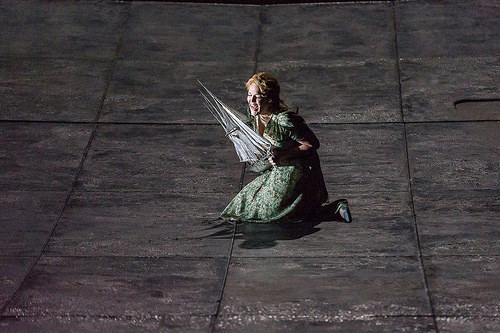
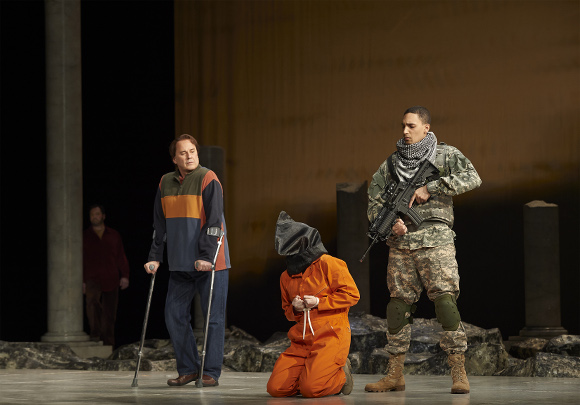
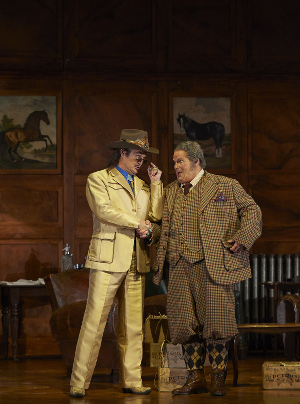
Well not so much “best of” as the good stuff that really made my year.  It was a pretty good year overall.  On the opera front there was much to like from the COC as well as notable contributions from the many smaller ensembles and opera programs.  The one that will stick longest with me was Peter Sellars’ searing staging of Handel’s Hercules at the COC.  It wasn’t a popular favourite and (predictably) upset the traditionalists but it was real theatre and proof that 250 year old works can seem frighteningly modern and relevant.  Two other COC productions featured notable bass-baritone COC debuts and really rather good looking casts.  Atom Egoyan’s slightly disturbing Cosí fan tutte not only brought Tom Allen to town but featured a gorgeous set of lovers, with Wallis Giunta and Layla Claire almost identical twins, as well as a welcome return for Tracy Dahl.  Later in the year Gerry Finley made his company debut in the title role of Verdi’s Falstaff in an incredibly detailed Robert Carsen production.  I saw it three times and I’m still pretty sure I missed stuff.

Hercules2a Continue reading

Falstaff up close

Falstaff-MC-0417

Photo: Michael Cooper

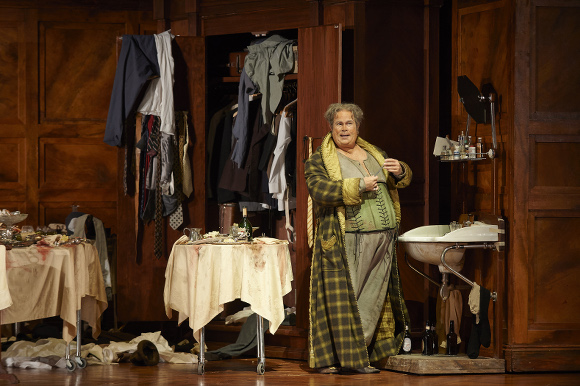
The nice thing about seeing a production for the the third time is that one can focus on what one wants to because the big picture is already known.  After two looks at the COC’s current Falstaff from the Rings I was glad to be able to see it from closer up and this time I also remembered my opera glasses.  The details in the production and the Personenregie are really amazing.  In the scene where Fortuna is offering gifts to Falstaff, the five cases of wine are Pétrus.  In a way that’s doubly funny because although Pétrus is typically the most expensive Bordeaux today it was relatively unknown in the 1950s.  My 1970’s copy of Hugh Johnson’s The Wines of Bordeaux talks of how, if he lived in France, he would certainly cultivate a number of petits fournisseurs in the relatively unknown and undervalued Pomerol appellation!  Anyway, back to Falstaff.  The money in the suitcase of money is clearly US currency.  Nice touch.  The ornaments in Mrs. Ford’s 1960s chic kitchen are hilarious.  I particularly liked the glass elephants.  The antics of Pistola and Bardolfo also came more sharply into focus.  They nick anything that’s not nailed down.  Are we sure Falstaff is from Norfolk not Liverpool?  The handbag snatch in the restaurant scene is especially good.

The other thing I noticed was how much fun the audience was having.  There was none of the “opera is SRS business” vibe going on.  Rather, much unaffected laughter and laid back enjoyment.  We could use more of that.  So when do we get Gerry Finley back?

Why productions succeed in one place but not another?

12-13-02-b-MC-D-3024In an age of co-productions many opera productions are seen in multiple houses.  Some of them we get to see in multiple guises.  For example I’ve seen Tcherniakov’s Don Giovanni on DVD and will be seeing it live later this season in Toronto.  Spmething that’s been fermenting in my brain for a while now is why the same production can get a drastically different reception in different places.  The piece that first made me think about this was Chris Alden’s Die Fledermaus.  This was generally well received in Toronto (more perhaps by my friends and acquaintances than the print media but that’s par for the course) but universally panned in London when it played at ENO.  Bryan’s interesting comments about the Carsen Falstaff kicked off the train of thought again and made me want to put some tentative thoughts into writing.

Continue reading

The Revengers’ Comedy

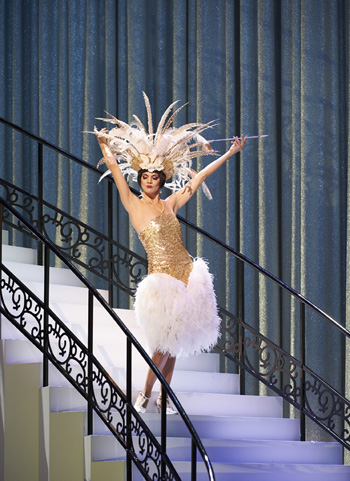
Last night, the COC opened its 2014/15 season with Verdi’s Falstaff; a work I was not familiar with and one that turned out to be a bit of a surprise.  It’s not your usual Verdi.  It’s his last opera, composed when he was 80, and is not at all typical of his earlier work.  There are hardly any “big tunes” or even conventional arias.  The odd chorus harks back to an earlier style but much of the music is quite dark; heavy use in places of the lower pitched instruments, especially for a “comedy”.  Don’t take that as a criticism though.  It’s a musically and dramatically tight, even compact, work that is both incredibly funny and also something more disturbing.  Perhaps it’s as much about mortality as love.

Falstaff-MC-1533 Continue reading

Up close with Aschenbach

Death in Venice is a curious opera.  Based on a Thomas Mann novella, it concerns the aging writer Gustav von Aschenbch and his meditations on aging and art, as well as his obsession with a Polish boy encountered at his Venice hotel.  Very little actually happens.  Aschenbach has a series of encounters with quotidien characters such as the hotel manager and a hairdresser but mostly he observes and what we hear are a series of inner monologues.  To work as theatre Aschenbach must capture our interest and our sympathy.  If he doesn’t the piece can be incredibly boring and irritating.

1.aschenbach Continue reading

A Parsifal in three acts

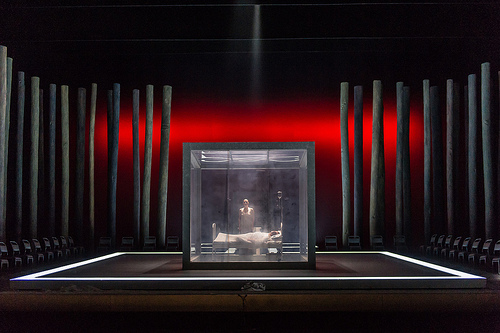
Yesterday, Easter Saturday, I got to see the Royal Opera House production of Wagner’s Parsifal.  It was broadcast live to many locations of December 18th last year but hasn’t been seen in Toronto until now.  It was very much a three act experience.  At the end of the first and longest act I thought we were perhaps seeing greatness in the making.  Stephen Langridge’s production concept supported by Alison Chitty’s fairly abstract modern designs were making all kinds of sense to me.  At centre stage is a white, semi transparent cube serving as both grail shrine and Amfortas’ hospital room.  Within it, various aspects of the back story are shown to us and it comes off as a place of knowledge; perhaps of a much deeper kind than has yet been revealed.  This impression is reinforced with the unveiling of the Grail late in the act.  It is a young, Christ like boy.  The grail ceremony involves Amfortas cutting him to release the blood for the ceremony.  There’s a lot of blood letting but it makes sense.  We are seeing a very wounded and dysfunctional polity.

sickbed Continue reading

David McVicar’s Die Meistersinger

David McVicar chooses to set his production of Die Meistersinger, staged at Glyndebourne in 2011, in the 1820s or thereabouts.  It’s an interesting choice as it puts German nationalism in a specifically cultural rather than political context and also rather clearly makes the point that “foreign rule” = “French rule”.  That said, he really doesn’t develop any implications from that and what we get is a production typical of recent McVicar efforts.  There’s spectacle aplenty and very good character development but he doesn’t seem to have any Big Ideas; for which, no doubt, many people will be grateful.  The only place he seems to go a bit overboard is in laying on some fairly heavy German style humour.  People who think that slapping waitresses on the bottom is the height of comedic sophistication will probably appreciate it.

1.Eva and Walther Continue reading

New departure

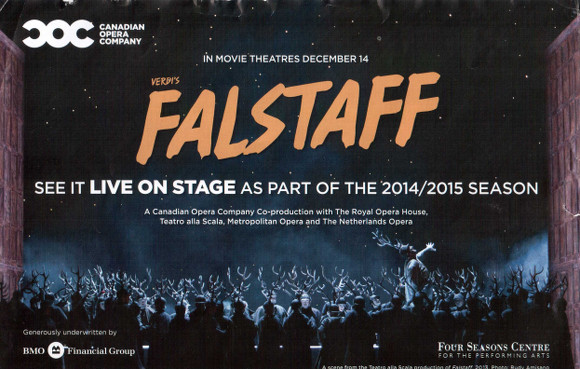
The COC is usually tighter than a duck’s arse when it comes to revealing information about future seasons so it was really quite surprising to find the leaflet illustrated below in last night’s programme.  It’s not exactly a secret of course.  I actually expected Falstaff to be in this season’s line up with the Verdi bicentennial and all.  It’s pretty well known that Gerry Finley will star and I have a pretty good guess on the Nanetta.

It’s an interesting ploy to piggy back on the Met HD season this way.

falstaff