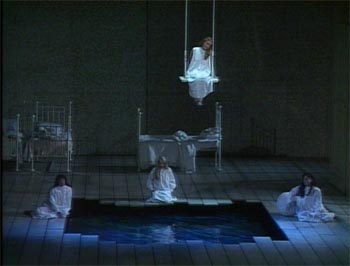
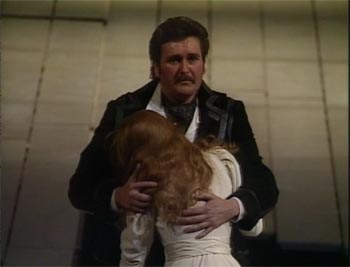
Stefan Herheim’s 2012 production of Dvořák’s Rusalka for Brussels’ La Monnaie Theatre is predictably ambitious and complex. He takes an explicitly Freudian (by way of Lacan) view of the piece(*). The female characters are representations of male views of the female and, sometimes it seems, vice versa. It’s seen most clearly in Act 2 and I found unpacking Act 1 much easier after seeing it so I’m going to start there. We open not with bucolic, if coarse, peasants preparing for a wedding feast. We are on a street in a scruffy part of, I guess, Brussels. The gamekeeper and kitchen boy are replaced by a priest and a policeman. The traditional dismembered game animals become a female chorus, many of them nuns, with exaggerated secondary sexual characteristics. There is, essentially, an orgy. Clearly the human world that Rusalka cannot enter is about sex in its most physical aspects not meaty Central European banquet platters! Rusalka and the Foreign Princess are dressed and wigged identically. They are quite freely interchanged. Lines that are canonically addressed to one are addressed to the other and so forth. It’s pretty clear that each represents, albeit imperfectly, the Prince’s ideal woman. Rusalka is the unattainable feminine ideal; flawed in that she cannot engage in fully satisfying sexual activity. The foreign Princess is sexually satisfying but falls short precisely by not being unattainable. Some less clear male duality is suggested by the appearance of the Vodnik dressed as the Prince. It just gets weirder from there with the ballet of nuns, prostitutes, fish, squid and heaven knows what else spilling over into the auditorium while the Prince and Foreign Princess watch from a box and Rusalka and the Vodnik get caught up in the action. At the conclusion of the act it’s Rusalka not the Princess that he begs for help.

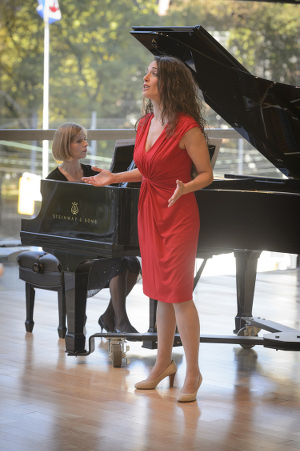
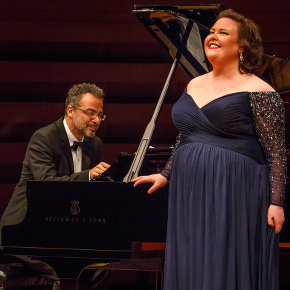 American mezzo-soprano Jamie Barton, 2013 winner of Cardiff Singer of the Year, sang at Koerner Hall last night with veteran Bradley Moore at the piano. Her first set; Joaquin Turina’s Homenaje a Lope de Vega gave us a pretty good idea of the basic value proposition. She has a fantastic instrument. There is power to burn, a pleasing dark tone, accuracy and musicianship. She never sounded remotely strained even while pushing out a very impressive sound. The rest of her first half programme; Chausson’s Three Melodies and four of Schubert’s Goethe settings showed that there was more than just a big accurate voice. Basically, it’s all there. She can vary colours and scale vibrato up and down. There’s some agility. She can float quiet high notes and she can tell a story. Her diction was clear in all three languages. I would say at this point the only question mark I had was around her ability to engage the audience. If I were to judge by the very highest standards, and I’m think Bryn Terfel or Karita Mattila, there was something just the merest shade cold and technical. The second half would see whether she could, as it were , lighten up a bit.